
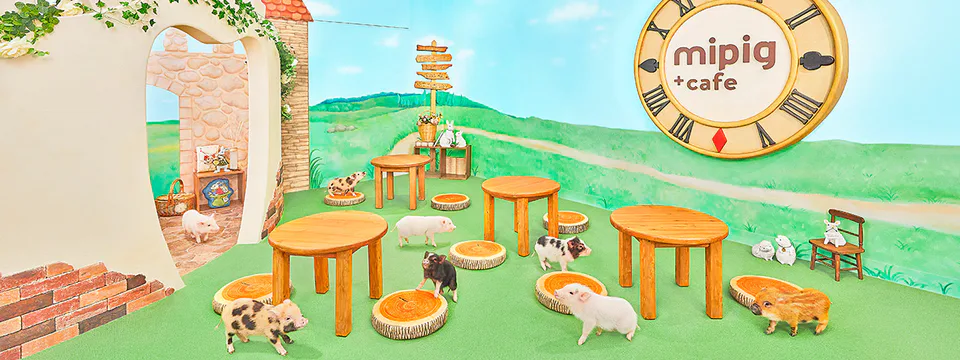
A reservation at mipig cafe Fukuoka Tenjin is an appointment for sitting with free-roaming micro pigs, not a guaranteed chance to hold one. That difference determines whether the ticket is worthwhile. A visitor whose main aim is to watch the pigs approach naturally will usually get more from the 55-minute session. Someone hoping for a posed cuddle photograph may be disappointed even if they pay for twice as long. Before deciding between 25 and 55 minutes, check whether the previous 48 hours of your trip make you eligible to enter at all.
The café fits most easily into a Daimyo or Tenjin afternoon already on the calendar. Its adult admission is ¥1,760 for 25 minutes or ¥2,310 for 55. The extra ¥550 buys 30 more scheduled minutes, a large difference for an animal-led activity in which contact may take time. It does not buy a promise that a pig will sit with you. Its reservation and arrival rules also make the visit longer than the printed session length. A three-day Fukuoka plan can help place it without turning a brief activity into a separate cross-city excursion.
Travel history can rule out the booking
mipig’s entry precautions bar visitors who feel ill, have been in a country or region affected by African swine fever within the previous two days, or have touched pigs outside the café in that period. This is a recent-travel and contact condition. It is not a rule based on a passport or ethnicity. For a journey through several Asian countries, the destination visited shortly before Japan can matter even if the inbound flight itself was short. A zoo, pig enclosure or pet pig encounter can matter too.
African swine fever and classical swine fever affect pigs and wild boars rather than people, but travellers can carry infection between animal populations. That is why the café screens recent visits and animal contact. The list of affected places can change; a copied list in a travel article would be a poor basis for entry. Recheck the live biosecurity notice immediately before making the reservation and again near the visit if your route changes. If you are inside its 48-hour exclusion, move the café appointment later in the Fukuoka stay. A city afternoon can move more easily than an international flight.
The test belongs before paying for any slot. A traveller who lands after a relevant country stop and books the next morning may lose the reservation despite being healthy. Conversely, a traveller who has spent several days in Japan may have no recent overseas exposure but still needs to consider pig contact at another attraction. Read the actual conditions for your date rather than assuming that “48 hours in Japan” is a universal substitute for every listed restriction. A Fukuoka late-arrival hotel choice may help if the first city night should be kept simple anyway.
↔ Scroll table left or right
Before choosing a slot | Action | Why it matters |
Recent travel through an ASF-affected place | Use the current café notice and allow the stated 48 hours | Entry can be refused even though you are well |
Contact with pigs at another venue | Check the previous two days | The condition is about transmission between pigs |
Illness or symptoms | Reschedule rather than attend | The operator restricts unwell visitors |
Eligible and genuinely interested in free-roaming pigs | Compare session length | The ticket then becomes a value and schedule decision |
Expecting a guaranteed hold or posed photograph | Reconsider the activity | Neither duration guarantees that result |

The 55-minute ticket buys waiting time, not a pose
At the Fukuoka Tenjin branch, an adult pays ¥1,760 for 25 minutes or ¥2,310 for 55. The increase is ¥550, about 31% of the shorter price, for 30 extra minutes. Scheduled time rises from 25 to 55 minutes, an increase of 120%. Those ratios describe the booking, not an expected amount of animal contact. The pigs are not on a timetable. If several minutes pass before one chooses to approach, the delay consumes a much larger share of a 25-minute visit.
↔ Scroll table left or right
Guest | 25 minutes | 55 minutes | Extra cost |
Adult | ¥1,760 | ¥2,310 | ¥550 |
Elementary-school child | ¥1,210 | ¥1,540 | ¥330 |
Preschool child | ¥660 | ¥660 | ¥0 |
For an elementary-school child the added half-hour costs ¥330. For a preschool child the published admission is ¥660 either way, but equal price does not settle the choice: a child may find 55 minutes of sitting and waiting too long. A group should buy the duration that suits its least patient member, not simply the lowest price per minute. Check the rate at the live reservation step, because a price printed today is not a guarantee for a later booking. The English Fukuoka page carries the same current price table.
The café’s visitor questions suggest one to two hours for the fullest free-roaming interaction. Fukuoka’s standard public sessions shown on the branch page are 25 and 55 minutes. Fifty-five is nearer that general guidance, while still being under an hour. Choose it if the pigs are the reason you came, the party can sit patiently and the Daimyo stop is part of an existing day. A 25-minute slot is sensible for a cautious first look, a companion who is unsure about animal cafés, or a tight schedule with another fixed booking. Neither duration should be chosen as a way to force a particular pig to approach.
Staff direct guests to their seats and the pigs circulate on their own. Visitors may not lift or hold them. A pig may step onto a seated guest if it chooses, but the possibility is different from an included cuddle. Photographs and ordinary video are allowed without flash; live streaming and phone calls are restricted. The operator says staff observe the pigs and give them separate rest according to health, stamina and compatibility. A traveller with particular animal-welfare concerns can review those management rules before booking, while recognising that the published account is the operator’s description rather than an independent welfare inspection.
One question can prevent the wrong purchase: would you still enjoy the session if a pig never climbs into your lap? Watching their movement and waiting for an approach can be the whole point. If the answer is no, a longer ticket merely prolongs the risk of disappointment. For a family whose actual wish is a broad mix of animal displays over several hours, Marine World Uminonakamichi answers a different request. For a short café-style activity in Tenjin, maidreamin’s entry and evening pricing is a different kind of reservation choice.

A 55-minute booking occupies more than 55 minutes of the day
The Japanese branch page asks guests to arrive about ten minutes before their slot. Add that to the 55-minute session and the committed period is at least 65 minutes from requested arrival to finish. Finding the fifth-floor entrance at BROOM Fukuoka, checking in and getting back onto the street use additional time. For a practical itinerary, allow around 75 to 90 minutes rather than placing the next paid booking at the earliest theoretical finishing minute. This is a planning allowance, not a stated café service duration.
The address is BROOM Fukuoka 5F-C, 2-1-18 Daimyo, Chuo-ku. The branch lists roughly seven minutes on foot from Nishitetsu Fukuoka (Tenjin) Station and ten minutes from Tenjin subway station. Those walks can become longer with a stroller, luggage, rain or a wrong exit. A good sequence is Daimyo shopping, the reserved session and dinner in Tenjin. A poor sequence is leaving a Hakata hotel, crossing town solely for 25 minutes with the pigs, then immediately returning to Hakata for a train. The ticket may be modest while the fixed appointment and transport consume a larger part of the afternoon. Hakata versus Tenjin for a Fukuoka base is the more useful decision if the hotel area is still open.
The café is reservation-only; the branch directs visitors to its web booking process rather than phone reservations. That matters if you were planning to fill a surprise gap after another attraction. The exact available slot should shape the surrounding day. If a museum visit or meal runs late, a 10-minute early-arrival request leaves little margin. How many days to give Fukuoka helps decide whether a specialised one-hour interaction belongs in the city portion at all. A Fukuoka shopping and food itinerary can keep the stop in the same district as the rest of the afternoon.
Dinner geography matters too. If the party wants Tenjin food stalls afterward, the Fukuoka yatai district comparison can keep the post-café walk within the same area. If the hotel is near Akasaka, Hotel JAL City Fukuoka Tenjin and its short station walk show how little transfer work a central base can require. A family choosing its hotel around this and other city outings should compare Fukuoka family-room and laundry needs before committing to a cross-city return each evening.
Published closing times disagree; the booking calendar decides
The Japanese Fukuoka branch page currently gives 10:00–18:00 and asks for arrival ten minutes before the session. Its English page lists 10:00–20:00. Those two pages cannot both establish the last bookable appointment on a particular day. Do not plan a 19:00 visit solely from the later English closing time. Open the date-specific reservation calendar and build dinner or an onward train around a slot that is actually offered. If the calendar has no evening appointment, a rainy-day plan based on the longer hours will fail.
This discrepancy also affects the 25-versus-55-minute choice. A late slot may be unavailable in one duration or may end too close to the next booking. The branch’s stated opening span is useful context, but an offered reservation is the actionable unit. If you need an indoor fallback without a fixed time, browse Fukuoka rainy-day options and choose something that fits the actual weather and district. “Indoors” alone does not make a pig café right for someone uninterested in pigs.
Children can enter, but they cannot treat the pigs as toys
The operator has no minimum visitor age in its general rules, while elementary-age children and younger cannot enter alone. Adult supervision is only part of the fit. A child has to remain in the assigned area, avoid chasing or grabbing, tolerate a pig walking away, and accept that picking it up is not allowed. A child who wants to observe may enjoy a longer visit; one who expects an immediate cuddle may not. The preschool admission being identical for both lengths does not override attention span. A parent should choose the slot the child can enjoy, not the apparently better per-minute tariff.
Ask what the family means by “animals” before paying. If the wish is to see many species, move about freely and adjust the duration during the visit, this fixed-seat, single-species interaction may be a poor match. If the child is specifically excited by micro pigs and can wait calmly for them to approach, the 55-minute booking offers more opportunity for that unforced encounter. Fukuoka with a child-friendly three-day route gives the broader day shape; Marine World’s family time commitment is the longer attraction alternative.
Weather and geography change the value of a short visit
Rain does not remove the indoor interaction in the way it might spoil an exposed garden or waterfront outing. That makes a pre-booked session more resilient on a wet Tenjin day. It does not mean you should buy a fixed slot only because it is raining. Underground shopping, museums and ordinary cafés often allow more flexibility; mipig requires a specific time and an interest in pig-led interaction. Fukuoka rainy-day planning is useful if staying dry is the main goal.
The geographical cost is easiest to miss with the cheaper 25-minute ticket. A small ticket can create two cross-city transfers and an early check-in deadline. Put it after Daimyo shopping or before a Tenjin dinner and those movements mostly disappear. If a Hakata train or Dazaifu visit pins the same afternoon, a special trip to Daimyo may be the weakest use of limited time. Dazaifu from Fukuoka and a Fukuoka city-day route can show which day naturally passes Tenjin. A traveller staying near the airport for an early departure may have still less reason to add a late cross-city reservation.
A Dazaifu day has its own rhythm: shrine-town food in the Dazaifu food guide and time at Kyushu National Museum can fill the daylight without forcing a timed animal-café return. On a wet city day, a Tenjin underground route may combine better with the reservation than a distant outdoor stop. If an early flight sets the final night, Hakata versus Tenjin for that last night is a more consequential decision than squeezing in one more 25-minute appointment.
The booking decision in five checks
↔ Scroll table left or right
Check | Proceed when | Pause or change plan when |
Eligibility | Recent travel, illness and pig contact satisfy current entry rules | A 48-hour exclusion may apply |
Expected interaction | Watching pigs choose to approach sounds enjoyable | You require a guaranteed hold or posed contact |
Duration | ¥550 adult difference is worth a less rushed session | The group has limited patience or a tight next booking |
Actual slot | Reservation calendar offers the time you can reach early | A website closing hour is your only evidence |
Day placement | Daimyo and Tenjin are already in the plan | The café creates a separate Hakata round trip |
For an eligible first-time visitor who wants the animals and already has a Tenjin afternoon, I would select 55 minutes. The price difference is modest relative to the added scheduled time, and a slow approach from the pigs then takes less of the session. I would use 25 minutes for curiosity or a group whose interest is uncertain. I would move the booking when the biosecurity rule applies and skip it when the group wants guaranteed physical contact. The most useful reservation is one whose rules, available slot and location fit the day you already intend to have.
More Fukuoka choices
Fukuoka Self-Drive Hotels: Choose Your Car Days Before You Choose Hakata, Tenjin or Uminonakamichi · Kanayama Castle: The Stamp Is on the Summit — Choose Your Route from Ota Before You Start Walking · Before You Buy a 2-Day Huis Ten Bosch Ticket, Check Your Hotel—Day Two May Already Be Included · The ¥800 LEGOLAND Japan Upgrade Is Cheap — Your Family’s Last Two Hours Are Not · One Day in Kyoto: Choose Fushimi Inari or Arashiyama Before You Build the Route · The Naha Terrace: Are 35m² Rooms and 12:00 Check-Out Worth a 15–20 Minute Station Walk? · Tokyo Disney Split Stay: Move the Night Before or After Your First Park Day? · Hakone Loop Before Check-In or After Checkout? The Best Order for a One-Night Ryokan Stay · Ghibli Park Tickets 2026: Before You Buy Standard, Name the Buildings You Refuse to Miss · National Museum of Nature and Science 2026: The ¥630 Ticket Is Cheap — Your 3–5 Hours Aren’t · Sapporo Shopping Hotels: Stay Where You Can Drop Your Bags, Not Just Where the Shops Are.
A Tenjin base lets you fit the cafe around shopping or a short city stay without a separate cross-town journey. Check rooms around Tenjin alongside the appointment time before you pay for either.