
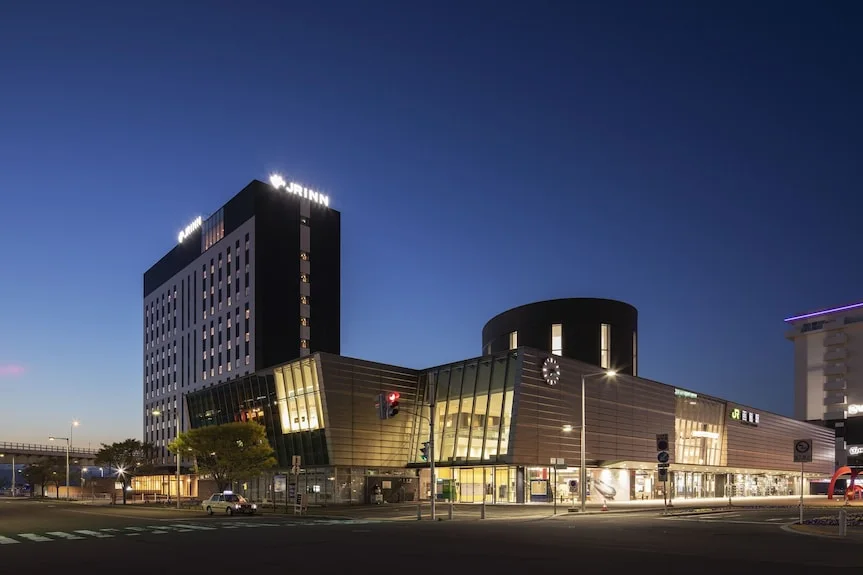
The reason to consider JR Inn Hakodate is the last part of the journey: its entrance adjoins JR Hakodate Station through the north-side passage. After a train arrival, you can put a case in the room before heading to the Morning Market or waterfront. That advantage grows in snow or rain and matters less if you arrive by car. If you are still deciding how many days Hakodate deserves, use the Hokkaido regions and transport guide to settle the route first; the hotel choice follows from how often you will use the station.
Where the station connection earns its price
For a short rail stay with luggage, this hotel removes a small but repeated task: hauling cases outdoors between the station and a separate building. If bathing in natural hot-spring water matters more, La'gent Stay Hakodate Ekimae is a close competitor. Hakodate Kokusai Hotel puts the balance further towards larger rooms and the harbour. The sensible booking depends on the arrival, departure and room you actually need, not a claim that one Hakodate hotel is best for everyone.
Arriving by train changes the value of the address
The connection is most noticeable at the beginning and end of a stay. A traveller with a daypack on dry pavement might barely notice a nearby outdoor walk. Two heavy cases on icy ground make the same distance more consequential. You also save the pause outside the station to orient yourself after a long journey. Once the bags are inside, JR Inn Hakodate is still a base for exploring the city; station proximity does not mean your evenings must be spent around the platforms.
A driver should weigh the car park and next road leg more heavily. The Hokkaido winter driving guide covers the conditions that affect that choice. By contrast, an Onuma rail outing brings the station advantage back into the picture; the Hakodate and Onuma autumn guide helps work out whether that day is likely to be part of your route. One train excursion can make a connected hotel more useful than a waterfront address that looks prettier on a map.
What the 20 m² and 30 m² twins actually change
↔ Scroll table left or right
Room | Best fit |
20 m² Twin | Two guests on a short rail visit who can use a shower and open cases in turn |
30 m² Large Twin | More luggage, a third guest or a room bathtub; compare the additional rate |
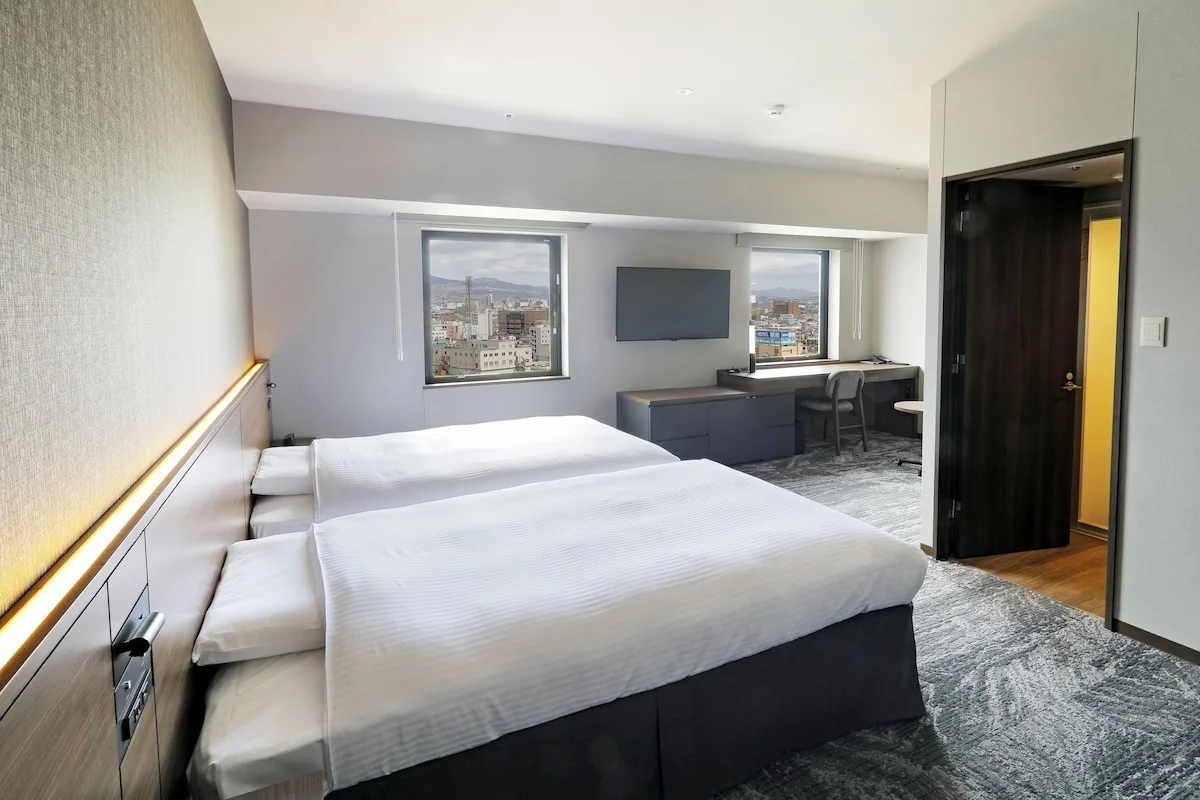
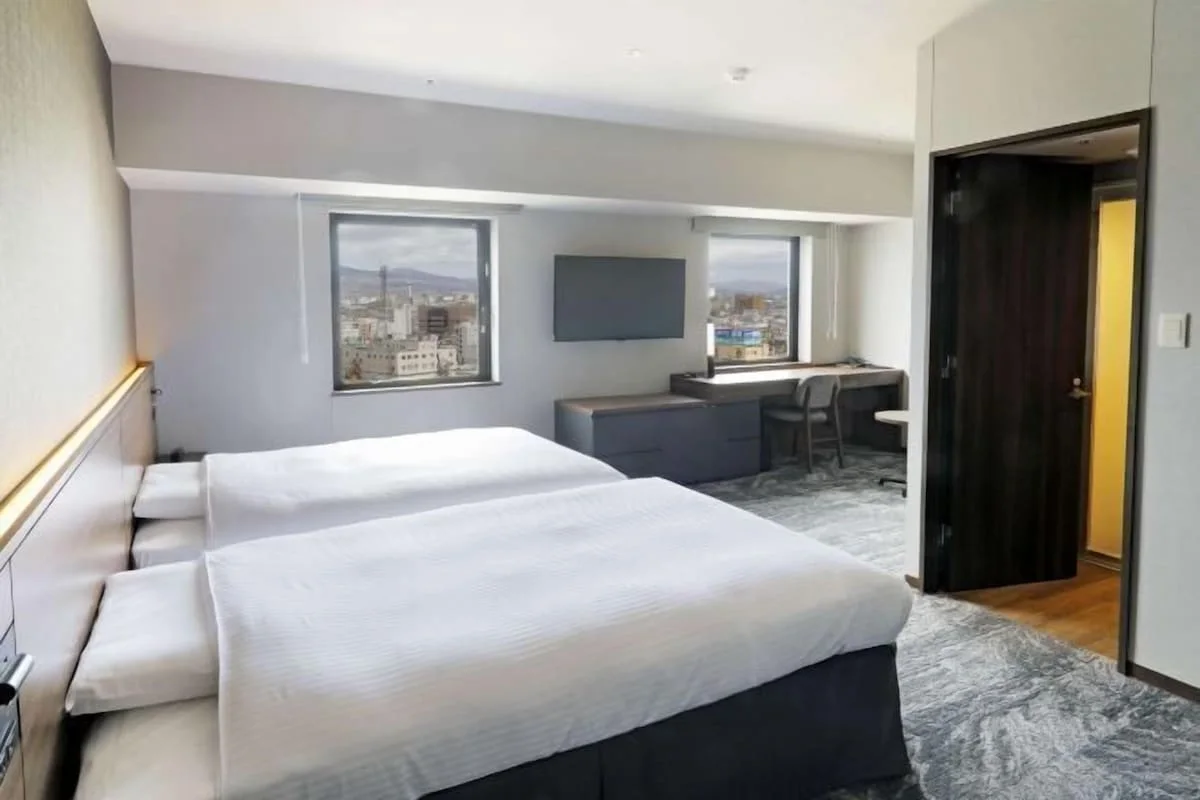
The standard 20 m² Twin sleeps two in 110 cm wide beds and has a shower booth. Its floor area is workable for a short stop, but a pair of large cases may need to be opened one at a time. The 30 m² Large Twin has 120 cm wide beds, room for up to three guests and a bathtub. Those are material differences for a longer stay or anyone who uses the room for more than sleep. If the whole trip is crowded with luggage, Japan luggage forwarding may remove more effort than buying a larger room at every stop. For two travellers, test the luggage layout rather than assuming that ten extra square metres is essential. If each person can keep a case closed except when changing clothes, the smaller room may be adequate for one or two nights. If a third person is joining, the extra capacity of the Large Twin becomes a booking requirement, not simply an upgrade. Ask which beds will actually be made up for the quoted occupancy and whether opening all bags still leaves a clear route to the door and bathroom.
Consider the next hotel before paying for extra floor area here
Three nights of laundry and market mornings may point instead to Tokyu Stay Hakodate Asaichi Akarinoyu. If the next stop is Otaru, the Otaru hotel comparison can prevent a second station-versus-room mismatch. For a move inland, the Furano accommodation-base guide asks a different question: whether to change hotels at all. The best Hakodate room is partly determined by what it must hold and where your bags go next.
An early bath and breakfast suit a rail departure
The twelfth-floor public bath opens 15:00–01:00 and again 05:00–10:00. It is free for guests, who bring towels from their rooms and use the room key to enter. The adjacent lounge also opens in the early morning. This is a public bath with an outdoor tub and station views; it should not be sold as a natural hot spring. The Japanese onsen etiquette guide is useful for bathing customs, while travellers specifically seeking spring water should compare a different property.
Breakfast runs 06:30–10:00, with last entry at 09:30; the hotel currently lists ¥3,500 for elementary-school age and above. Hakodate Morning Market lies opposite the station area, so breakfast is a genuine choice. A 07:00 train may favour the predictable downstairs meal only if you can eat without rushing; a later start leaves time to browse the market. Build that choice into the Hokkaido travel itinerary guide rather than paying for breakfast on every day by habit. Separate the breakfast decision by morning. A train day calls for a meal that fits the departure time; a market morning might be more enjoyable outside the hotel if nobody is pressed to leave. A prepaid breakfast for both days removes that choice. Check whether the rate includes breakfast or adds it at checkout, and compare the total for the same two guests. If one person wants the market and the other wants a quick hotel meal, the station location permits them to meet before setting off without forcing an identical breakfast routine.
How two nights might use the location
On arrival, take the main cases straight to the hotel and make the first evening a light-bag outing. You can go towards the waterfront or dinner without designing the route around luggage storage. The late bath window gives you an option after returning, although it should not become an excuse to schedule an implausibly late train connection. The room is a practical stop between two parts of the city day.
The second day can begin at the market, at the station for Onuma, or with a city walk. All three work without checking out or repacking the full cases. In unsettled weather, nearby rail and bus connections make it easier to change that day than from a more isolated address. The Hokkaido winter activities guide can help decide whether the outing belongs in Hakodate or another part of the trip. On departure morning, an early bath and 06:30 breakfast can fit before checkout only if the train leaves enough margin.
Storage and laundry are conveniences with a time cost
The hotel’s location does not make it a long-term bag depot. Confirm any plan to leave luggage beyond the immediate check-in or checkout period with the property, especially if you will spend nights elsewhere before returning. A small overnight bag or a courier transfer can be simpler than routing yourself back to Hakodate to retrieve a suitcase. A short stay benefits most from the station connection when the bags move with the rail journey.
Shared laundry can rescue a two- or three-night stay, but it still takes a trip to the machines, a wait and a return to collect clothes. In a 20 m² room, drying or sorting a large load may also compete with luggage space. For a longer stay, compare a property with in-room washing facilities and the total trip time, not just the nightly room rate. The difference becomes clearer after several cycles of sorting and waiting.
The checkout clock matters on a slow final morning
Checkout is 10:00. That works naturally before an early departure and becomes restrictive if you want a leisurely market breakfast followed by packing. The hotel may arrange an extension under its own terms, but plan around the stated checkout unless the extension is confirmed for your booking. If the final day begins late, compare the cost of extra time or luggage storage with a property that suits that pace better. The ten o’clock deadline also changes a two-night plan: the market visit may be better on the middle morning, leaving departure day for the train and luggage. If the train is much later, ask whether the property will hold cases after checkout and what conditions apply, then plan a light-bag walk. Do not build a full final-day itinerary on an unconfirmed extension. This is a small scheduling detail, but it determines whether the station connection remains useful right up to departure.
When another Hakodate hotel will suit you better
Choose a different room or property if a bathtub in the booked room, natural hot-spring water, large open floor space or a late checkout is central to the stay. The basic Twin provides a shower, while the Large Twin changes the bathing and space equation. A car trip that barely uses JR receives less benefit from the indoor station approach. The connected entrance is a specific convenience; it does not replace checking the amenities that will shape your own nights.
If you continue to Sapporo, the Sapporo Station, Odori or Susukino guide helps place your next base. A night inside the airport terminal is another kind of transfer decision, covered by Portom International Hokkaido.
Compare the booked room, not the hotel name
On each booking platform, match the room category, bed width, shower or bathtub, breakfast inclusion, tax, payment date and cancellation deadline. A cheaper 20 m² Twin rate is not the same purchase as a 30 m² Large Twin with a bath. Check the final total for your dates before paying; the room trade-off stays the same even when prices change.
Compare JR Inn Hakodate rooms and nearby stays
Seven site scores for a two-night rail stay
The seven category scores and overall judgement are out of ten. Room, location, facilities, food and value reflect the room plans, opening hours and charges discussed here. Cleanliness and service draw on aggregated guest categories. The overall score is for a short visit by rail with luggage.
Decision dimension | Site score | Published detail behind the score |
|---|---|---|
Location | The hotel adjoins JR Hakodate Station through the north-side passage; the Morning Market is nearby. | |
Room | The 20 m² Twin is compact for two large cases; the 30 m² Large Twin adds floor area and a tub. | |
Cleanliness | The current aggregated guest cleanliness category is above 9/10. | |
Service | The aggregated guest service category is also above 9/10; the 10:00 checkout still limits slow final mornings. | |
Facilities | A twelfth-floor public bath opens morning and evening, and the hotel has shared laundry. | |
Food | Breakfast starts at 06:30 and currently costs ¥3,500; the nearby market offers another morning choice. | |
Value | Station access and the bath earn their keep on a rail-led stay; the breakfast charge changes the total. | |
Overall | Best suited to a short Hakodate visit by rail, with room category and breakfast bought deliberately. |
Hotel details
JR Inn Hakodate rooms, facilities and access
Room sizes, bath hours, breakfast service and checkout terms are set out in the hotel information linked above. Confirm the booked room category and any service changes for your dates.
Related guides: JR Inn Asahikawa: Is a Station-Connected Hotel Worth a Smaller Room? · Hotel Torifito Hakata Gion Review: Is a 23 m² Twin and Public Bath Worth Leaving Hakata Station? · Swissôtel Nankai Osaka vs MIMARU Osaka Namba Station: Is Station-Connected Worth Splitting Four Adults? · Hotel Sosei Sapporo Review: Is a 39 m² Twin-Queen Room Worth a 15-Minute Walk from Sapporo Station? · La Vista Hakodate Bay: Is a 15-Minute Walk from Hakodate Station Worth It? · Hotel Metropolitan Tokyo Marunouchi: Is Tokyo Station Access Worth It Before an Early Shinkansen? · Hotel Gracery Sapporo: Is a 1-Minute Station Walk Worth a 15 m² Room? · voco Osaka Central: Is the Premium Room Worth Leaving Osaka Station? · Hotel Royal Classic Osaka: What Does “Connected to Namba Station” Actually Save? · Hotel Hankyu RESPIRE OSAKA: Is a 3-Minute Osaka Station Walk Worth the High-Rise Trade-Off?
Tokyu Stay Fukuoka Tenjin: Is an In-Room Washer-Dryer Worth Leaving Hakata Station?
JR Tower Hotel Nikko Sapporo Review: Is Sapporo Station Access Worth the Premium?
Hotel Granvia Osaka: Is Staying Directly Above JR Osaka Station Worth It?
Hotel JAL City Fukuoka Tenjin: Is a 1-Minute Akasaka Walk Worth Choosing Over Tenjin Station?