
Winter in Hokkaido can fill a trip without a single ski lift. Ice fishing puts you on a frozen lake, Abashiri's Aurora sails the Okhotsk coast, and guided walks around Utoro can take you onto drift ice. Dog sledding, snowshoeing and gentler resort days add very different kinds of movement. The difficult choice is geographical: a short activity can demand several days of transport and accommodation once its location and weather window are taken seriously.
If this is a first five- or six-night visit, choose the area before collecting reservations. A Sapporo or Asahikawa base keeps a snow day flexible. Abashiri and Shiretoko are stronger choices when the ice itself is the reason for travelling east. Tokachi makes sense when you want Tokachi beyond a dog-sled booking. Niseko is particularly useful for a group in which some people ski and others do not. Hokkaido's regional itinerary choices show why these are different trips, even though all are sold under the same winter label.
What each winter activity asks of the itinerary
Compare more than the time printed on an activity ticket. A one-hour ship sailing in Abashiri may require an eastern-Hokkaido hotel night; a half-day session near Sapporo might need no hotel change. A reservation also has two separate vulnerabilities: the operator may have no space, and weather or ice may make a booked session impossible. The table keeps the original planning dimensions while using descriptions that can be traced to the geography and conditions rather than invented numerical scores.
↔ Scroll table left or right
| Base and experience | Time cost | Booking exposure | Weather exposure | Route fit | Distinctive reward | Overall commitment |
|---|---|---|---|---|---|---|
| Sapporo or Asahikawa snow day | Often fits a day from one city base | Depends on the chosen operator | Outdoor session can change, city day remains | Strong if the hotel is already there | Snow experience without a new region | Low when kept local |
| Niseko non-ski day | Full day within a resort stay | Guided or motorised sessions need advance places | Conditions can cancel a particular outing | Strongest when travelling with skiers | Snow activities while the group shares a base | Moderate if Niseko is already booked |
| Tokachi dog sledding | Usually a regional stay, not a casual city add-on | Small-capacity operator and snow calendar matter | Snow and animal welfare affect operation | Works if Obihiro or Tokachigawa is already wanted | Travelling with a dog team across snow | Moderate to high |
| Abashiri Aurora | About one hour aboard, plus eastbound travel | Reserve a suitable departure | Ice location, sea and wind change the sailing | Good with an Abashiri overnight | Drift-ice scenery from a heated vessel | High if added only for the boat |
| Utoro drift-ice walk | Activity plus travel and local stay | Guide space and participant requirements | Ice position and safety can prevent the walk | Best inside a Shiretoko block | Guided contact with the ice itself | Very high when coming from elsewhere |
These descriptions are not a ranking of operator quality. They answer a narrower question: which hotel, transfer and fallback decisions does each experience force? On a short holiday, the path between bases can consume more useful daylight than the activity. The five-, seven- and ten-day winter routes help put that hidden cost into a real calendar.
Abashiri: choose the sea, then choose the sailing
Aurora's published operating period runs from 20 January to 31 March, with the large vessel's individual adult fare shown at ¥7,000 and an approximately one-hour sailing. The smaller Aurora III has a different fare and duration, so do not treat every listing under the Aurora name as the same ticket. The operator warns that departures depend on sea and ice conditions. Check the exact sailing when the next season's booking opens rather than converting an older dollar equivalent into a present-day price.
The main distinction is between a boat trip and a drift-ice sighting. The company says it may not reach ice within the vessel's operating radius. Wind and currents move ice even between morning and afternoon, and a departure without nearby ice can become a sea excursion. If the ice is the point of an eastbound detour, keep another usable window in the Abashiri stay; booking a second speculative sailing is not the solution, because the operator asks visitors not to hold multiple departures as weather backups.
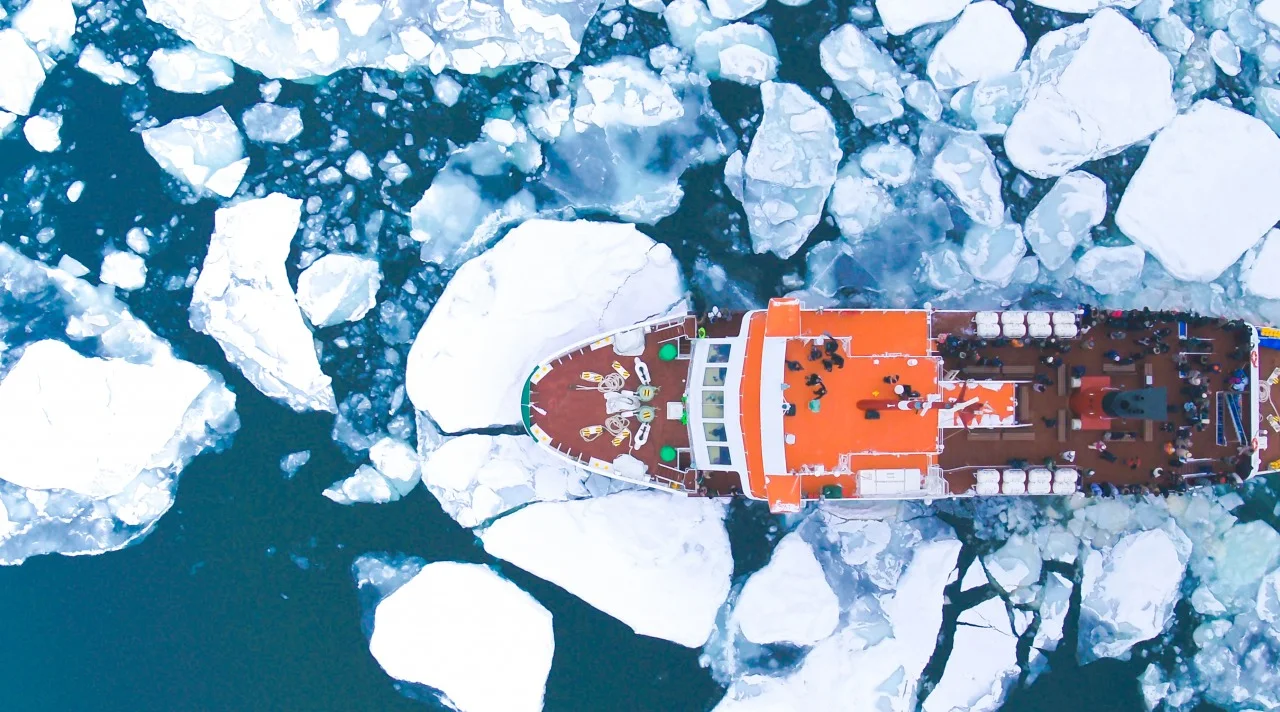
Aurora is easier on the body than walking on ice. A heated indoor space gives cold-sensitive visitors a place to retreat, while the outside deck provides the open view when conditions allow. The ship can still move substantially on rough water, so people prone to seasickness should prepare before boarding. The operator says to complete ticket procedures at least 20 minutes before departure; a last-minute train arrival is an avoidable risk even with a reservation. The Abashiri cruise decision examines whether an independent eastbound stay, a tour or a charter fits the larger route.
Abashiri can support more than the vessel. Frozen Lake Abashiri has seasonal wakasagi, or smelt, fishing, and regional guided outings combine snowshoeing, winter wildlife observation and fishing. These are not guaranteed substitutes for sea ice: a frozen-lake session has its own ice-safety and operator conditions. But they can make an Abashiri night useful even if Aurora's route changes. A city museum or slower local day is a more realistic poor-weather replacement than trying to reach Niseko on the same day.
Ice fishing is a sitting-in-the-cold decision
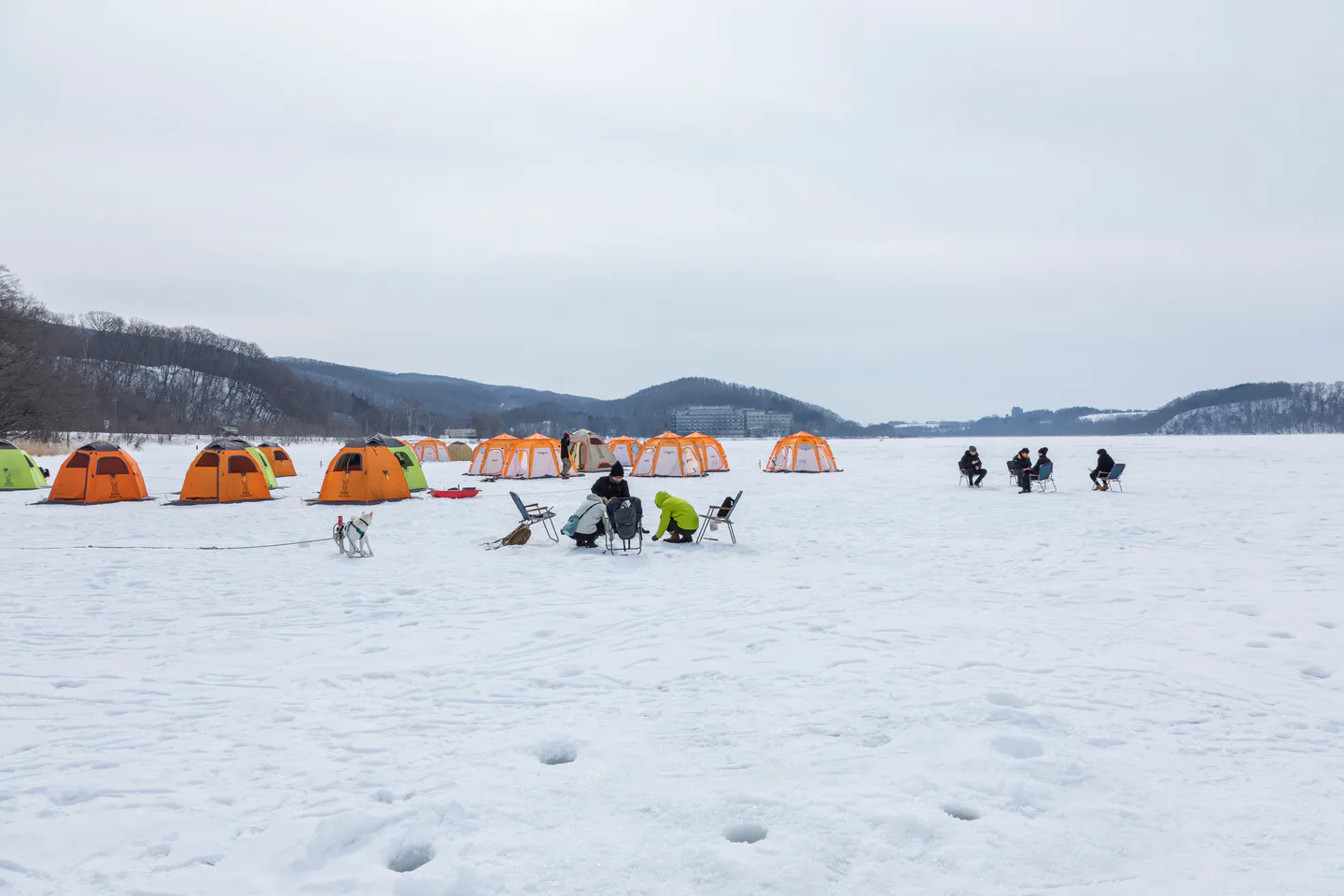
The photograph below shows anglers spread across a snow-covered frozen lake, with orange shelters, chairs and drilled holes in the ice. It depicts the scale of the environment more honestly than an image of a solitary trophy catch would. This can be a calm introduction to Hokkaido winter, but little movement means you may feel colder than on a snowshoe walk. Ask whether the booking includes a tent, tackle, insulated footwear, pickup, a toilet and a warm place afterward. A promise to fry the catch is specific to certain packages, not every lake booking.
Ice fishing appears in several Hokkaido regions, including the Sapporo area and eastern lakes. The activity does not require an Abashiri trip unless the frozen lake is part of a broader Okhotsk plan. For a group travelling without a car, transport to the actual lake access point matters more than a city name on a listing. Check whether the guide collects guests, whether the session is weather dependent and whether children can join. A family already staying in Sapporo can try a nearby operated outing without making the holiday depend on one distant stretch of lake ice.
Utoro drift-ice walking needs a local night
The Shiretoko Shari tourism association describes LANTOKO's guided experience around Utoro as running roughly 1 February to 10 March during ice-landing conditions. Participants wear dedicated dry suits and go with experienced local fishers. Other guides have their own dates, sizes and eligibility rules. The sensible way to plan is to reserve with a named operator, read that operator's age, height and health conditions, and leave a local replacement window. Never walk onto sea ice in ordinary outdoor clothing or without a qualified guide.
This is the strongest option for somebody who specifically wants to be on drift ice rather than view it from a ship. It also has the greatest sensitivity to the ice's position. A one-afternoon stop between fixed transport connections offers little recovery if the guide cancels. An Utoro overnight makes an earlier or later session possible and leaves space for a nearby guided nature activity or onsen if the ice cannot be used. The Shiretoko walk planning guide covers clothing and winter access in more detail.
A short guided session can still be more demanding than a longer indoor-and-deck cruise. Putting on a suit, moving over uneven ice and dealing with wind differ from sitting aboard a ship. Ask about the length of exposure, where you can warm up, and whether there is a toilet before or after the meeting point. A brochure's word “easy” does not describe those practical constraints for a child or an older traveller. Winter clothing guidance helps with the travel days around the specialist gear.
Tokachi dog sledding should not be the only reason for Tokachi
Hokkaido tourism material features dog sledding in Tokachi, including an example of a multi-day Shikaoi winter camp. That example proves the region has the activity; it does not prove that every operator offers a short public ride on the dates of your visit. Snow cover, team capacity, care for the dogs and the operator's calendar determine availability. Confirm the exact product and transfer before buying a hotel night or a long rail journey.
Remove the dogs from the draft itinerary for a moment. If Obihiro, Tokachigawa Onsen or a Tokachi winter landscape would still justify that base, the booking can enrich an already coherent stay. If the answer is no, the whole trip is being reorganised for a small-capacity activity. That can still be a deliberate priority, but add a weather day and accept the real transport cost. The dog-sled route comparison separates a Tokachi stay from an outing sold near Sapporo.
Experience labels deserve scrutiny. A passenger ride, a self-drive lesson and a longer team journey ask different things of the visitor and the dogs. Check the meeting point, instruction, minimum age, clothing, duration on the sled and what happens if conditions are unsafe. A group that includes someone unwilling or unable to ride should agree on a nearby plan for that person instead of assuming they can watch comfortably in freezing conditions for the entire session.
Niseko works best when the travelling party splits its days
Niseko does not need to win a contest of unusual non-ski activities to be useful. Its advantage is shared accommodation for mixed interests: skiers can spend the day on the mountain while companions choose snowshoeing, a snowmobile outing, food, onsen or rest. A ski day and a non-ski day can end in the same village without another hotel transfer. The details depend on the resort area; a room convenient for lifts is not automatically convenient for every non-skier's meeting point.
If nobody skis and the goal is the Okhotsk drift ice, a Niseko detour adds distance without serving that goal. If half the group skis, the same base has more value because it prevents a daily negotiation over who has to move. Hirafu, Hanazono, Annupuri and Niseko Village differ in transfer convenience. A snowmobile session is an active outdoor day, not a recovery substitute for somebody already tired or cold.
Do not plan an alternate region every time a non-ski outing is unavailable. A warm meal and rest, local onsen or a different nearby guided activity can preserve the shared-hotel advantage. A cancelled snowshoe session is disappointing, but it need not turn into an overnight move. This is especially useful for families with ski equipment and other bulky luggage. Luggage forwarding can reduce what travels between regions, though it cannot make a multi-base winter schedule immune to disruption.
A city base leaves the weather room to change
Sapporo and Asahikawa offer a lower-commitment way to learn what kind of winter day the group enjoys. Keep the hotel fixed, book one accessible snow activity and leave another day open to the city. A snowfall, tired child or changed road transfer then costs one outing rather than the entire route. The trade is straightforward: city-based snow time can feel less singular than walking on Shiretoko ice, but it is much easier to replace.
This model suits five nights, large bags, older travellers or visitors who are uncertain about prolonged cold. It also gives a group the option to add an onsen night without attempting four different winter bases. A car-free winter week is a useful check on rail and bus continuity. Drivers need a different weather margin; renting a car does not eliminate whiteout or road risks.
Asahikawa and Sapporo are not interchangeable on a specific day. Choose from the transport and outing actually available near the booked hotel, then assess the remaining journey. “Sapporo area” can still mean a long pickup or multiple transfers. Families should compare door-to-door time and the availability of a warm waiting place before choosing by the advertised minutes of play on snow.
Keep a replacement inside the same travel basin
A cancellation plan only helps if it can be carried out from the hotel you have. The table below gives examples of a useful same-area replacement and an ambitious cross-island substitution that would consume the day. The options are examples, not a promise that another guided operator has last-minute space.
↔ Scroll table left or right
| Hotel base | Weather-sensitive booking | Nearby replacement | Replacement that adds a new transfer problem |
|---|---|---|---|
| Abashiri | Aurora sailing | City museums, a local winter outing or an unhurried Abashiri day | Trying to reach Niseko immediately |
| Utoro | Guided ice walk | Onsen, rest or a local guided activity that is operating safely | Crossing back to Sapporo to fill one afternoon |
| Tokachi | Dog-sled session | Tokachigawa Onsen or another suitable nearby winter plan | Searching for a same-day replacement in Abashiri |
| Niseko | Snowshoe or snowmobile outing | Food, onsen, rest or a local indoor interval | Changing hotels for a replacement activity |
Refund terms matter, but a refund returns money rather than the day. The more remote the activity, the more useful an uncommitted local day becomes. Keep at least one night around a natural-condition priority when the overall trip permits it. On a five-day trip, choose fewer hard-to-replace bookings rather than asking each successive region to behave perfectly.
Three routes with different tolerance for cancellation
Five nights with simplicity first: Make Sapporo or Asahikawa the principal base, reserve one reachable snow day and consider an onsen night if the transport is sensible. This gives the group a first encounter with winter without making an ice-dependent sea trip the measure of the whole holiday. Choosing Sapporo's length helps prevent a snow outing from displacing the city time you actually wanted.
Five or six nights with drift ice as the priority: Allocate a genuine Abashiri and/or Utoro block, include a second usable weather window, then keep the other base simple. Aurora and an Utoro walk offer different contact with the phenomenon; one does not guarantee the other. Do not place both between rigid transfer days and then expect a late cancellation to be recoverable. The cruise logistics and the guided walk requirements should be planned together only when the eastbound journey has enough time.
Six or seven nights for a mixed ski group: Stay several nights in Niseko and use Sapporo as the second base. Non-skiers can arrange their own winter day without forcing skiers to abandon the mountain, and both groups can share evenings. This is about using one accommodation base for two travel styles, not filling every open hour with another prepaid experience.
A ten-day trip can include more than one winter region if the group travels light, understands winter transport and accepts activity loss. The rule becomes stricter when there are young children, substantial luggage or several non-refundable hotel reservations. Outside the practical drift-ice season, choose another winter reason to travel rather than treating a photograph of sea ice as a guaranteed future condition.
The booking questions that prevent the wrong winter day
Before paying, confirm the actual meeting location and the time spent outside rather than only the marketed activity length. Ask whether warm-up space and toilets are available, what clothing or footwear is supplied, who can participate, and how the operator handles snow, wind or insufficient ice. For guided ice walking, verify the dry suit and guide arrangements. For a vessel, distinguish poor visibility or no drift ice from a complete cancellation. For dog sledding, check the riding format and the team's operating conditions.
These details affect people differently. A physically short activity may leave a still participant cold, while a longer walk can keep somebody warmer if properly dressed. A boat passenger can often step inside; someone on sea ice relies on specialist clothing and supervision. Match the group to exposure and transport as carefully as to the activity photograph.
The most rewarding non-ski plan is therefore usually a regional decision. Abashiri and Utoro can justify a deliberate eastern block for sea ice; Tokachi earns its detour if the region itself appeals; Niseko works for a group sharing a ski base; and a city base is often enough for a first snow experience. Let the most valued activity set the anchor, and let the nearby days remain useful even when nature changes the program.
If drift ice is the activity that sets your route, compare Abashiri rooms around the port and rail arrival before adding a long day trip from Sapporo.