
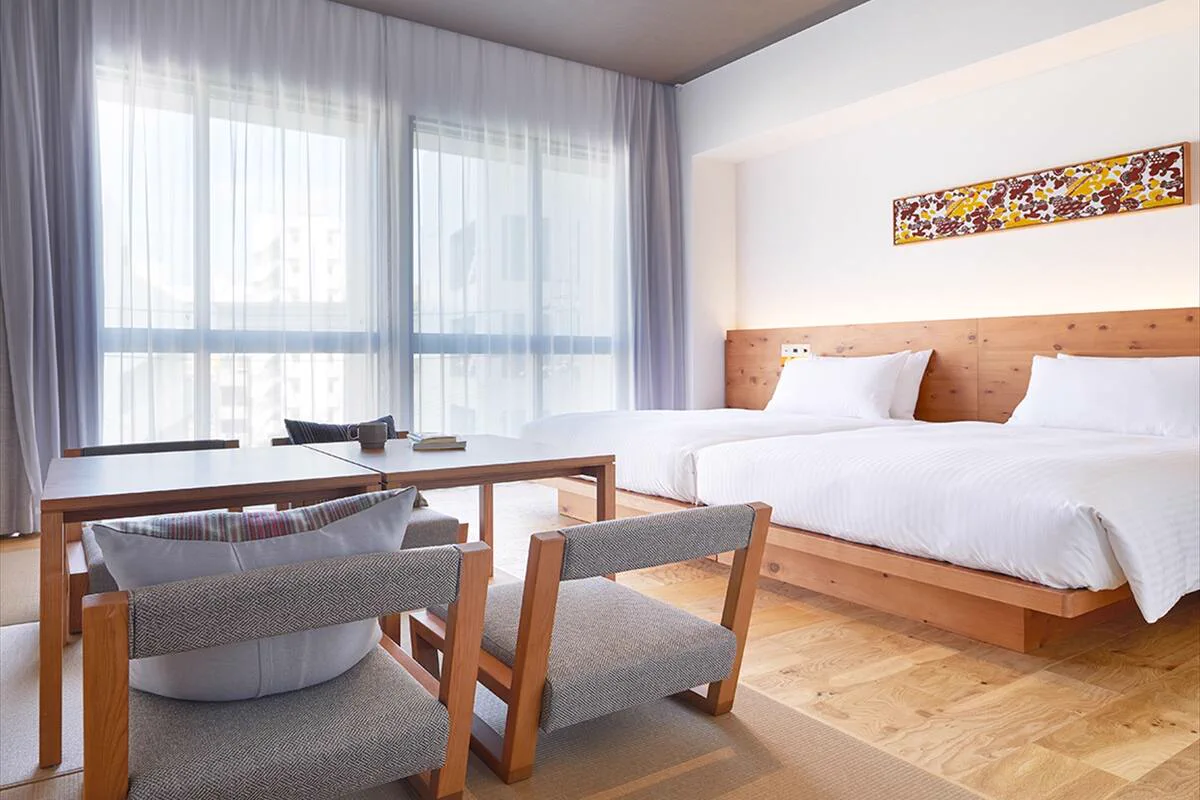
The 21 m² Standard Twin at Hotel Emion Sapporo already includes the hotel's winter strengths: two 120 cm beds, a shoe dryer, the guest public bath and an underground approach for much of the trip from Sapporo Station. The 24 m² Club Twin adds three square metres, a bathroom with a washing area and Club Lounge access. For two adults staying one to three nights and spending most of each day outside, start by pricing Standard. Club makes more sense when several afternoons or evenings are actually spent in the lounge and the bathing layout matters.
The access numbers need precision. The surface route from JR Sapporo North Exit is about four minutes. The hotel's current Japanese access page gives about eight minutes from JR Sapporo through the underground passage and Exit 15, whereas the six-minute underground estimate begins at the Toho subway Sapporo station. The older five-minute claim from JR used the wrong starting point. In snow, weather protection can still be worth several extra minutes with luggage. The Sapporo Station–Odori–Susukino base guide comes first if the trip's repeated end point is not the station.
↔ Scroll table left or right
| Stay pattern | Room to price first | Why | Reason to switch |
|---|---|---|---|
| One to three nights; two adults mostly out | 21 m² Standard Twin | Core winter route, bath and shoe dryer are already available. | Two large cases must remain open or Club costs little more. |
| Four or more nights with afternoon returns | 24 m² Club Twin | Lounge use and separate washing area can repeat their value. | Early starts and returns after lounge closing erase the upgrade. |
| Natural hot spring is essential | Another property | Hohoemi is a public bath, not a natural onsen. | No room upgrade changes the water source. |
| Most evenings end in Susukino | Review the district | Station-side shelter may not offset repeated late trips back. | Frequent JR day trips can restore station value. |
What the underground route actually buys in snow
The hotel connects through the Exit 15 building and a passage used to reach Sapporo's underground network. Its route guide starts at JR's East ticket gate and includes corridors, escalators or lifts before the Exit 15 connection. It is therefore useful for snow, wind and slush, though it is longer from JR than a straight surface walk. A child, wheeled case or late airport arrival can make the reduced outdoor exposure more valuable than the stopwatch difference. A JR Tower hotel comparison helps if direct station integration is the actual requirement.
Do not confuse “underground connected” with a zero-walk platform transfer. You still navigate station concourses, vertical changes and the hotel's connecting building. In dry weather, the four-minute surface route may be simpler. If you drive most days, the protected station path cannot solve snow-road decisions; the Hokkaido winter driving guide becomes more relevant than the hotel entrance. A car-free seven-day Hokkaido route shows when repeated JR access earns its place.
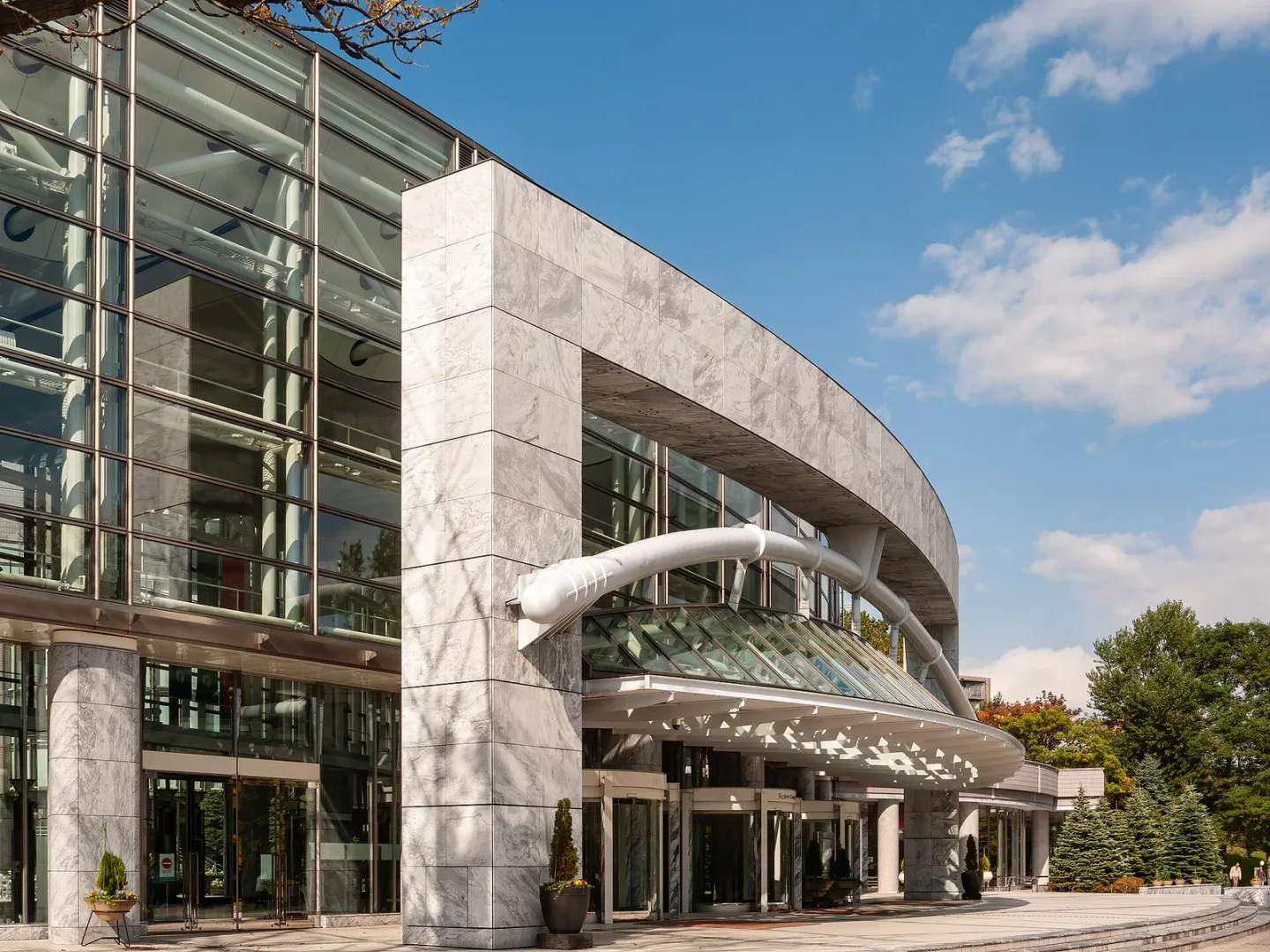
The first inline image shows a glass-and-stone building with a curved canopy. It is included as a city-approach visual; the picture alone does not identify the exact underground exit, so use the hotel's route guide for the final turn.
Three square metres do not settle a two-suitcase stay
Standard Twin is 21 m² with two 120 × 200 cm beds. Club Twin is 24 m² and keeps the same bed count and width. The published area gain is three square metres, or about 14.3% relative to Standard. That can improve circulation, but it cannot guarantee that two large hard-shell cases remain open without blocking furniture. The actual difference also includes Club's bathroom with a washing area and lounge access; those are stronger reasons to pay a substantial premium than area alone.
↔ Scroll table left or right
| Twin category | Published area | Area per person, two guests | Distinct reason to buy |
|---|---|---|---|
| Standard | 21 m² | 10.5 m² | Core winter amenities at the base room rate. |
| Club | 24 m² | 12 m² | Washing-area bathroom and Club Lounge eligibility. |
As a simple comparison, 21 m² divided between two people is 10.5 m² each; 24 m² is 12 m² each. Neither figure is free floor after the beds, table and storage. For one to three nights, opening cases in turn can make the 21 m² room quite workable. Four or more nights of coats, purchases and two cases left open increases daily friction. Luggage forwarding can remove more trip-wide trouble than buying three extra square metres at every stop. A Sapporo twin-room comparison provides other layouts if the bedroom itself is the veto. Shopping-heavy stays make the case and return journey a daily issue.
Standard already lists an in-room shoe dryer. Wet boots or trainers after snowy pavements can affect the next morning, so a repeatable drying tool has a different kind of value from a single lounge visit. The hotel does not promise an exact drying time for every shoe, and the device is not a substitute for waterproof footwear. The practical point is that this winter aid does not require the Club upgrade. The hotel also provides charged coin laundry, which may matter much more on night four of a multi-city trip than on a single transfer night. Sapporo's budget-hotel factors help check the full stay cost; Tokyu Stay Sapporo Odori offers a different four-night room and laundry trade-off.
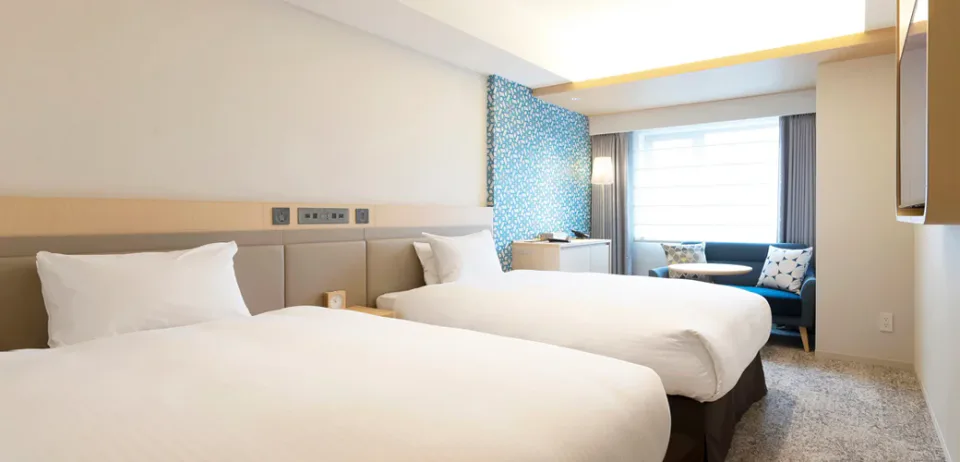
The Standard Twin photo shows two beds and window-side seating. Compare the exact room category rather than assuming the furniture leaves a fixed amount of open suitcase floor in every room.
The bath is included; the Club Lounge runs on a narrower clock
Hohoemi Bath is free for staying guests and is a public bath rather than a natural hot spring. It operates 15:00–25:00, final entry 24:30, then 06:00–10:00, final entry 09:30. That unusually late evening window can suit a winter city day and a slower following morning. Guests who require natural spring water should compare an actual Sapporo onsen property; the Club category does not change Emion's bath into one.
Club Lounge breakfast runs 06:30–10:00, with final entry 09:30. Tea time is 14:00–17:00; cocktail time 17:00–22:00, final entry and last order 21:30. Check your own days against those windows. An early ski departure or an evening ending after 22:00 uses little of the lounge. Two afternoon returns and two cocktail-hour evenings across four nights create a materially different case for Club. Children under 12 require a guardian in the lounge and are not admitted to cocktail time, so a family should not count those sessions as value for the whole party.
↔ Scroll table left or right
| Four-night routine | Club use likely | Decision implication |
|---|---|---|
| Two afternoon returns plus two cocktail-hour evenings | Repeated tea and evening sessions | Price Club seriously against Standard. |
| Outside 07:00–23:00 each day | Almost none | Standard is a stronger baseline. |
| Family needs washing-area bath but reaches the lounge once | Room feature plus limited lounge use | Compare the full premium and child restrictions. |
A washing-area bathroom can be a separate reason for Club, especially when two people want a different bath routine from the communal facility. The extra room space may help too, but price the complete room premium for the full stay. No fixed “three visits” rule proves an upgrade will pay back: one family's bathroom preference may outweigh several unused tea periods. The key is whether the named facility solves a repeated problem. A smaller Gracery station room and a larger Keio Plaza twin bracket the room-space alternative.
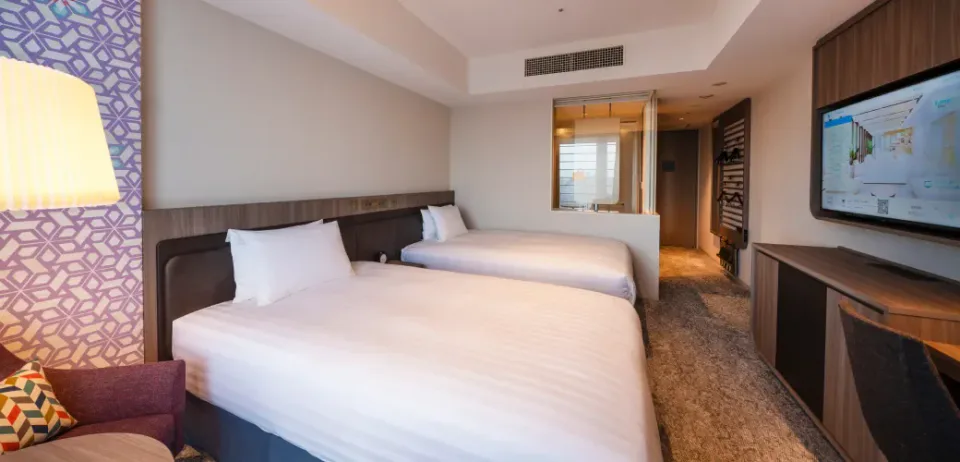
The Club Twin image shows its two beds and wall-side furnishings. The photo is useful for comparing the category's arrangement, while the lounge hours and washing-area bathroom are the real upgrade differences.
The three room photographs appear in a swipeable gallery below. They show hotel rooms, not a promise that every floor has the same window view.
Seven dimensions before paying for Club
↔ Scroll table left or right
For a winter rail trip with two adults and two cases, Standard provides the short station route and public bath. Club earns more only if the larger bathroom or timed lounge will actually be used.
| Hotel dimension | Our score | Why |
|---|---|---|
| Location | JR Sapporo is about four minutes by surface route or roughly eight minutes by the sheltered route via Exit 15. The latter saves snow exposure but is not a four-minute underground shortcut; Susukino evenings add a return journey. | |
| Room | Both Twins have two 120 cm beds. Standard is 21 m² with a shoe dryer; Club is 24 m² with a washing-area bath. Two open winter cases and coats can make that modest area difference material. | |
| Cleanliness | Recent guest cleanliness feedback is strong, including for the public areas; a 21 m² floor plan alone cannot show daily room upkeep. | |
| Service | Recent staff feedback is strong. Club child rules and lounge eligibility still need to be checked for the exact booked party. | |
| Facilities | The included public bath runs to 25:00 and charged coin laundry helps a longer stay. The bath is not a natural onsen; Club adds timed lounge access rather than different water. | |
| Food | Club breakfast, tea and evening service can be useful with afternoon returns, while early starts and late returns may miss most of the schedule. | |
| Value | Standard already includes the winter route, bath and shoe dryer. Club earns a higher rate only when its private bathing layout or repeated lounge visits matter. | |
| Overall | a practical station-side winter base in Standard; the Club premium depends on luggage spread, bathing preference and actual lounge hours. |
The source’s old decimal “fit” marks gave personal luggage tolerance and lounge use an unexplained precision. Our seven site scores use published room and bath details plus dated guest feedback; your exact winter route still changes the room choice. A two-night rail arrival with medium cases can favour Standard; five nights with two cases permanently open may demand more space; a four-night Club stay can earn its rate through repeated lounge visits. A two-night Club booking with early starts and returns after 22:00 is unlikely to use its defining feature. The Sapporo couples-hotel guide puts bath and winter convenience alongside other real priorities.
A nightlife-centred stay with repeated late Susukino endings can weaken Emion's station position. A rail-heavy itinerary can pull the answer back toward Sapporo Station. JR Tower versus GRANBELL compares station resilience with a different bathing offer; Sapporo Grand Hotel provides another underground-walk model. None automatically beats Emion without the room and daily route in view.
For a short winter rail stay, begin with the 21 m² Standard Twin and confirm that the two cases and coats can be managed. Price the 24 m² Club Twin if the lounge schedule and washing-area bathroom will be used repeatedly. A stroller or a traveller who cannot use stairs should trace the accessible lifts through the station and Exit 15 rather than relying on a single walking-time figure; a protected route only helps when its vertical changes work for the group. Compare Hotel Emion Sapporo rooms on the same dates, guest count and cancellation terms, then add any breakfast and local accommodation tax shown at checkout. The right purchase is the category that solves the actual winter routine.
Other Sapporo hotel and winter routes
Hokkaido winter driving guide · Sapporo Station vs Odori vs Susukino · Keio Plaza Hotel Sapporo · JR Tower Nikko vs GRANBELL · Hokkaido winter activities without skiing · Best eSIM for Hokkaido · Hotel Emion Sapporo — overview and station · Standard Twin · Club Twin · Club Floor and lounge hours · public-bath hours · Hotel Gracery Sapporo vs Solaria Nishitetsu: Winter · THE BLOSSOM HAKATA Premier: Is the 7-Minute · JR Kyushu Hotel Blossom Shinjuku Review: Is · Solaria Nishitetsu Hotel Sapporo: Is the Five-Minute · Sapporo Summer Festival After 8 PM: Is · Ghibli Park Tickets 2026: Before You Buy · Sapporo Autumn Fest 2026: The One-Kilometre Food