
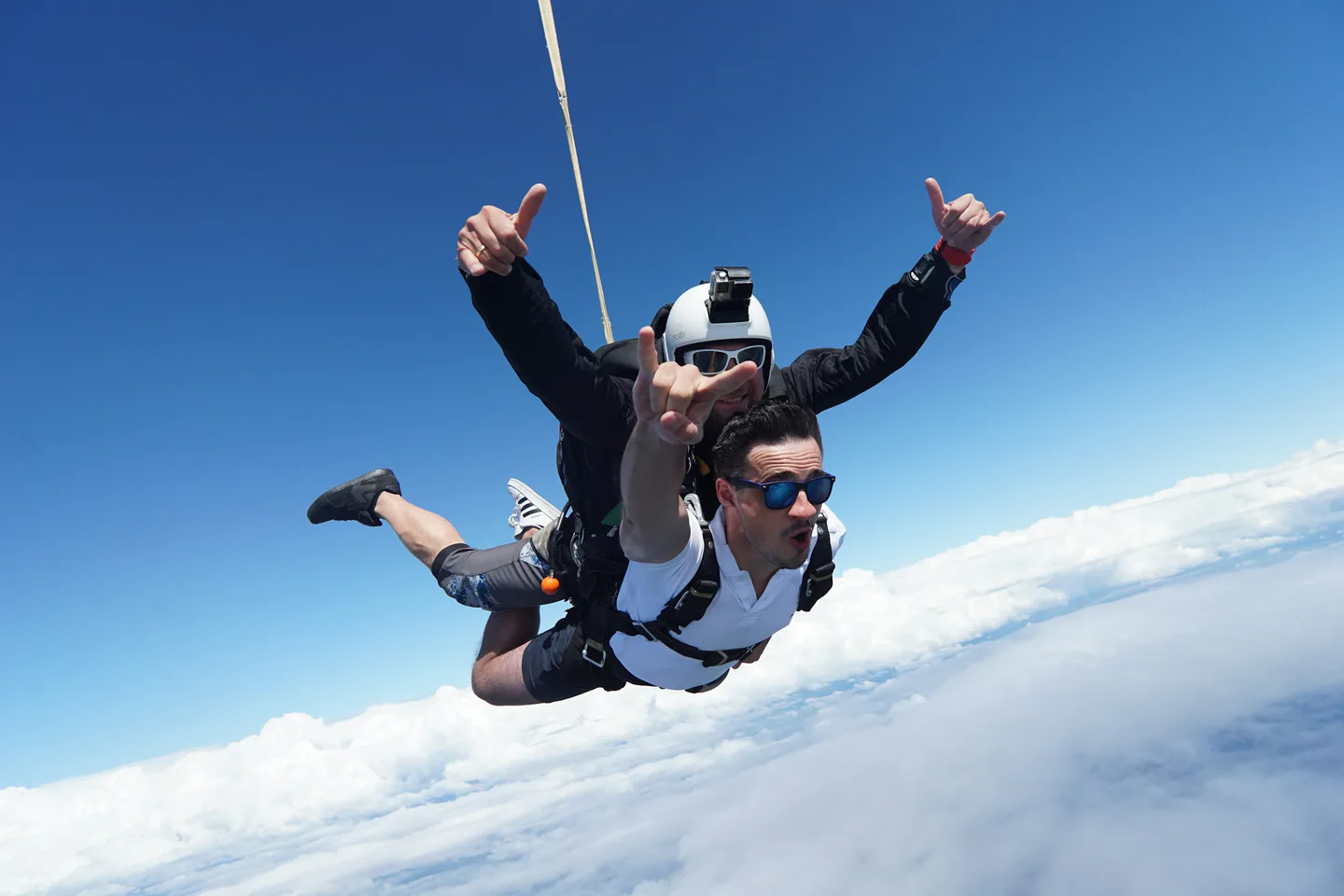
A tandem jump near Tokyo takes less than a minute in freefall, but it can occupy most of a travel day. Skydive Nippon's meeting point is in Kawajima, Saitama, outside central Tokyo. The jump, ground briefing, weather checks and return journey have to fit your itinerary as one block. Book it because you want the exit and freefall, not because a skyline photograph made it look like a quick substitute for a Tokyo observation deck.
The experience description used for this guide puts the exit at around 4,000 metres, with roughly 40–50 seconds in freefall and about four minutes below the parachute. The operator has asked guests to allow at least three hours from meeting to completion and to keep the wider day flexible. A rail journey from Tokyo, a final local bus or taxi, and the trip back make a smooth five- to seven-hour footprint plausible. That footprint is an itinerary estimate, not a finish time promised by the jump centre. On a short first visit, compare it against the three-, four- or five-day Tokyo plan before paying.
Decide whether the freefall is the reason for the trip
| What you actually want | Decision | What would change it |
|---|---|---|
| The freefall itself is a long-held goal | Protect a full day and a later fallback date | No operating day remains if weather stops the first attempt |
| You mainly want views from above | Compare a helicopter or observation deck | The aircraft exit is the attraction, not a relaxed panorama |
| You have only two or three usable Tokyo days | Count the neighbourhood day you would lose | Skydiving ranks above those city plans for your party |
| An international departure or concert is fixed that evening | Choose another day | The entire following schedule can absorb a delayed finish |
| The final possible operating day is your only option | Accept that there may be no second attempt | You can return on a later trip |
The question is personal but the time trade-off is concrete. A morning booking does not automatically leave an afternoon in Shibuya. If the day is built around eastern and western Tokyo areas, the Kawajima detour can cut across both. If you planned a regional attraction anyway, check whether an autumn day trip would use the same scarce day. The value of skydiving rises when freefall is the thing you would otherwise regret leaving out.
The travel and jump clocks are separate
The meeting and final dispersal point listed by the current operator site is 496 Yamagayato, Kawajima-machi, Hiki District, Saitama. Earlier access guidance described rail options through Okegawa or Kawagoe, followed by local transport; the Yamagayato bus stop is about a ten-minute walk from the site. The old approximate rail figures were about 45 minutes from Tokyo Station via Okegawa or 56 minutes via Kawagoe. Those figures do not include your hotel-to-station walk, a wait for the final bus, the last walk or your return after landing. Check the route on your actual date rather than treating the rail segment as the entire excursion.
| Part of the day | Planning allowance | Why it is variable |
|---|---|---|
| Hotel to main Tokyo departure station | Depends on your base | A Shinjuku room and a Tokyo Station room start differently |
| Regional rail to Okegawa or Kawagoe | Earlier guidance: roughly 45–56 minutes from Tokyo Station | Chosen connection and timetable |
| Bus or taxi and final approach | Add a separate block | Bus frequency, road conditions and meeting instructions |
| Meeting to completion | At least about three hours | Weather, aircraft cycles and safety operations |
| Return to Tokyo | Allow the regional journey again | Final dispersal and onward connection |
Even when everything runs smoothly, this is not a three-hour city activity. The most useful booking pattern is a jump on Day 2 or Day 3 of a longer Tokyo stay, after a normal night's sleep, with another operator day still available to swap in. A long-haul arrival followed immediately by a jump adds fatigue and flight-delay risk. Putting it on the last possible day makes a weather cancellation final. A four-, five- or seven-day Tokyo route has enough room to show whether a swap day really exists.
For arrival-day planning, a late Haneda flight or a late Narita arrival should be resolved before picking a jump date. Likewise, Tokyo Station versus Shinjuku lodging affects the start of the regional rail journey.
Package prices depend on the camera and the date
The published tandem prices used in the earlier 2026 booking guide were ¥61,500 on weekdays and ¥65,000 on holidays for the instructor's Hand Camera package. A separate cameraman package was ¥81,500 on weekdays and ¥85,000 on holidays. Edited video cost another ¥4,500. Those are useful comparison figures for dates on which that schedule applies, but they are not a fixed year-round promise: the operator's 30 August 2026 notice says weekday prices will return to the holiday level from December. Check the booking screen for your specific day before budgeting. The ¥20,000 gap between the two filming packages is more important than a small difference in train fares.
| Package in the previous 2026 schedule | Weekday | Holiday | What is different |
|---|---|---|---|
| Hand Camera | ¥61,500 | ¥65,000 | The tandem instructor films with a hand camera |
| Cameraman | ¥81,500 | ¥85,000 | A separate camera flyer records an outside angle |
| Edited video add-on | +¥4,500 | +¥4,500 | Editing is an additional purchase |
Decide about footage before arrival. If you want proof of the freefall but rarely watch travel videos, the instructor camera can be enough. If the outside angle is part of why you booked the jump, compare the total with the cameraman included. Do not infer that a cheaper “jump only” product exists simply by subtracting the camera from the listed package; the original published minimum already included Hand Camera. The previous operator terms said payment was made on site in cash after the jump was confirmed operable. Because payment conditions can change, carry the amount needed for the selected booking and follow the current confirmation's instructions rather than assuming a card will work at Kawajima.
There are other costs without a ticket line: regional rail, local taxi or bus, and the Tokyo day you surrender. An edited video is optional, but missing a fixed paid evening event because the operation ran late can be much more expensive. Keep luggage storage and hotel checkout practical if the jump day also involves moving rooms; carrying a large case to the meeting site is an avoidable complication. If you are splitting a longer stay between neighbourhoods, change hotels on another day.
Weather and operating days determine the recovery plan
The current operator homepage lists Mondays, Tuesdays, Fridays, weekends and public holidays as operating days, with Wednesdays and Thursdays closed. That updates the earlier version of this guide, which omitted Tuesday. Rain, strong wind and aviation conditions can delay or cancel jumping; a flight can also be stopped for safety after the day has started. Book an early suitable date and mark one later open day that you could exchange with a flexible Tokyo plan. A weekend after a Thursday booking is not a recovery date if the site does not operate on Thursday in the first place.
| Risk | What it changes | Useful response |
|---|---|---|
| Weather or aviation hold | The jump can start late or not run | Keep a later operating date free |
| A long-haul arrival delay | You may miss the meeting time | Sleep in Tokyo first |
| Fixed concert or train that evening | A delayed completion threatens another booking | Move that hard clock to another day |
| No remaining open date | A cancellation ends the attempt on this trip | Only book if that outcome is acceptable |
Check the forecast for Kawajima and the message from the jump centre, not just the weather outside a Shibuya hotel. A clear morning over central Tokyo does not override a wind restriction at the drop zone. In case of a weather cancellation, the operator's applicable terms govern rebooking or refunds; independently purchased rail tickets and hotel nights are separate expenses. This is a stronger reason to keep the surrounding itinerary flexible than to buy the earliest possible train to Saitama.
Check eligibility before choosing a non-refundable hotel or train
The previously published tandem criteria were ages 16–69, height 140–190 cm and weight 40–92 kg, with parental consent for ages 16 and 17. The on-site weight check includes the clothes and shoes worn for the jump. Even within a stated numerical range, an instructor must be satisfied that the harness fits safely. Original identification is required. Read the criteria on your current booking form and resolve a borderline case with the operator before paying for non-refundable extras; an article cannot clear a person medically or overrule the instructor on the day.
The published restrictions have included alcohol or drugs, recent scuba diving within the preceding 24 hours, blood donation within a week, pregnancy and some medical histories. Securely laced athletic shoes are the practical default; loose footwear is unsuitable. If any medical condition or recent activity might affect eligibility, ask the jump centre directly with the relevant details before building a trip around the experience. Keep the required ID, the booking information, suitable shoes and the intended package payment together so the long journey does not end at check-in.
| Before leaving Tokyo | Why it matters at the drop zone |
|---|---|
| Original ID and booking details | Identity and reservation must match |
| Current age, height, weight and consent rules | Eligibility is checked for the selected jump |
| Secure shoes and suitable clothing | The harness and landing require proper fit |
| Recent diving, donation or health issue disclosed | Safety restrictions can prevent participation |
| Payment method and package total | Earlier terms specified cash on site |
| Message about operations and weather | The programme may shift before you travel |
How the jump compares with an aerial view or a normal city day
Skydiving's distinctive moment is the exit and freefall. A Tokyo helicopter night route gives you moving views without that moment; its heliport, weather and whole-aircraft cost create a different decision. The short Tokyo helicopter comparison is useful if daylight flying is enough. A Tokyo observation deck is simpler if height and skyline are enough. Paragliding near Fuji is a different flying experience, with a different transport day. None should be called a cheaper version of freefall; they meet different motives.
| Experience | Strongest reason to choose it | Main sacrifice |
|---|---|---|
| Skydive Nippon tandem | You specifically want freefall | Regional journey, eligibility and weather exposure |
| Tokyo helicopter sightseeing | You want moving aerial views of city landmarks | High charter price and separate heliport logistics |
| Observation deck | You want a skyline without an aviation day | No freefall or moving route |
| Tokyo neighbourhood day | You value streets, food and museums more | Less singular physical experience |
The seven practical dimensions from the earlier assessment are money, time, booking certainty, weather resilience, crowds, route fit and uniqueness. Cost is high before transport and filming upgrades. Time demand is at least a regional half-day and often most of a day. Booking is structured, but eligibility and operating dates narrow it. Weather resilience is limited. Tourist crowds are not the main problem; the aircraft schedule and conditions are. Route fit is weak for a normal central-Tokyo sightseeing cluster. Uniqueness is the main reason to accept those disadvantages. There is no defensible universal numerical score for those personal trade-offs, so use the dimensions against the trip you are actually taking.
If weather cancels the jump after you have travelled out, do not assume a same-day substitute in Kawajima will rescue the whole trip. A separate Kawagoe visit can be an option only if its hours and your transport route work that day. Otherwise go back to the Tokyo plan you kept flexible; the Tokyo rain plan is a more dependable fallback than rushing into an attraction chosen solely to fill the gap.
For a first Tokyo visit, check where the hotel base sits and whether the day lost would remove an entire neighbourhood theme. A longer itinerary may permit the Kawajima trip without displacing your highest-priority city day. If a later free day already exists, the weather problem becomes manageable. If the stay has no margin, the jump is still possible, but the booking should be made with a clear understanding that it may consume or lose the one day you gave it.
Book the Kawajima tandem when freefall is the reason you would travel there, the party meets the current eligibility rules, and your schedule leaves a second possible operating day. Choose the filming package before comparing prices and keep cash or the payment method specified by your confirmation. Leave the evening free enough to tolerate a late finish. If the main goal is simply an aerial Tokyo view, use the helicopter and deck comparisons first; they answer that goal without turning a short freefall into a full regional excursion.
For a base before or after the jump, compare hotels around Tokyo Station with the actual Okegawa or Kawagoe connection. The hotel location cannot remove the drop-zone journey, but it can avoid beginning a long activity day with an unnecessary crossing of Tokyo.