
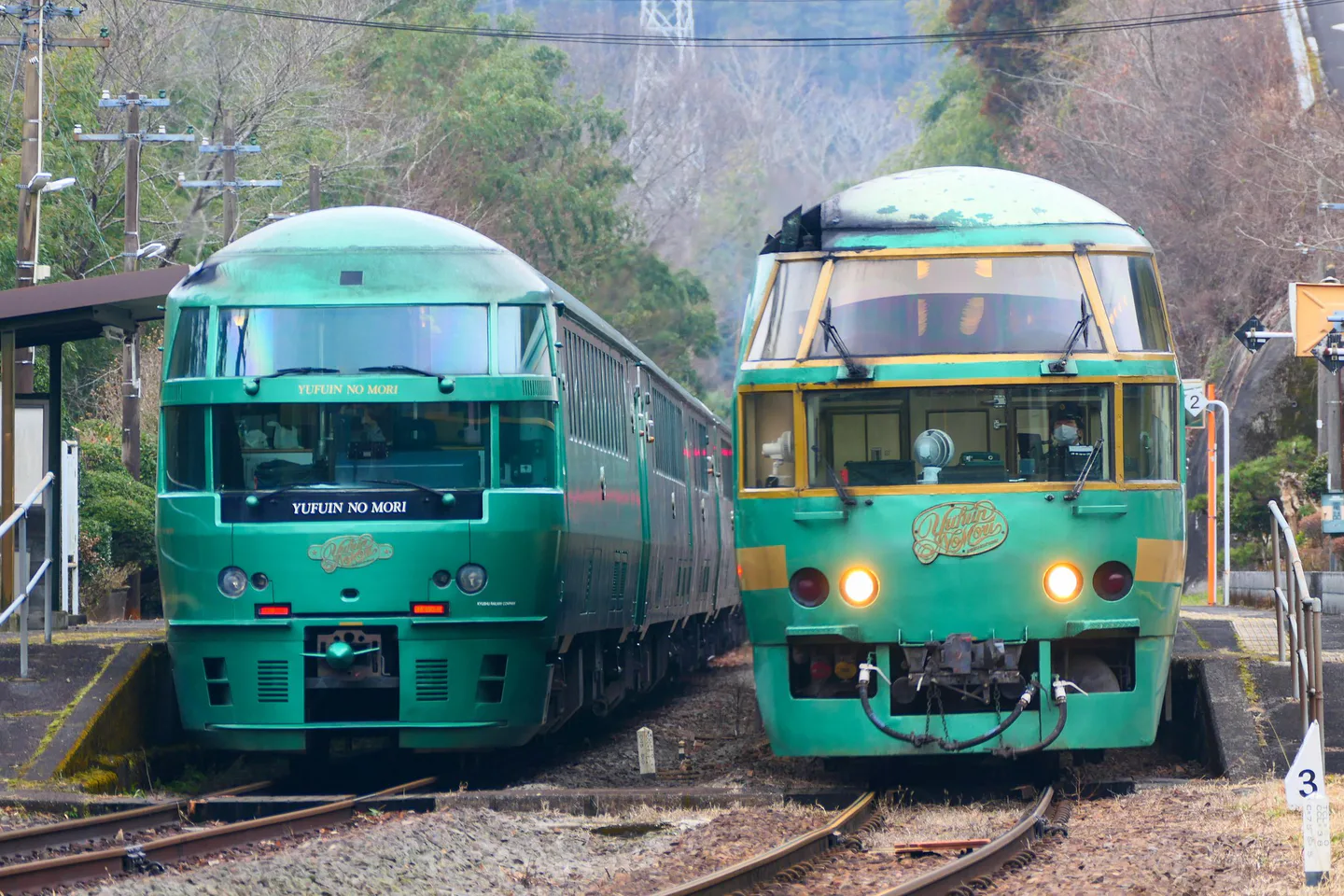
Booking Yufuin no Mori in late 2026 is mostly a matter of choosing the right train on the right day. The temporary replacement of Nos. 3 and 4 ended on September 18; the sightseeing services returned to the published plan from September 19. That historical disruption still appears in older search results, but it should not send an October or November traveller towards a different departure without checking the current operating calendar.
Begin with your destination and hotel check-in time. A beautifully timed train ride is a poor purchase if it arrives too late for a ryokan dinner. Equally, a conventional Yufu service may be a sensible route to Yufuin while missing the reason someone wanted this particular sightseeing train. Those are two separate priorities, and the booking screen will not decide between them for you.
The September replacement is history; the operating date still matters
When you travel | Train availability | Booking consequence |
Through September 18, 2026 | Nos. 3 and 4 were replaced by Yufu 73 and 74 | That past substitution no longer governs an October booking |
September 19 onward | The plan restored Yufuin no Mori Nos. 3 and 4 | Check the exact operating date and train name |
October and November 2026 | The published calendar distinguishes full and reduced operating days | Use the calendar for your day before selecting a seat |
The September change replaced the usual No. 3 and No. 4 slots with Yufu 73 and 74 using a four-car KiHa 185 set. The route was still usable, but the vehicle was not the Yufuin no Mori experience. Since September 19 the two named services have been back in the plan, alongside Nos. 1, 2, 5 and 6. On a particular date, however, inspection or other operating decisions can still alter which trains run. A seasonal headline cannot substitute for the day-specific calendar.
The Yufuin no Mori train page and the current operation notices are worth opening immediately before you reserve. Search for the exact train name and number, not just a departure at roughly the time you want. Yufu and Yufuin no Mori are both legitimate ways to reach the area, but only one provides the onboard design and service that give the sightseeing train its appeal.
Work backwards from the hotel, not the station clock
Your fixed point | Choose first | What could change the answer |
A particular sightseeing train | An operating Yufuin no Mori departure | No adjacent seats or a cancelled operating day |
A ryokan dinner in Yufuin | Arrival with a comfortable check-in buffer | A later scenic service would miss the meal |
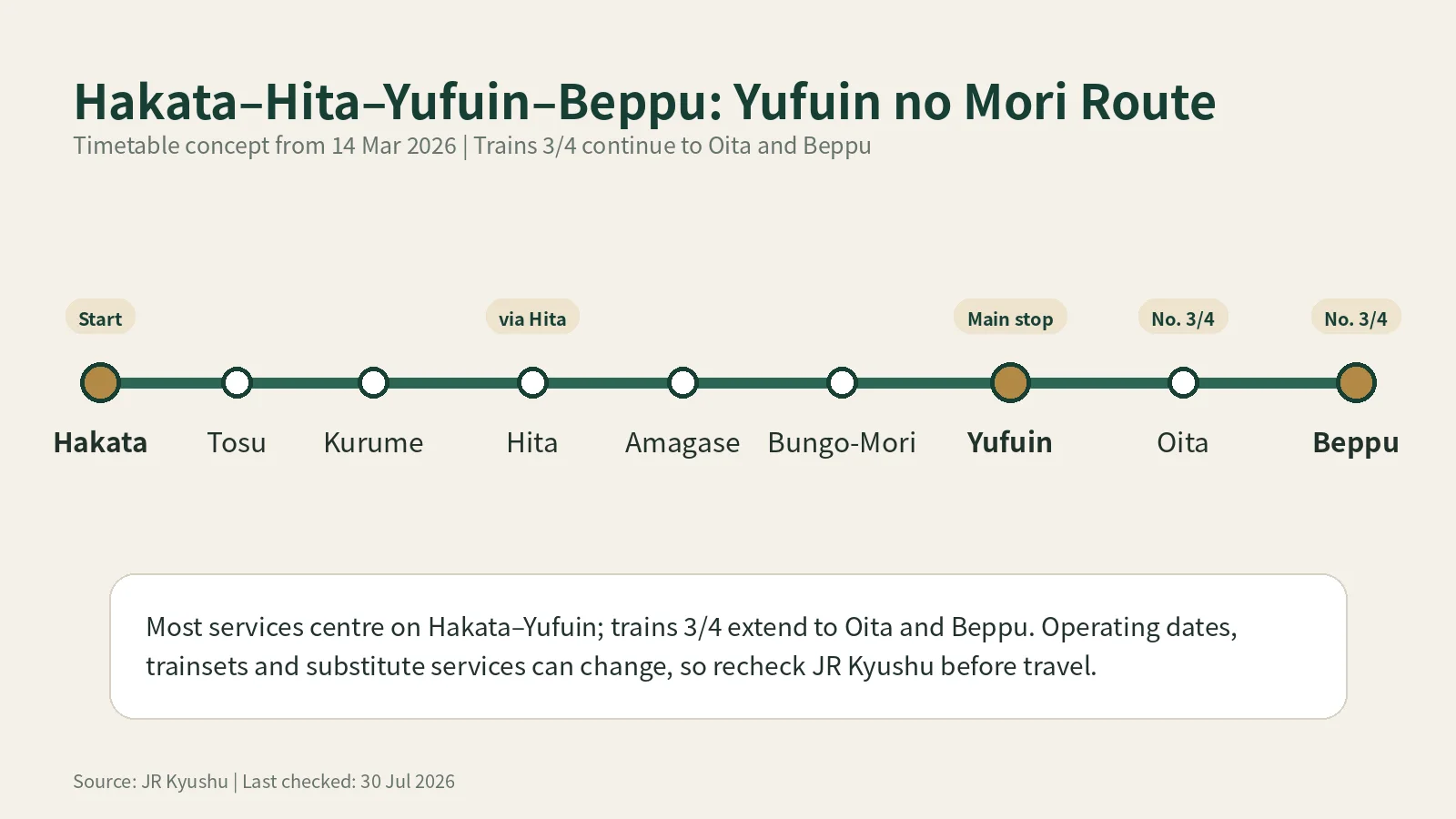
An overnight in Beppu | A service that actually continues beyond Yufuin | Only some departures reach Beppu directly |
Yufuin no Mori No. 3 is the departure to examine if you need a service continuing to Oita and Beppu; not every train in the branded group does so. For a Yufuin overnight, compare the arrival with the property's dinner policy and the time needed to reach it from the station. A tight final transfer can turn a leisurely train into an anxious last hour. If you are deciding whether the overnight belongs in Yufuin at all, the Beppu versus Yufuin stay comparison should come before the seat purchase.
The same logic applies in reverse. If you want a full final afternoon in Yufuin, a later return may matter more than a particular carriage. If you have a flight or another long-distance train that evening, protect the onward connection first. The branded service is valuable when it fits the whole day; it is not a good reason to remove all margin from an expensive travel chain.
When reservations become available
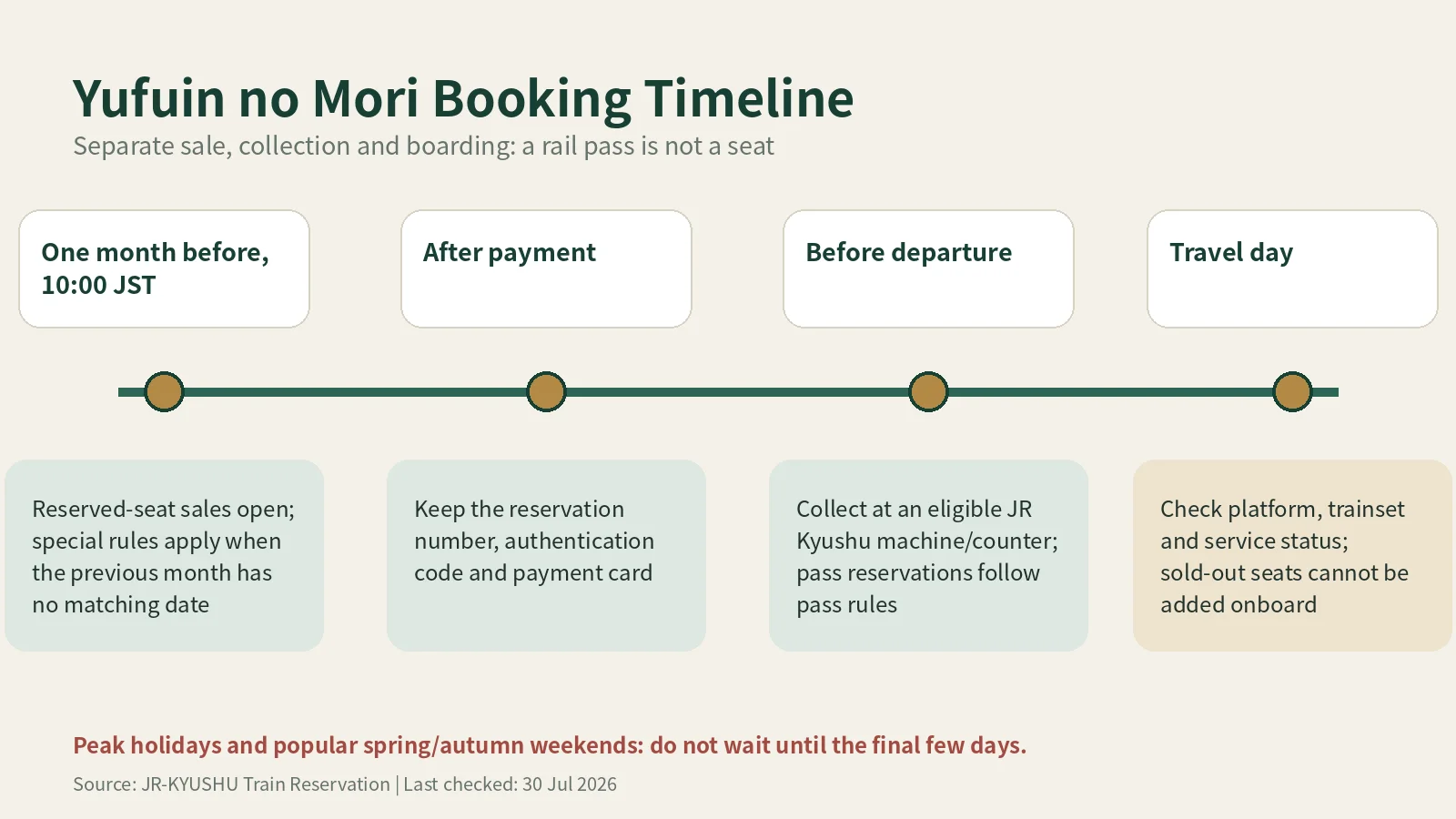
Reserved seats normally go on sale at 10:00 Japan time one month before the date of travel. Every Yufuin no Mori seat is reserved, so there is no unreserved carriage to use if you simply turn up. On a weekend, during school holidays, or when a group needs seats together, mark the opening date rather than waiting until the rest of the itinerary is finished.
Check the booking method as carefully as the release time. The JR-KYUSHU train reservation service has its own collection rules, while a rail-pass holder may use a different online advance-seat process. A search result showing availability is not the same as a completed reservation. Keep the confirmation and find out which ticket or pass documents must be presented before boarding.
The English reservation service lists ordinary reception hours of 05:30–23:00 JST, permits bookings until six minutes before departure while seats remain, and accepts up to seven passengers in one transaction. Those are system limits, not a sensible target for a group that needs seats together or has a fixed dinner. Use the one-month release date for a high-demand departure.
Before payment, read one line of the booking result slowly: travel date, train name and number, boarding station, arrival station, passenger count and seat positions. This catches two common errors. One is selecting Yufu when the desired product was Yufuin no Mori. The other is reserving a train that terminates at Yufuin when the actual hotel is in Beppu.
A rail pass covers travel, but it does not conjure a seat
Ticket situation | Seat rule | Cost or limit to notice |
Ordinary point-to-point ticket | Reserve a specific train and seat | All Yufuin no Mori seats are reserved |
All Kyushu Rail Pass | Standard seat reservations within the valid area are unlimited | A seat still has to be available |
Northern Kyushu Rail Pass | Up to six standard reservations under the pass terms | Advance online booking carries a separate fee |
An All Kyushu Rail Pass allows unlimited standard reserved-seat bookings within its valid area; the Northern Kyushu pass normally allows six before an additional limited-express ticket is needed. The rail-pass seat rules make the distinction clear. The pass itself never guarantees a place on a sold-out Yufuin no Mori departure. For a train where seating is entirely reserved, the booking step remains essential even when the fare is covered.
JR Kyushu also sells advance pass-holder reservations online. The current additional charge for Yufuin no Mori is ¥1,500 per adult, and those paid advance bookings do not count towards the Northern Kyushu pass's six standard reservations. That fee is for securing the seat in advance under the online service; it does not mean the train is generally excluded from the pass. Compare the charge with the value of certainty for your particular travel day.
Do not buy a regional pass merely because this train looks expensive. Add the rest of the journeys first, then use the Northern Kyushu pass comparison to test the whole route. A single Hakata–Yufuin leg and a multi-city Kyushu circuit are different calculations. The pass decision and the seat-availability decision belong on the same page, but they are not the same question.
Seats, views and the actual carriage
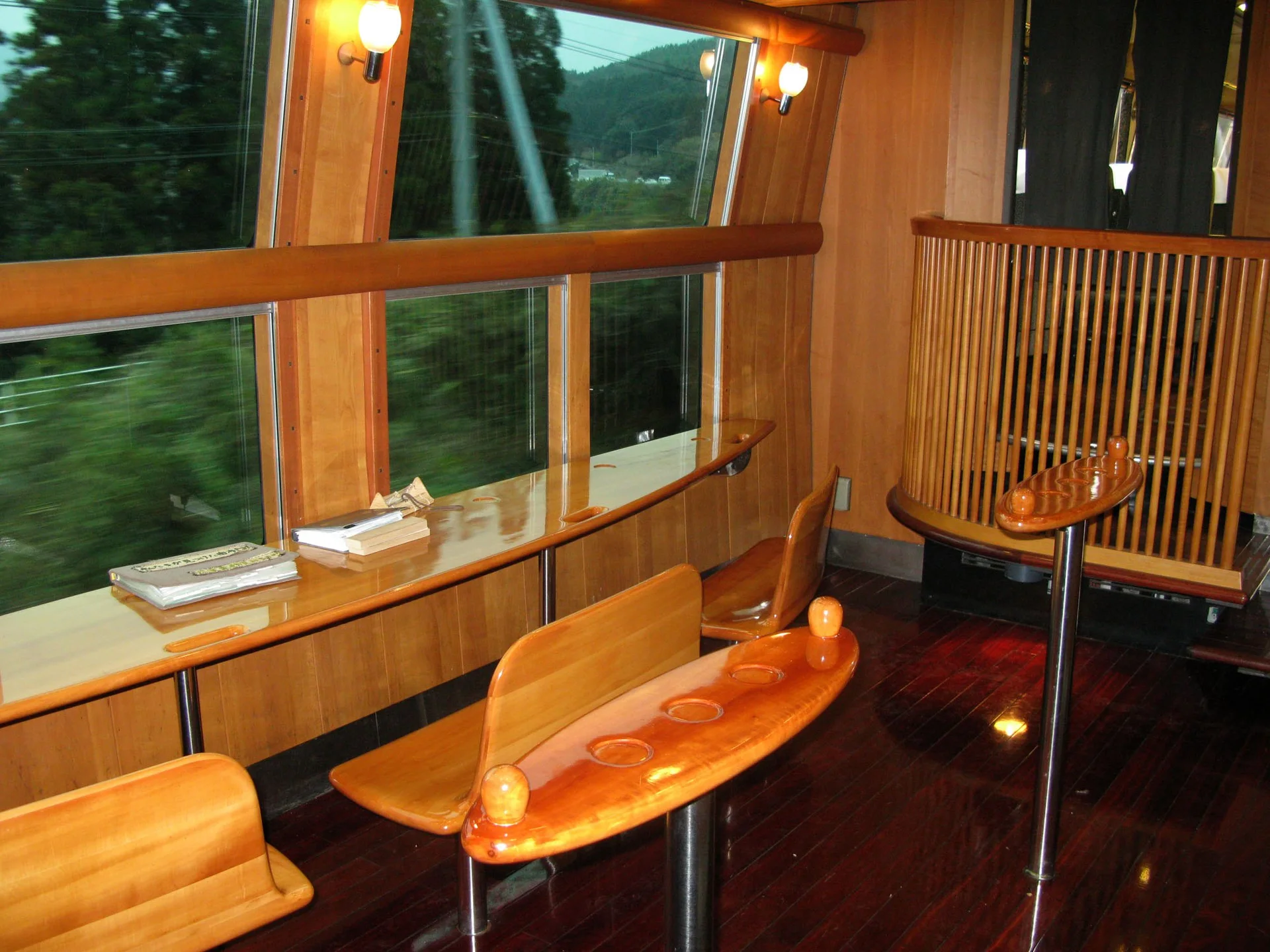
There is no consistently superior side for the full ride. The line bends through changing terrain, and the view shifts. Travellers booking for two will usually get more from adjacent seats on a suitable departure than from chasing an idealised window position and ending up apart. If the specific train's configuration is important to you, check the formation shown for that number before choosing a car.
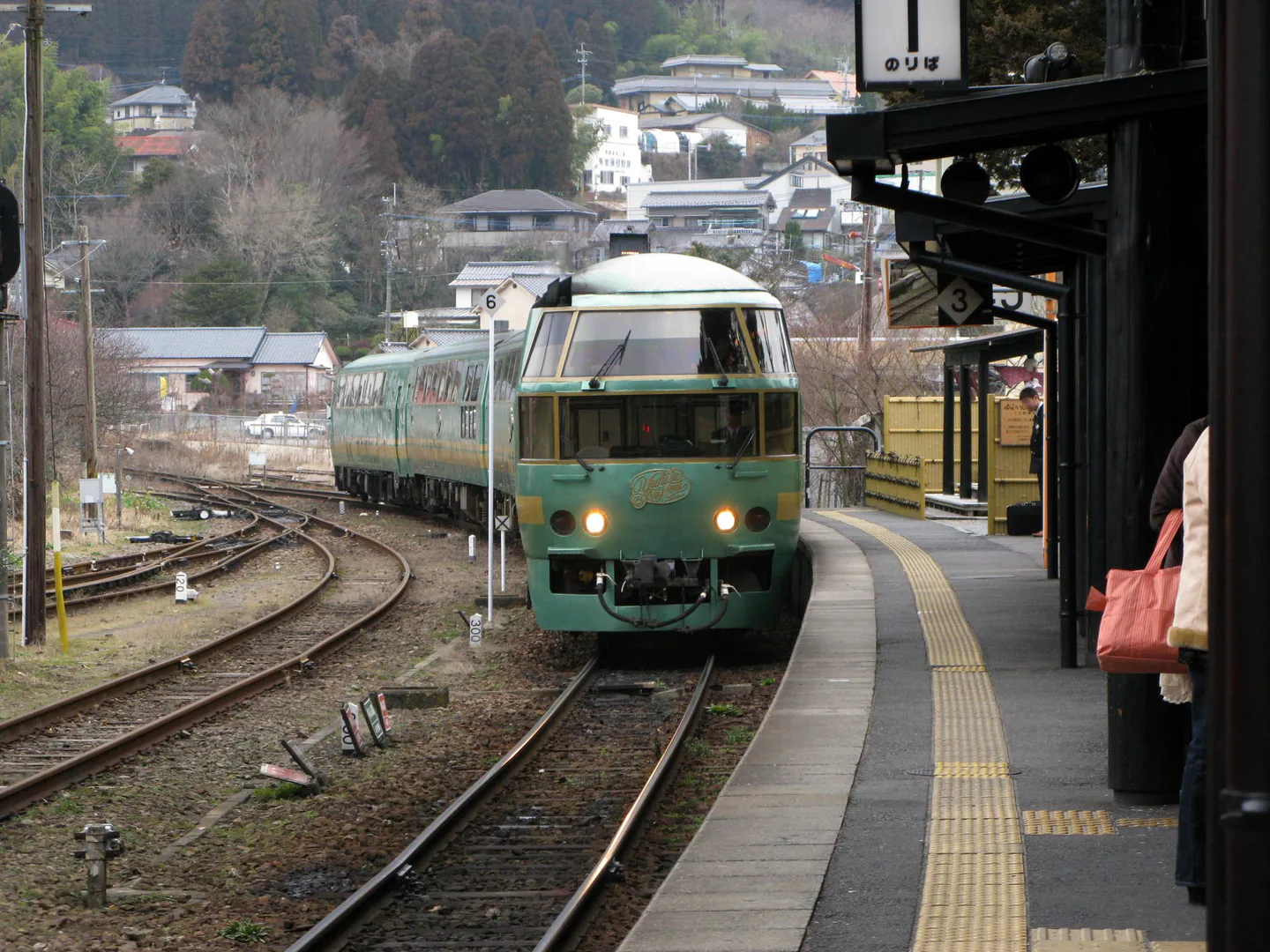
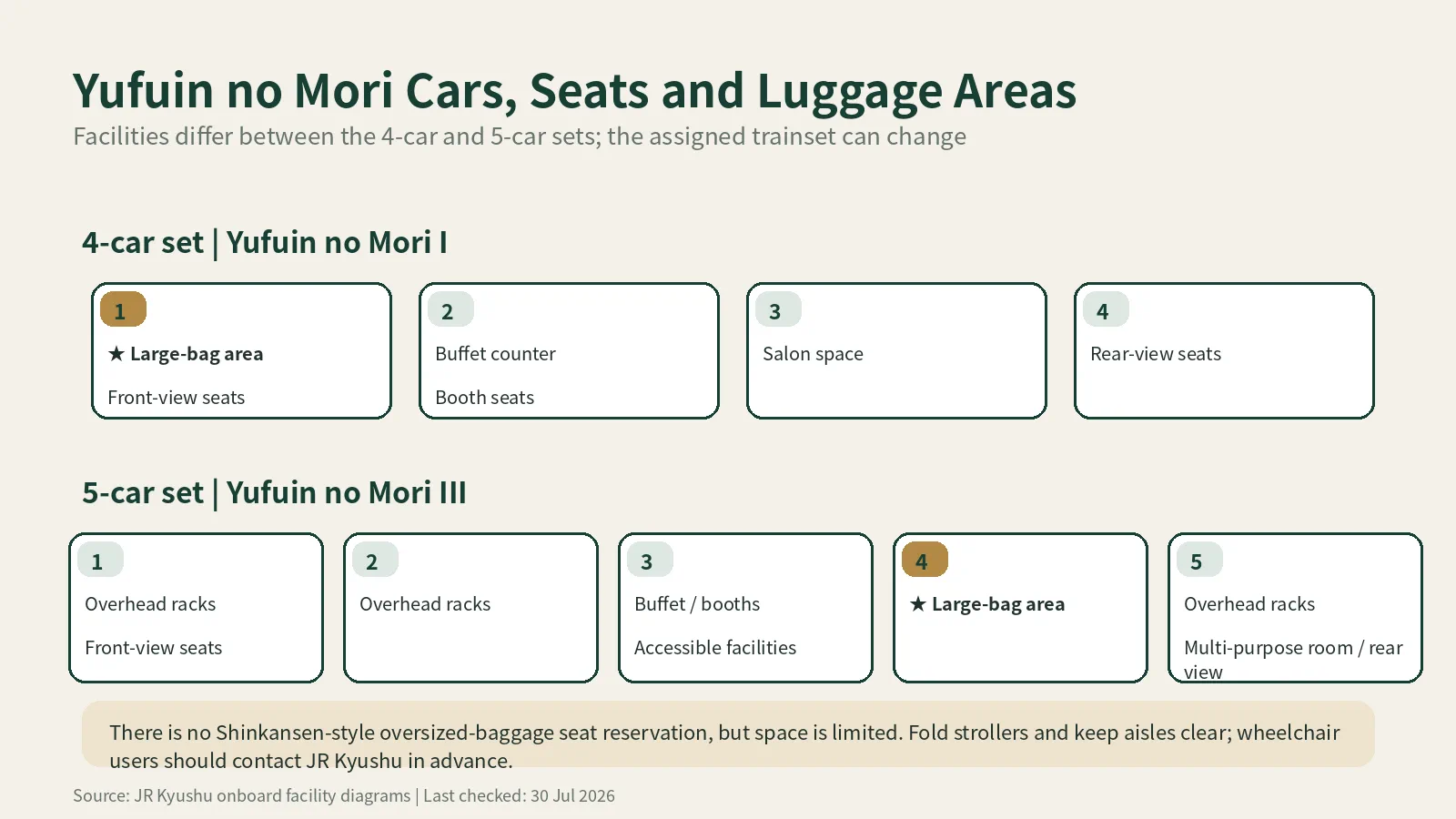
The sets used for Nos. 3 and 4 differ from those generally used for Nos. 1, 2, 5 and 6, and inspection-related substitutions can change a formation. This affects where certain seats and luggage spaces sit. Box seats cannot be reserved through the ordinary rail-pass online seat flow; arrange the particular seat product with a ticket office. The train's raised floor and narrow passages also make wheelchair access a matter to discuss with JR staff before travel, rather than assuming the seat map alone answers it.
For a family or pair with one large suitcase each, the practical priorities are boarding without a rush and using the train's designated spaces without blocking the aisle. A seat booking is not a private luggage reservation. If your bags would make a short ryokan stay cumbersome, forwarding the largest case may simplify the whole Hakata–Yufuin–Beppu route, provided delivery timing matches the hotels.
When the first train sells out
If your first choice is unavailable | What remains useful | What you surrender |
Another Yufuin no Mori departure | The sightseeing-train experience | Your preferred arrival or departure hour |
Limited express Yufu | The direct Hakata–Yufuin corridor | The Yufuin no Mori interior and service |
Sonic towards Oita, then local travel | Another rail route to the area | A longer journey and at least one change |
Yufuin-go highway bus | A different direct option if seats remain | Road-delay exposure and a separate booking |
Decide what you are unwilling to lose. If the train itself is the attraction, another Yufuin no Mori departure may be better than the ideal hotel arrival time, as long as dinner remains safe. If the overnight is the central event, a Yufu service or bus that protects check-in may be the better choice. The train's name should not take priority over a paid room and a meal you cannot move.
The bus is not an unlimited backstop: it has its own seat inventory and road conditions. The Sonic route through Oita can work when direct inventory is poor, but it involves a different journey and onward rail. Our Fukuoka–Yufuin transport comparison places the rail, bus and car options on the same itinerary, including what each does to the arrival day.
A stop in Hita changes the ticket plan
Hita can make the corridor more interesting, but a reserved Hakata–Yufuin seat does not let you step off for several hours and reboard a later train in the same seat. Build the trip as two travel segments, then check that the second one has availability. The romantic idea of a spontaneous stop is less useful when the service is fully reserved and the evening ends with a fixed ryokan check-in.
For a day that genuinely splits at Hita, the Hita-to-Yufuin itinerary and luggage-routing guide cover the ground between the two bookings. Decide where the larger bags will be during the stop before treating it as free sightseeing time.
Collect the right ticket before the rush
Some online purchases still require physical ticket collection at an eligible JR Kyushu counter or machine. The card, booking reference or pass documents needed depend on the channel used. If you land late and plan to catch a morning Yufuin no Mori, look up the collection location and its operating hours in advance; the earliest part of departure morning is a poor time to discover the machine does not accept your purchase method.
For an ordinary JR-KYUSHU Train Reservation purchase, bring the same payment card, the five-digit reservation number and the four-digit identification number chosen at booking. A pass booking has different collection documents. Collect at an eligible machine or ticket office before boarding; a confirmed online payment by itself is not the paper ticket required for that channel.
A good reservation has four parts: a train operating on your date, seats for everyone travelling, an arrival that fits the stay, and a pickup or pass process you can actually complete. When one part fails, change the journey before paying for the others. The September 2026 restoration makes more departures possible again, but it does not remove the need to check the exact service and seat.
Fit the train into the rest of Kyushu
If Yufuin is one night on a larger route, compare Hita, Yufuin and Beppu in three days with Fukuoka or Yufuin for the extra night. The Yufuin ryokan guide helps set the dinner and bath priorities that should determine arrival time. In autumn, the Lake Kinrin guide explains why an overnight can matter more than a day trip. If the other night belongs in Beppu, use the two-town stay decision before settling the rail sequence.
Beyond this corridor, the five- or seven-day Kyushu plan, regional pass comparison, Beppu two-day route and Beppu bath guide help decide what this train connects to. Book the seat as one piece of that route, not as an isolated trophy.
If the train is bringing you in for a night rather than a return ride, compare Yufuin rooms for the train’s arrival date after checking how luggage and dinner fit around check-in.