
With USJ Halloween 2026 already under way, the useful date question has narrowed. The broader autumn event runs through 8 November; Halloween Horror Nights runs from 11 September through that same closing date. As of 24 October, ordinary midweek candidates still include 27–29 October and 4–6 November. Halloween weekend, the 1–3 November holiday period and the final 7–8 November weekend remain choices for visitors who specifically want the intense late-season atmosphere or have fixed leave. None of those labels predicts a queue length.
The park publishes event periods, opening hours, ticket inventory and Universal Prime Annual Pass: Standard blackout dates. It does not publish a reliable day-by-day attendance forecast. Use the published dates to remove hard conflicts, then compare the same Studio Pass, Express product and hotel terms across two or three actual days. The 2026 Halloween programme guide can identify the experience worth protecting; this article deals with the date that gives it room.
Which remaining 2026 dates deserve a first look?
On the park's current Standard-pass calendar, 23–26 and 30–31 October, then 1–3 and 7–8 November are blackout dates. A blackout is a useful caution, not a claim that Annual Pass holders disappear: USJ also offers an eligible discounted 1-Day Studio Pass to Standard holders for 2026 blackout visits. The restriction signals an operating and demand consideration, but availability, special events and each group's priorities still decide the day. The table records the practical choices still ahead, while preserving the old comparison of ordinary, blackout, holiday and closing profiles.
↔ Scroll table left or right
| Remaining date shape | 2026 dates to compare | Reason it may fit | Question before buying |
|---|---|---|---|
| Ordinary late-October weekdays | 27–29 October | No Standard-pass blackout listed for these dates | Do ticket, Express windows and hotel price suit the visit? |
| Halloween weekend | 30–31 October | Late-season mood is the point of the trip | Are you willing to pay for the exact product and tolerate less flexibility? |
| Holiday and blackout continuation | 1–3 November | Fixed leave or a holiday atmosphere | Can the group accept demand and hotel/transport constraints? |
| Midweek near the finish | 4–6 November | Another set of dates outside the listed blackout blocks | Are your must-do experiences operating at usable times? |
| Event closing weekend | 7–8 November | Last opportunity for this year's programme | Does last-chance value justify reduced date flexibility? |
An unblocked Tuesday can still be crowded; a blocked Saturday can still be the right day for a visitor who values costumes and energy more than a low-stress first visit. The comparison is between complete days, not between weekday names. A day with unusable Express entry times, a hotel far from the needed return line or an age-restricted must-do can lose to a theoretically busier day. Express Pass value depends on the actual windows available to buy, not on a generic crowd forecast.
What the blackout calendar can and cannot tell you
For the whole 2026 Halloween run, USJ's Standard Annual Pass exclusions include 12–13 and 19–28 September; 3–5, 10–12, 17–19, 23–26 and 30–31 October; and 1–3 and 7–8 November. Most of those dates have already passed. They explain why a simple “all weekdays are easy” rule was misleading: 21–25 September and 23/26 October sat inside exclusion runs despite their weekday labels. For a new booking on 24 October, focus on the remaining blocks and current inventory.
USJ currently allows eligible Standard-pass holders to buy a 50%-discounted 1-Day Studio Pass for blackout-date visits between 12 September and 31 December 2026 under its stated conditions. Do not interpret the exclusion as proof that those guests cannot enter by any means. Nor can the date-based Studio Pass price be translated into a precise crowd number; it is a commercial signal. If two candidate dates otherwise fit equally well, compare an unblocked weekday first and then look at the same Express product and room terms. The ticket and Express guide helps distinguish admission from timed access.
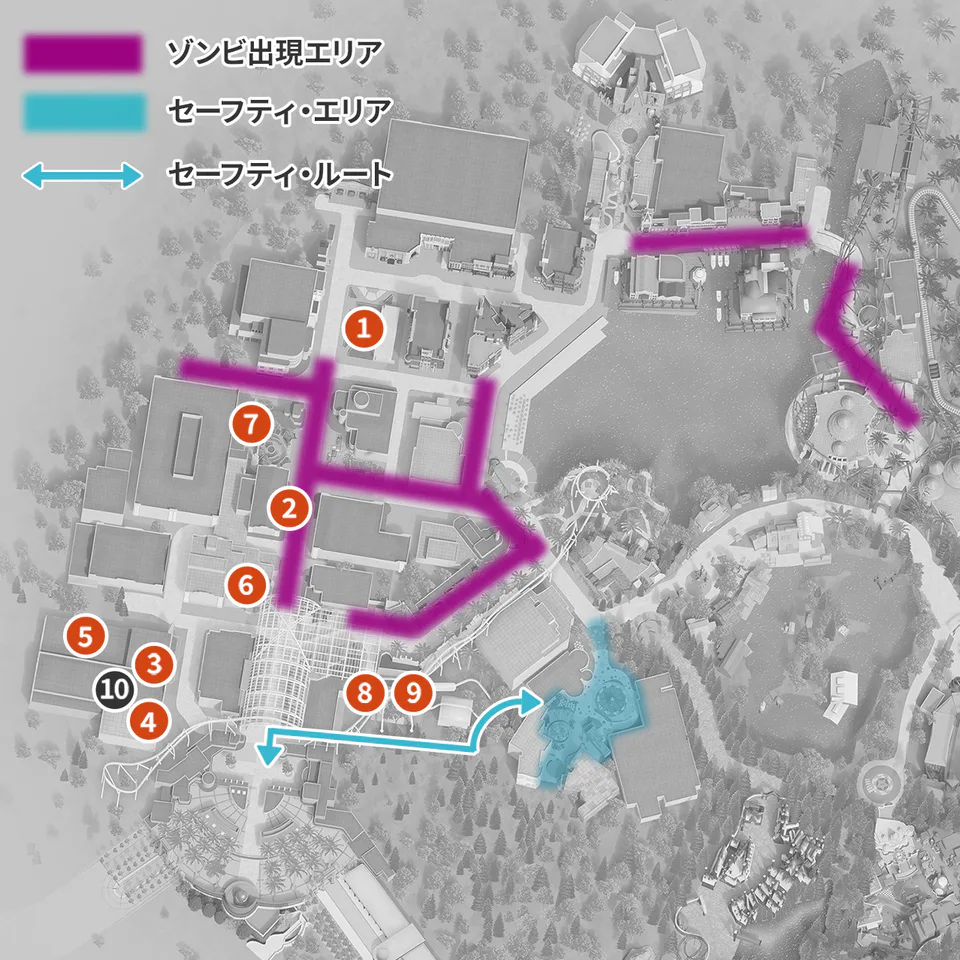
The map image below uses purple to mark zombie appearance zones and blue for a safety route. Its Japanese labels concern movement inside the park, not the expected crowd on a particular date. For a family, knowing where the Halloween activity occurs can be more consequential than choosing between two unblocked days. The children’s Halloween route covers where to avoid the horror intensity.
September's All-Night event is over
Friday 25 September 2026 was a special Halloween Horror Nights: All Night product from 22:00 until 05:00 the next morning. It required a separate ticket, did not admit guests under 18, and ordinary day-pass visitors had to leave before the overnight period. This was never an ordinary “busy Friday” on the same scale as a daytime visit. It has now finished, so do not use a currently displayed historical product page as a bookable option for late October or November.
For a later-year planning comparison, the lesson is about category. A separately ticketed overnight event changes sleep, luggage, hotel-use and age rules. A room beside Universal City may be valuable for a shower or next-day recovery but can sit unused during its usual evening hours while a guest remains inside the park. In 2026 that calculation belonged specifically to 25 September. The All-Night explanation can be read as a record of that event, not as a current checkout route.
The ordinary Horror Nights programme still has age guidance. USJ says its overall night event is not recommended for guests aged five or younger, and children aged 12 or younger require parental consent. Individual attractions can have different restrictions, including an R-18 experience. A date is poor value for a group whose one hoped-for attraction is unavailable to someone in the party. The attraction-by-attraction age guide should be checked before paying for scarce time windows.
Compare five signals on the same screen
Park hours and event operation: Inspect the schedule for the exact date, including Halloween-specific start times and any special paid event. A late return plan depends on the actual closing hour, not on the event period written across a poster. A one-day park sequence helps expose collisions between meals, timed entries and evening horror.
Studio Pass and Express price: Compare the same admission category and the same Express bundle on each candidate day. A cheaper Studio Pass paired with poor Express windows may not serve the attraction list. Express availability is not a direct attendance estimate either: products can sell out for their own supply reasons. Look at the windows you would actually accept, not just the presence of a green purchase button.
Blackout and holiday pressure: Mark the published Standard-pass exclusions and Japanese holiday calendar as context. The 1–3 November block has a different travel shape from an ordinary Wednesday, but it cannot tell you exactly how long a particular queue will be. A photographer who wants stronger costume participation may willingly choose a more intense day; a first-time family may place more value on an earlier finish and easier movement.
Hotel inventory: Compare several real rooms using the same guest count, dates, cancellation terms and final tax/fee treatment. A cheap Universal City room does not prove the park is quiet, and an expensive one is not an attendance counter. A hotel next to the park earns a premium when the late return matters; Namba or Umeda can make more sense when the other Osaka days dominate. The Universal City, Umeda and Namba comparison is a location decision, not a crowd forecast.
Weather and journey home: On a date weeks away, buy flexibility rather than pretending a precise forecast exists. In the final week, add weather alerts, transport notices, attraction changes and the actual last return. A date that looks better on ticket price but forces the group to leave before its chosen night content is the wrong date for that purpose. The Universal City last-train guide shows how a final attraction can become a rail decision.
A park-side room changes the late evening
Universal City accommodation is most compelling when walking back after Horror Nights saves a crowded rail transfer. It is less automatically useful on a short daytime visit when the rest of the Kansai stay is based in central Osaka. Compare the cost of keeping one Namba or Umeda hotel for several nights against moving solely for USJ. The correct rate comparison includes occupancy, room size, check-in, luggage and cancellation, not just a nightly headline price.
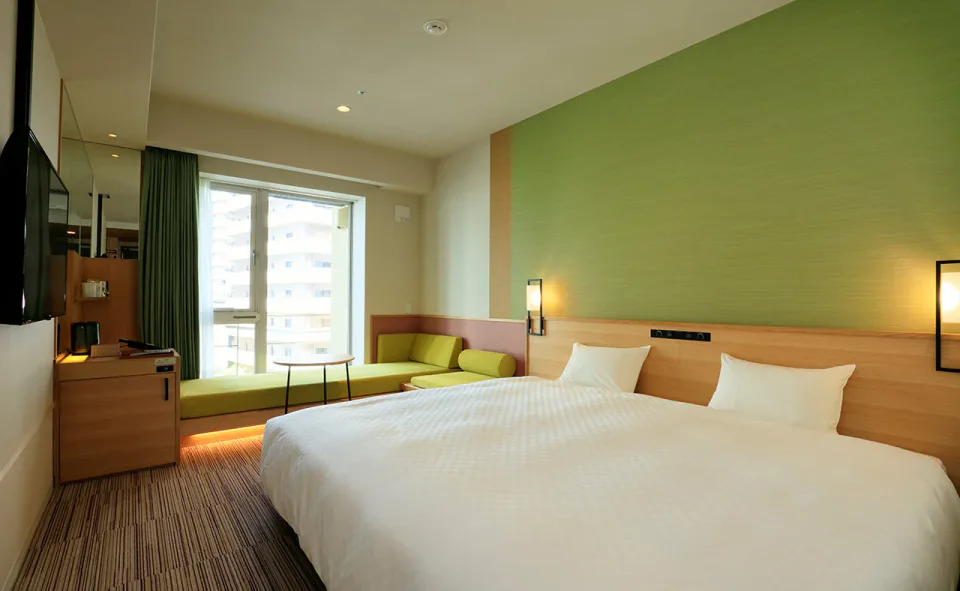
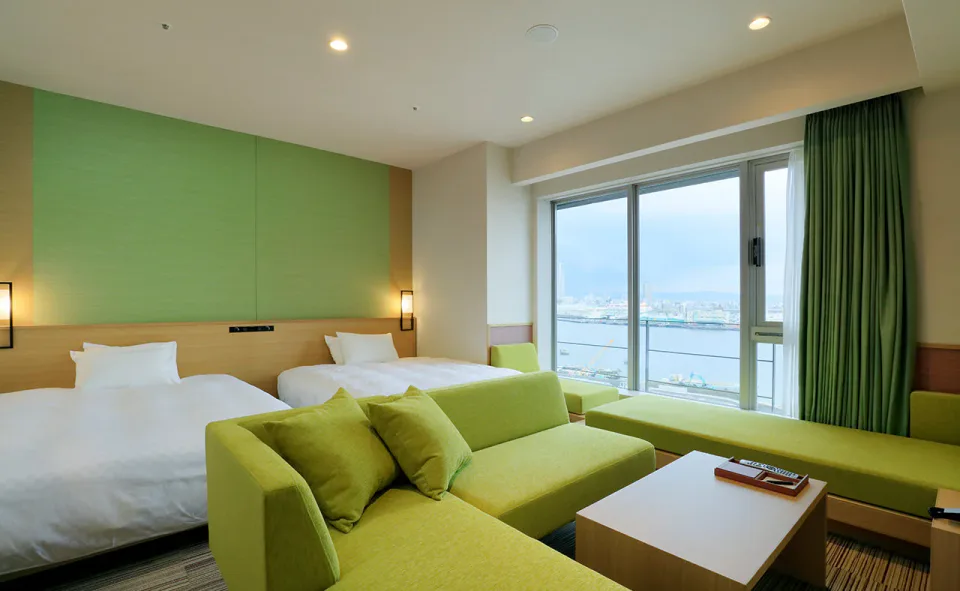
These are two different room layouts shown for a park-area accommodation comparison: a double bed with window seating and a twin arrangement with extra lounge space. Neither photograph tells you the Halloween room rate or whether the selected date remains cancellable. THE SINGULARI hotel review is useful if park proximity is already the deciding feature. Compare rooms around Universal City on your chosen night with the same guest count and cancellation conditions.
The rest of the trip should still have a vote. On a four-night Osaka stay, a slightly longer USJ return may be acceptable if central accommodation reduces travel on the other three days. Travellers visiting Kyoto should check whether a hotel move is being driven by one park date rather than by the whole Kansai route. Namba versus Umeda and Kyoto versus Osaka place the park day in the wider itinerary.
Buy the day that survives the real constraints
Begin by removing dates impossible because of flights, fixed hotels or age limits. Pick two unblocked weekdays that suit the trip and add a Halloween or closing weekend only if that atmosphere is genuinely valuable. Compare matching Studio Pass and Express products, then check nearby rooms and return transport. For a family, include the ability to exit before the strongest horror programme. For an adult fan, make sure the selected horror experiences are included in the ticket or bundle being purchased.
As the date approaches, revise with real information. Around a month out, protect a flexible hotel rather than lock every component at once. A couple of weeks out, compare the same available ticket and room products. During the final week, let the weather, transport and operator notices refine the plan; the evening before, verify QR codes, assigned times and the route home. These are sensible planning intervals, not USJ deadlines. A wider Japan route can reveal when protecting one theoretical park date harms Kyoto, Nara or a departure day more than it helps USJ.
For most first visits still being booked on 24 October, compare 27–29 October or 4–6 November before committing to the Halloween or closing blocks. Use the later peak dates when the specific atmosphere, fixed leave or final chance is worth the trade. Check current ticket, Express and hotel inventory before paying. A date has earned the booking when the programme, age rules, assigned windows, accommodation and ride home all work for this group; a claimed “quietest day” cannot substitute for those checks.