
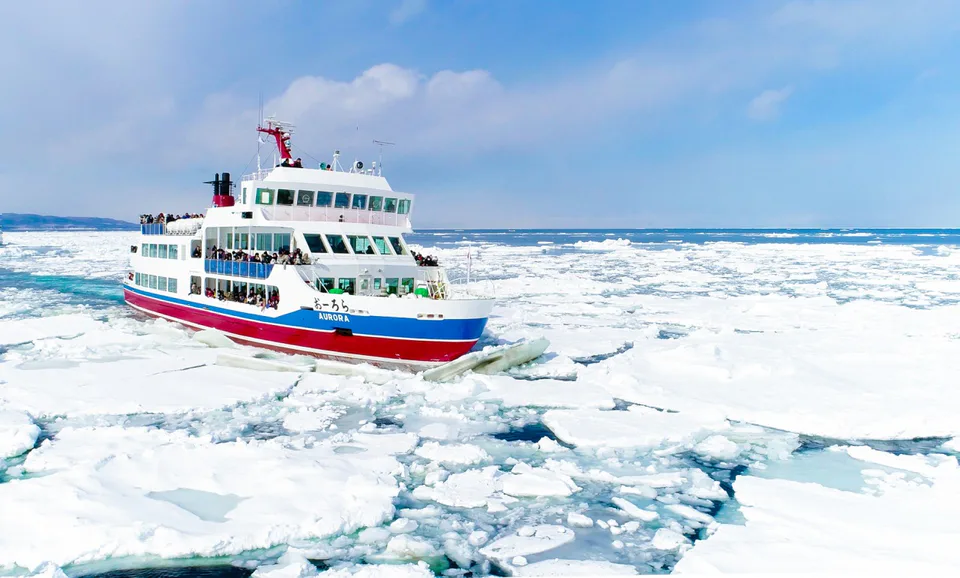
For a 2027 drift-ice cruise, choose the port that fits the eastern Hokkaido route before comparing boat fares. Aurora departs Abashiri, a natural stop for a journey through Memanbetsu Airport and Shiretoko. Garinko III IMERU sails from Monbetsu. Its adult ticket is ¥2,000 less on the currently displayed fares, yet the operator says there is no direct bus from Memanbetsu Airport to its terminal. A cheaper hour at sea can therefore add a much larger detour on land.
The two operators have now moved beyond the old 2026 season information. Garinko has published a 15 January–31 March 2027 winter season and opened reservations on 9 October 2026. Aurora's status notice says telephone reservations for 2027 began on 15 October, with web reservations planned for early November; the exact web start can change. The published Aurora fare page shows ¥7,000 for the large ship and ¥9,800 for Aurora III, but check the selected sailing and booking screen when you pay. Neither operator can promise that drift ice will be near the ship on your day.
↔ Scroll table left or right
| Your trip shape | Best starting point | Why it fits |
|---|---|---|
| Memanbetsu, Abashiri or Shiretoko already on route | Separate large Aurora ticket | Add the cruise to an eastern Hokkaido stay instead of buying another long transfer. |
| Monbetsu or the northern Okhotsk coast already planned | Garinko III IMERU | The lower fare also aligns with the route. |
| Still sleeping only in Sapporo | Price a two-day transport package | Its value lies in handling winter distance and an overnight, not in stronger ice. |
| Four to eight people with several eastern stops | Request a vehicle quote | Shared cost and one luggage plan may replace several transfers. |
| Five-day trip already full of Sapporo, Otaru and skiing | Leave this cruise out | An hour on the water cannot recover the lost regional travel days. |
Hokkaido's regional route guide helps decide whether the Okhotsk coast belongs in the trip at all. If it does, the boat can be a rewarding one-hour element within a broader stay. If it does not, a 2027 sailing should not be forced into a short Sapporo holiday merely because a ticket is available.
Abashiri and Monbetsu are different gateways
The large Aurora's current fare page lists an adult offshore cruise at ¥7,000 and about one hour, with an operating period of 20 January–31 March. Garinko's live 2027 booking page lists ¥5,000 for an adult, about one hour and daily service from 15 January through 31 March. The ¥2,000 difference is meaningful for a family, but it is only one line of the journey budget. Travel to the right harbour can outweigh it.
↔ Scroll table left or right
| 2027 planning comparison | Abashiri Aurora | Monbetsu Garinko III IMERU |
|---|---|---|
| Displayed adult fare | ¥7,000 large ship | ¥5,000 |
| Usual duration | About one hour | About one hour |
| Published winter window | 20 January–31 March on fare page | 15 January–31 March 2027 on booking page |
| Gateway logic | Abashiri, Memanbetsu Airport, Shiretoko | Monbetsu and northern Okhotsk coast |
| Main planning mistake | Treating a far-east sailing as a Sapporo side errand | Detouring from Abashiri only to save the boat fare |
Aurora's access information connects its harbour with Abashiri Station and Memanbetsu Airport by direct bus. Garinko's FAQ states that no direct bus links Memanbetsu Airport to its facility; using several ordinary rail and bus connections can take four to five hours one way, while a seasonal express bus or road transport may be available. This makes Monbetsu sensible when it is already a destination, not a substitute Abashiri pier. Check winter express-bus dates before building a self-guided route around one. The car-free Hokkaido winter route shows why each eastern transfer matters more than a small fare difference.
Flying into one Hokkaido airport and out of another can make a long regional route more coherent than returning to Sapporo; the open-jaw Hokkaido itinerary explains that broader decision. A late arrival at New Chitose can also consume the transfer day before any eastbound travel; its airport-versus-city overnight comparison is relevant when flights frame the cruise.
Do not read a winter operation window as a guarantee of ice. The ships can only encounter what wind, current and temperature bring within their sailing time. Garinko says a booked passenger may see no drift ice. Aurora says even a sailing on an ice day may not reach the ice band within the hour. The usual high-probability period is roughly mid-February to early March, but both operators caution that the pattern changes. A wildlife sighting is an additional possibility, never part of the purchase promise.
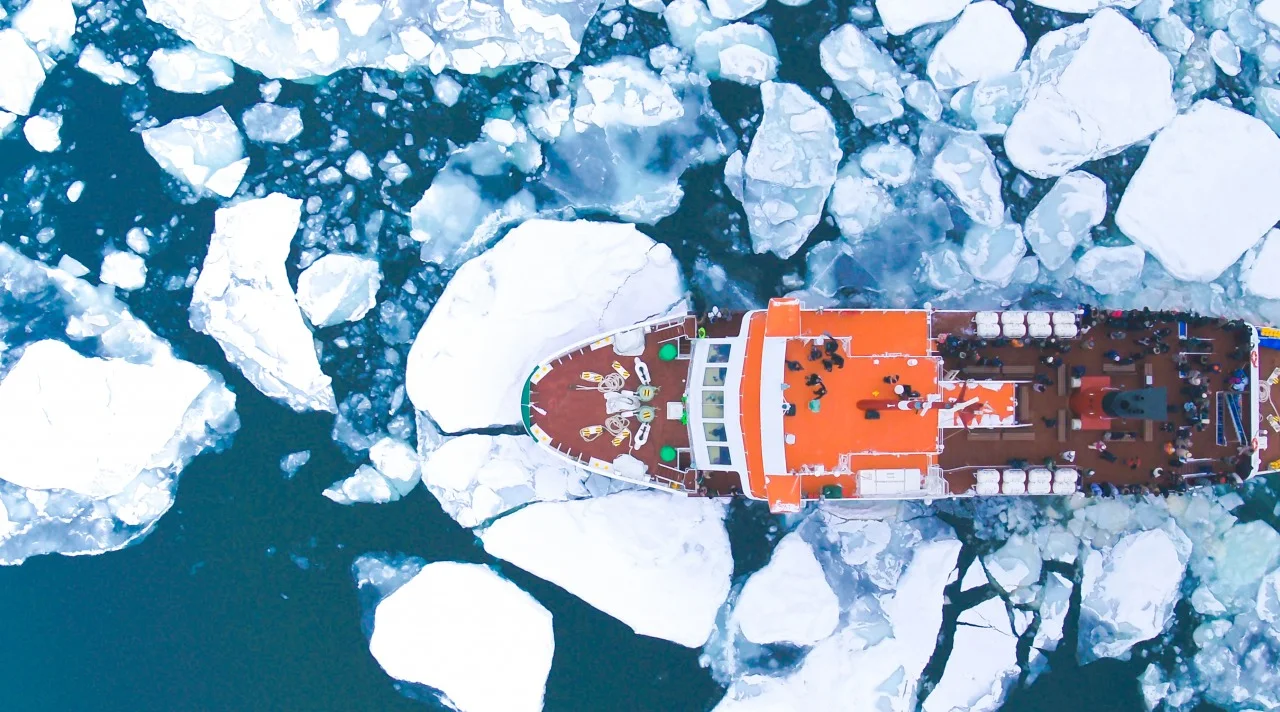
The overhead photograph shows a vessel amid separated ice floes. It illustrates the shifting sea surface; it cannot predict the density or position of ice on a future departure. Other non-ski winter activities give a regional stay something to do if the sea conditions change.
Aurora III buys sea time, with tighter conditions
The small Aurora III is a different ticket, not simply a better seat on the large ship. Its published adult fare is ¥9,800, ¥2,800 above the large Aurora, and the route is about two hours rather than one. The posted schedule has fewer departures. Aurora says the small vessel does not operate when drift ice is absent; the large vessel instead may run a sightseeing route toward Cape Notoro. If a traveller has only a narrow Abashiri stop, the large ship's additional departures and no-ice alternative make it the safer baseline.
Aurora III is worth pricing when the extra hour at sea is itself the purpose and an overnight gives room for a conditional departure. Do not equate its smaller size with a calmer ride. Aurora describes the large ship as comparatively stable, yet its FAQ warns that rougher conditions can still make it roll. A motion-sensitive passenger should compare the length and exposure of the one-hour and two-hour products. The company does not sell motion-sickness medicine on board, so anyone who normally relies on it should arrange it before arriving at the quay. A Shiretoko drift-ice walk is a separate guided activity if being on the ice, rather than spending longer at sea, is the actual goal.
The vessel's indoor space does not remove the cold on an observation deck. Aurora's preparation guidance describes roughly −10 to 0°C before the additional wind over the sea; Garinko gives a broad −15 to 0°C winter range. Gloves, protected ears and a warm outer layer are useful if the deck view matters. These ranges describe typical conditions in the operators' advice, not a forecast for any selected sailing. The large ship also has indoor space, toilets and a shop; the smaller Aurora III has fewer facilities. Check access requirements if stairs or a wheelchair matter, because the vessels differ substantially.
One Abashiri night creates a better weather buffer than two reservations
A workable Aurora plan reaches Abashiri the previous afternoon, sleeps locally and books one first-choice sailing the next morning. Keep later local time or the following morning free if the overall route allows it. The terminal is at Roadside Station Ryuhyo Kaido Abashiri; Abashiri Prison Museum, the Okhotsk Ryuhyo Museum and Kitahama Station can fill a day without making the entire stop depend on an ice sighting. An onward Shiretoko leg can give the eastern stay a second focus.
The operator asks passengers not to reserve multiple sailings merely as a private hedge against weather or missing ice. Holding two seats reduces availability for others and creates avoidable late cancellations. The better hedge is an extra block in the region, while booking only the departure you intend to take. Aurora usually decides whether a ship will operate about an hour before departure, although fast-changing sea conditions can produce a later cancellation. It does not telephone every reservation holder individually. Check the day's operating page yourself before setting out.
When the operator cancels, its FAQ says you need not cancel that booking manually; eligible prepaid partner or card bookings are handled through the relevant channel and card cycle. No drift ice in sight is a different event. The large Aurora may still sail toward Cape Notoro, so “no ice” does not automatically mean that the boat was cancelled or that a fare will be returned. Garinko's 2027 terms also state that deciding to cancel because ice is absent can incur its normal cancellation charge. Read the selected booking conditions before committing to a non-refundable hotel or flight.
A five-, seven- or ten-day Hokkaido plan is a useful reality check: an eastern overnight needs space on the calendar. Winter-road precautions matter if you intend to reach Abashiri by car; a paid cruise cannot make a whiteout drive sensible. Partial versus full-trip rental may let you use rail or air for the longest section and drive only where it solves local movement.
What a Sapporo two-day package is actually buying
From a Sapporo base, a two-day guided or self-guided package can remove a complicated series of transfers, hotel decisions and local movements. It does not buy denser ice. Compare its price with an open-jaw or return transport plan, one Abashiri hotel night, the separate cruise fare, local buses or taxis, and the value of two days taken from Sapporo. If the city stay was only three nights, this is not a small day trip; it becomes the main excursion. The Sapporo night-count guide helps expose that trade-off.
Travel time and winter transfer risk are the legitimate reasons to pay for a package. Ask whether the itinerary states its cruise operator, ticket inclusion, accommodation standard, pickup point and response to a weather cancellation. A package that leaves those open has not solved the crucial uncertainty. Sapporo versus Niseko nights and the final airport night can also change how much city time is truly available.
If you would rather reach the coast independently, compare Abashiri rooms for the cruise night with the ship departure time and the next day’s onward transport.
When a private vehicle earns a quote
For four to eight travellers moving together with winter luggage, children or older relatives, a private vehicle may replace several train, bus and taxi changes. It becomes more plausible if the route also links Lake Akan, Abashiri and Shiretoko instead of simply returning to Sapporo after one cruise. Split the total vehicle cost across the party and compare it with individual fares, luggage handling and route flexibility. For two people making only a cruise trip, the premium is harder to defend unless a driver also removes several other transport problems.
Ask for vehicle hours, distance allowance, overtime price, driver language, pickup and drop-off points and how winter road closures change the plan. “Private charter” does not guarantee unlimited route changes. A route that spends much of its allowance crossing Hokkaido may leave little time at the harbour. The general driver-versus-transit cost logic is similar, though eastern Hokkaido's weather and distances need their own quote. A partial winter rental remains another option if only the eastern section needs a car.
Hokkaido charter hours are particularly easy to spend on road time; do not read a ten-hour booking as ten hours at stops. If self-driving instead, the New Chitose rental timing guide helps separate an airport pickup from the later point at which a vehicle is genuinely useful.
Checks before the cruise becomes a fixed booking
Use the 2027 Garinko booking page and current Aurora reservation notice, rather than treating last winter's timetable as current.
Keep a five-day Sapporo–Otaru–ski trip separate from a long eastern detour unless you deliberately remove something else.
Do not pick Monbetsu for a ¥2,000 fare saving when flights and hotels already point to Memanbetsu and Abashiri.
Expect ice and wildlife to vary; neither a boat ticket nor a February date guarantees either.
Reserve only one intended Aurora sailing and make regional time, not duplicate seats, the backup.
Prepare for ship movement and cold decks before boarding; motion-sickness medicine is not sold aboard Aurora.
Abashiri is the straightforward choice when the eastern Hokkaido route already reaches it. Monbetsu works when the northern Okhotsk coast is on the itinerary. A Sapporo-based traveller should first decide whether two eastern days deserve space at all, then choose the transfer format. The current adult boat fare difference is real, but it does not replace a route plan or a weather buffer. Review a car-free winter framework before locking regional hotels and flights.
Further route and operator details
Abashiri Aurora — fares, FAQ, seasickness and sailing-decision · Aurora — duplicate-reservation notice · Aurora current timetable and fare table · Aurora operating-status page · Garinko — winter operation page · Garinko III IMERU — 2026 drift-ice ticket · Garinko FAQ — drift-ice and access guidance · Hokkaido Dog Sledding 2026–27: Tokachi 6km or 10km+ · Best Day Trips from Osaka: Kyoto, Nara, Kobe · Sapporo Ramen Tour 2026: Ramen Alley Is Free · Okinawa Fishing 2026: Shared Boat, Private Charter or · Sapporo Private Ski Lessons: Don’t Compare Hours Alone · Okutama Rafting 2026: Tokyo Full-Day Tour vs Local · Mt Fuji Paragliding 2026: Tandem Flight, Pickup Package · Lake Towada Oirase 2 Day Itinerary: Buses, Walks, · Mt Fuji Private Car Charter from Tokyo: 10 · Sapporo Teine vs Sapporo Kokusai: Which Is Better · AOAO SAPPORO Is Better After Dark — Because · Tokyo Bay Private Cruise 2026: Yacht, Yakatabune or · Kyoto Private Car Charter: 8 vs 10 Hours? · Munakata Shrine & Izu Honten Day Tour: I’d