An overnight sailing from Osaka to Beppu can turn a transfer day into a night on the water. You leave Kansai after sightseeing, sleep aboard and begin the next morning in Kyushu, without paying for another Osaka hotel room. That convenience has a price: the fare, any cabin upgrade, meals and journeys to and from the ports. Compare that total with a daytime train or flight and the hotel night it replaces. If your first Beppu morning has a fixed, demanding booking, the certainty of a proper hotel night may matter more than the hours you save.
↔ Scroll table left or right
Traveller or priority | Cabin to examine | What changes |
Travelling alone and willing to share the sleeping room | Private Bed | The lowest room spend comes with shared space and no view |
Two travellers who want their own shower and toilet | Superior Twin | The surcharge buys a fully private room and bathroom |
A sea-facing window is part of the appeal | Deluxe | Its window is most useful in daylight or around sunrise |
A balcony and a bath are worth a holiday splurge | Suite | Judge the extra room charge as you would at a premium hotel |
A demanding appointment awaits soon after docking | Daytime rail and a hotel | A conventional night's sleep may justify losing daytime to transport |
The ferry departure begins at the port gate
MOL Sunflower's published Osaka–Beppu timetable has Sunday to Thursday departures at 19:05 with arrival at 06:55 the next morning. On Friday and Saturday, the ferry leaves at 20:05 and reaches Beppu at 07:55. Those times describe the ship's journey, not the hour you can walk into the terminal. Check the schedule for your sailing date before arranging your last Osaka afternoon.
Foot passengers should complete boarding procedures 60 minutes before departure. The usual deadline is also 60 minutes for a car or motorcycle, extending to 90 minutes in busy periods; travellers who need assistance or bring pets have a 90-minute requirement. The operator warns that an arrival within 30 minutes of sailing may be refused. If any of those conditions applies, use the earlier deadline printed for your booking rather than assuming the standard foot-passenger rule covers you.
For a 19:05 departure, work backward from 18:05 at the terminal desk and leave slack for the last metro connection. A small delay at Nanko is much less stressful when you have already finished sightseeing and eaten or planned dinner aboard. The ferry is useful precisely because the final Osaka transfer can be routine; a rushed dash across the city cancels out much of that benefit.
Trade Center-mae is the station you need
Osaka–Beppu passengers depart from Sunflower Terminal Osaka Terminal 1, inside the ATC ITM Building. The nearest Newtram stop is Trade Center-mae; allow roughly five minutes on foot after leaving the station, plus whatever time you need to find the boarding desk. Save the terminal name and station in your route app before you leave the hotel.
Do not get off at the stop called Ferry Terminal Station. Its name sounds plausible, but it is not the station for this Osaka–Beppu departure. That one wrong choice can consume the buffer you built into the evening. Follow the operator's Terminal 1 directions through ATC rather than navigating toward a generic ferry icon on a map.
From Namba, Umeda or Shin-Osaka, the trip includes more than one train ride: first reach the Metro route, transfer to the Newtram and then walk from Trade Center-mae through ATC. Count from the hotel door all the way to the boarding desk. There is rarely a reason to move an entire Osaka stay closer to Nanko for one sailing; it is usually enough to leave the final afternoon clear of a distant attraction.
After docking, allow for the journey into Beppu
The ship docks at Beppu Kanko-ko, not beside Beppu Station. Allow time to leave the vessel, collect your things and reach your hotel or the station. The operator's access information puts the station connection at about 15 minutes by bus after the terminal-side walk, or roughly 10 minutes by taxi. The actual door-to-door time will also depend on disembarkation and the local service you catch.
A quiet first morning suits this arrival. Drop your bags, have breakfast, visit a bath or begin with an easy Beppu walk before committing to a longer outing. If you have to collect a car and drive into the mountains at a fixed early hour, consider whether you will sleep well enough on the ferry. An overnight crossing is less forgiving when a restless night immediately affects an activity you cannot move.
Price the cabin against the room you would otherwise book
There is no single year-round ferry price: MOL Sunflower uses fare periods and cabin grades. Private Bed is the starting point, with higher grades adding a surcharge for each traveller. For two people, multiply the upgrade accordingly before comparing it with a hotel. A fare that looks attractive for one berth can tell you very little about the cost of a private room for a couple.
Add up the crossing as part of the whole journey:
Compare the whole journey:
(overnight sailing + selected room + food + port journeys)
minus the Osaka room and daylight transfer avoided
The useful comparison is the total for the crossing after allowing for the Osaka hotel night and daytime intercity journey you avoid. Keep meals and both port transfers in the sum. That prevents a cheap berth from looking deceptively generous if you actually need a private cabin, while also giving credit for the daytime you gain in Kyushu. Use current fares for your dates; the arithmetic matters more than a headline fare from another season.
What each cabin upgrade changes
Private Bed is a berth in a shared Western-style room. It suits a traveller who wants to keep the crossing cost down and can sleep with less privacy. Think of it as practical overnight transport, not a hotel room at sea; you will use shared facilities and may hear other people moving about.
Private Single and Private Twin give you a more separate sleeping space, but check the exact cabin specification before assuming you have a lockable room with your own bathroom. The name signals privacy relative to a shared berth; it does not automatically provide the facilities of a conventional hotel room.
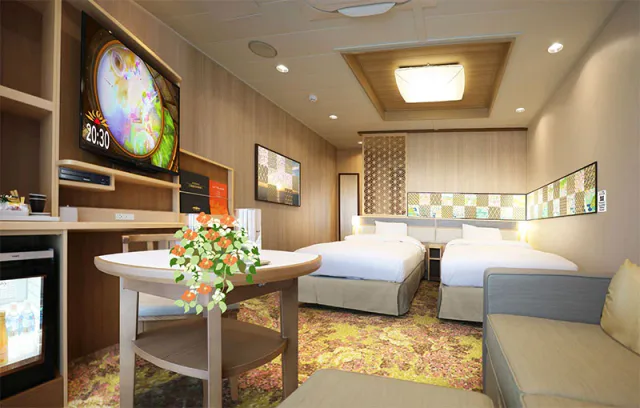
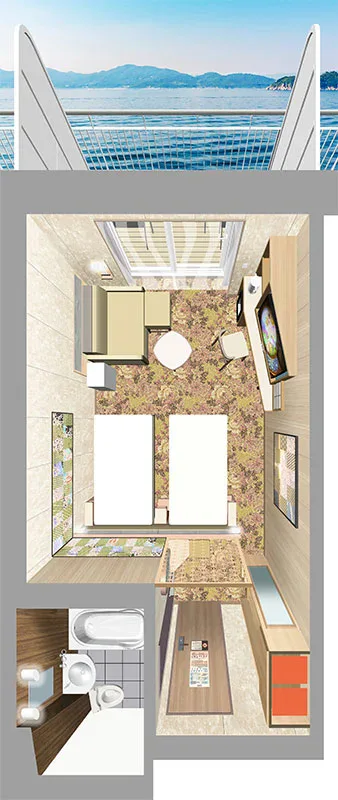
Superior Twin is the first clear step toward a hotel-style room for two, with a private shower, toilet and washbasin. It has no sea-facing window, so the extra money buys practical comfort rather than a view. For a couple who wants to sleep behind a closed door and wash without using the shared facilities, this may be the most useful upgrade.
Deluxe adds an ocean-side window to a private room. Consider how much time you will actually spend in the cabin while there is daylight. If you plan to eat, bathe and turn in soon after departure, you may use that window mainly at sunrise; check the sailing season and whether that is enough to justify the surcharge.
A Suite brings a balcony and private bathtub. It is an experience purchase as much as transport, particularly on a crossing where much of the voyage is overnight. Compare its extra cost with what you would pay for a similar upgrade in a land hotel. If the balcony and bath are the reason you want the ferry, the choice is easy to understand; if you only need a good night's sleep, a less elaborate cabin may serve you better.
Leave enough of the night for sleep
The public bath is included in the fare. On Osaka-to-Beppu sailings, evening bathing is scheduled from boarding until 22:30. The morning session begins at 05:15 for Sunday to Thursday departures and 05:45 for Friday and Saturday, continuing until the ship arrives. Onboard announcements can change operating hours, so listen for the schedule once you embark. Bring what you need for a quick visit rather than unpacking the whole suitcase.
Dinner and breakfast buffets are optional purchases. Breakfast, a last bath, dressing and packing can all fall into the short period before the 06:55 arrival. Choose what will actually help you start the Beppu day well. You might eat breakfast aboard and skip the second bath, or sleep longer and eat on land after disembarkation. Trying to use every facility is a poor bargain if it leaves you tired.
People who sleep lightly or become seasick should be especially selective about the evening. A simple meal, a settled cabin and an early night may do more for the next day than a full circuit of ship facilities. The useful outcome is reaching Beppu with most of the previous day intact and enough energy to enjoy the morning.
Pack for one night, even if your suitcase is larger
Put medicine, chargers, toiletries, sleepwear and a change of clothes in a bag you can reach as soon as you board. Keep the main suitcase closed if possible. That makes the cabin easier to use and avoids repacking a week's belongings before an early arrival. Travelling with a car or a large group may change the details, but the one-night bag is still the simplest way to settle quickly.
If the wider journey already has several heavy travel days, the Japan luggage-forwarding guide can help you decide which bags to send ahead instead of carrying each one onto the ship.
When the train is the better choice
A fixed early Beppu commitment is the strongest reason to travel by day and sleep in a hotel. The ferry can be comfortable, but sleep at sea is harder to predict. If the next morning involves a long drive, an expensive reservation or a tight onward connection, treat rest as part of the transport decision.
A high private-cabin surcharge can also tip the calculation. One traveller in a Private Bed and two people in a Suite are buying very different nights. Put the complete fare beside the hotel and daytime transport you would otherwise use, rather than comparing a luxury cabin with an economy rail ticket alone.
Finally, consider what you give up in Osaka to reach Nanko. The port transfer can take a substantial piece of the last afternoon from a city-centre hotel. If that time would have held an important Kansai stop, the apparent saving of a daytime transfer shrinks. The ferry works best when Osaka sightseeing is already complete.
Who gets the most from this crossing?
The Osaka–Beppu sailing makes particular sense when your Kansai visit is ending and eastern Kyushu is the next destination. It removes a hotel checkout and a daytime long-distance journey in one move. Private Bed keeps the route economical; Superior Twin provides a private room and bathroom for two. Deluxe and Suite are best chosen because you actively want their view or balcony, with the full surcharge included in your comparison.
Before booking the rest of the trip, look up your sailing date, plan to reach Terminal 1 via Trade Center-mae before the boarding deadline, and leave the first Beppu morning open enough to absorb a poor night's sleep. Those three details determine whether the crossing feels like useful travel time or an exhausting extra transfer.
For the morning after the sailing, compare places to stay in Beppu around your planned arrival and onward transport; the cabin is already your bed for the crossing.
MOL Sunflower route details
For the sailing you plan to book, consult MOL Sunflower's route timetable and boarding information, terminal directions, cabin descriptions and onboard facilities. Timetables, fares and onboard services can vary by date; use the details shown for your own departure.
Related guides: Miyajima Food Guide: Oysters, Anago Rice and Momiji Manju · Free and Cheap Things to Do in Osaka: A ¥3,000-a-Day Sightseeing Plan · Osaka Attractions: Stop Ranking Sights and Start Grouping Neighborhoods · 10 Days in Japan: Tokyo, Kyoto and Osaka Without Turning the Trip Into a Transfer Marathon · Osaka Hotels for Kyoto and Kobe Day Trips: When 3–5 Minutes to the Station Matter Twice a Day · Kyoto Hotels Sold Out in Autumn? Backup Bases in Otsu, Uji, Nara and Osaka · Hotel Torifito Hakata Gion Review: Is a 23 m² Twin and Public Bath Worth Leaving Hakata Station? · Osaka Long-Stay Hotels for 5–7 Nights: Laundry, Kitchens and When Not to Change Areas · Big Tamagotchi Exhibition Osaka Guide: Sold-Out Tickets, Timed Entry and Umeda Access · Osaka Autumn Leaves Guide: Minoh Falls, Osaka Castle and City Day Trips
Best Japan eSIM for Tokyo, Osaka and Kyoto: Data and Hotspots
Osaka Castle Cherry Blossoms: Nishinomaru, Castle Tickets and Night Viewing
CANDEO HOTELS Osaka The Tower Review: SkySpa, Rooms and Access
Naoshima E-Bike Guide: Rental, Art Island Route and Ferry Timing