
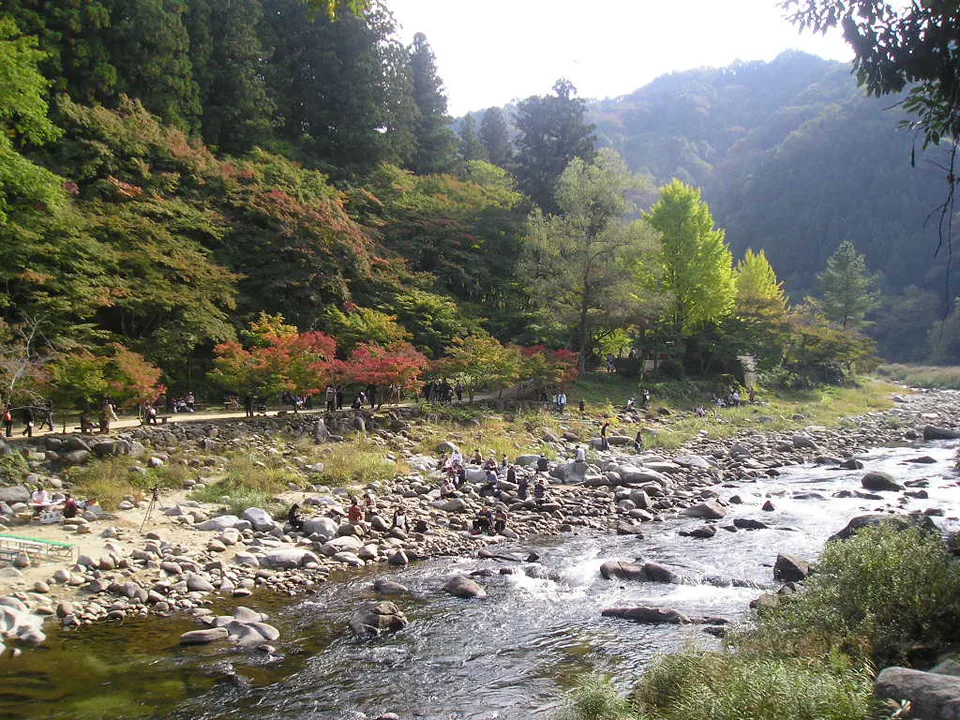
Korankei earns a full autumn day from Nagoya when the river gorge and Asuke townscape are the reason to travel. The gorge itself is free to enter, but the final road and bus queue can turn a short map distance into a long return. Leave a generous gap before any reserved train, flight or dinner. For a first visit, daylight gives enough time for the bridge, river path, hillside and old town without making a late bus the critical event of the day.
Night lighting is a different itinerary. It makes sense for a photographer or anyone who specifically wants the trees above the river after dark; it asks for a carefully checked final bus and train combination. Families who dislike standing in a queue, or travellers with a hard evening commitment, will usually enjoy the gorge more by arriving early and leaving before the illuminated return wave. An autumn rail outing closer to Nagoya may be a better fit when the schedule cannot bend. See the Mt. Takao rail-based foliage day.
The 2026 Maple Festival runs November 1–30. The trees are lit from sundown until 21:00 each day in that period; there is no October 31 lighting. The Asuke festival notice also says the direct Yakusa–Korankei bus will not operate in 2026, so use one of the regular Higashi-Okazaki, Toyotashi or Josui gateways. Festival information is current, but the tourism page still labels some detailed November bus timetables as 2025 and says 2026 versions are forthcoming. Check the dated operator timetable for your exact visit before planning a late return. See Toyota City: Korankei Maple Festival. See Asuke Tourism Association: Korankei festival updates.
The day changes when you stay for the lights
↔ Scroll table left or right
Traveller’s constraint | Best fit | Gain | Trade-off |
First Nagoya visit with one free autumn day | Daylight Korankei | Time for river, Asuke and food before the return peak | No illuminated trees |
Photography or lighting is the main goal | Stay through dusk | See the gorge in daylight and after dark | Bus queue and last train become central |
Children, older companions or difficulty standing | Arrive early; leave early | More return departures and less cold | Shorter evening atmosphere |
Flight, Shinkansen or fixed dinner that night | Use a rail-served alternative | Avoid a risky road-dependent deadline | Miss Korankei on this trip |
Three or four travellers renting a car | Drive only with an early start | Share costs and carry layers easily | Traffic and parking queues remain |
Korankei is a concentrated foliage landscape rather than a quick city stop. Taigetsukyo Bridge, the Tomoe River bank, maple slopes and the old Asuke streets all reward walking, while the road and bus stops concentrate departures. The useful question is how many hours you can safely give the return; the table below separates scenery from the transport and weather costs.
Where the trip gains and loses time
↔ Scroll table left or right
Decision dimension | What Korankei offers | What to allow for |
Scenery | River, red bridge, maple slopes and Asuke streets | The peak bridge viewpoint draws the same crowds |
Route | Three rail-to-bus gateways from Nagoya | No direct train to the gorge |
Day length | A walk of two or three hours can feel substantial | Both access legs may consume much of the day |
Weather | Asuke and the Yashiki add a partial alternative | Rain weakens the riverside walk and lighting |
Crowds | An early start can protect quiet walking | Buses and the approach road share bottlenecks |
First Nagoya trip | Strong if autumn colour is the priority | The city itself may deserve the free day |
Count the Nagoya hotel door, not only the bus ride
The published bus sectors are about 70 minutes from Higashi-Okazaki, 45 minutes from Toyotashi and 60 minutes from Josui. Each route still requires a rail journey from Nagoya, a transfer and a walk after the Korankei stop. Queues and Route 153 traffic can stretch the trip further during peak foliage weekends. The shorter Toyotashi bus sector does not automatically mean the fastest hotel-to-gorge route; compare the actual rail and bus connection on your date. See Toyota Tourism: Korankei access and parking.
Even a two- or three-hour gorge walk can fill a full day once both access legs and a buffer are included. Find a plausible second return departure before you leave Nagoya. A plan that only works if one bus arrives exactly on time is fragile, especially after the lighting when many visitors leave together. If the first bus is full, the backup matters more than saving a few minutes on the scheduled road sector.
↔ Scroll table left or right
Bus gateway | Published bus sector | When it can fit | Check before choosing |
Higashi-Okazaki | About 70 minutes | Meitetsu rail approach from Nagoya | Weekday return warning from 19:00; dated timetable |
Toyotashi | About 45 minutes | Toyota hotel, nearby city sights or after-dark return | Rail leg from Nagoya and road queue |
Josui | About 60 minutes | The Oiden departure matches your rail arrival | Transfer and actual return buffer |
River first, old town second
Arrive in time to see Taigetsukyo, the Tomoe River path and the Kojakuji approach in daylight. After that, move into Asuke’s preserved streets for a meal and a different view of the area. The two parts make the long journey more rewarding than repeated laps around one bridge. If photography is important, note that the 2026 night lighting focuses on Mt. Iimori and the bridge-river scene; it does not turn every wooded trail into an illuminated walk.
Keep one activity disposable. When the return queue grows, weather changes or a child tires, drop the second riverside loop or final cafe rather than consuming the travel margin. Festival crowds and colder November evenings make this especially useful. A daytime visit remains complete after the river and Asuke; staying until 21:00 is optional, not a requirement to get value from the journey.
Sanshu Asuke Yashiki offers an indoor or sheltered stop near the gorge, though it has its own admission. It cannot make wet riverside paths, crowded umbrellas or evening footing disappear. If the forecast is poor and the colour is weak, a Nagoya indoor day such as the public aquarium avoids the road risk entirely. If the leaves are the main reason you came to Aichi, wait for the next good weather window where possible. See the Port of Nagoya Public Aquarium. See a Sakae indoor art stop.
After dark, the return becomes the main decision
The lights run to 21:00 during November 1–30, 2026, but the end of illumination is not a sensible cue to begin looking for a bus. Temperatures fall, visitors converge on the stops and a road delay can break the last rail connection. In 2026, the three Mt. Iimori summit paths are closed to night entry because of wildlife safety; visitors may reach Kojakuji Temple precinct but must not continue up toward the summit after dark. See November clothing by region.
Before committing to dusk, save two usable return departures and their connecting trains. On the tourism access page, the Higashi-Okazaki return service is described as ending from 19:00 on weekdays; that warning makes a late light-viewing plan particularly unsuitable unless a newly dated timetable proves a workable departure. The still-posted festival bus notes include 2025 dates, so do not copy those times into a 2026 booking. See How to ride buses in Japan.
For visitors who want the lights and Obara’s autumn-blooming shikizakura on one date, Toyota Tourism lists 2026 day tours from Shin-Toyota on November 24 and 26 for the ¥14,000 washi workshop version, and November 25 and 27 for the ¥14,500 persimmon-tasting version. Each includes a daytime Obara stop and time at Korankei after dusk. The premium earns its place when both sights matter to you; it is difficult to justify solely as a way to avoid checking the public bus. Confirm availability before relying on the tour. See Toyota Tourism: 2026 Korankei and Obara illumination bus tour.
Driving changes who waits, not whether the road is busy
Korankei parking is listed at ¥500 outside November and ¥1,000 per vehicle in November. The fee is rarely the main car cost: include rental time, fuel, tolls and the approach queue. A car helps a group carrying layers or combining rural stops, but it still joins traffic toward the same gorge. Since April 2025 the Tokai-Kanjo Expressway interchanges require ETC-equipped vehicles; without ETC, the city points drivers to the Tomei Toyota interchange instead.
Three or four travellers can divide car costs and choose an early start, but driving only to the famous bridge at the busiest hour does not create a shortcut. Check parking and congestion before the final approach; a navigation estimate made before the morning rush cannot promise the same return time. If traffic has already swallowed the best daylight, use Asuke or another Toyota stop rather than treating time spent in the queue as a reason to spend still more. See the Gozaisho Ropeway weather choice.
The bus is also road-bound, so neither mode can guarantee a fixed arrival in peak season. Public transport avoids parking search and leaves the driver free to rest, while a car simplifies a rural sequence when everyone can leave early. Choose on the whole day’s route, not on the ¥1,000 parking sign or the nominal 45-minute bus segment.
A hotel base depends on the return you want
Nagoya Station protects Shinkansen and airport days around the excursion, so it remains the flexible base for a first Nagoya visit. Toyotashi shortens the last bus sector after illumination and removes one late rail leg, though you must still check the road and bus. An Asuke stay brings you closest to the gorge but has a smaller lodging selection and needs deliberate transport planning. Book the base after choosing daylight or dusk, not before. See Nagoya Station hotel choices. See a Nagoya hotel with a guest bath.
For a Nagoya base, compare rooms near Nagoya Station that fit your onward train plans. See Nagoya Station stays.
For a dusk visit, compare rooms around Toyotashi Station and check the last bus independently. See Toyotashi Station stays.
When to change the plan
A newly released 2026 late bus timetable with comfortable rail connections could make independent illumination easier. Heavy rain, high water, poor colour or traffic controls can make even the daylight version less attractive. With only three days on a first Nagoya trip, weigh the gorge against the city and a rail-served autumn option; the scenery must justify a road-dependent day. See Central Japan autumn leaves route guide. See Japan autumn leaves in late November. See a Nagoya-to-Takayama time comparison. See an Osaka-based Nara foliage trip. See an airport choice guided by the foliage window.
The payoff is the combination of river, bridge, maple hillside and Asuke, rather than one photograph. A foliage-first traveller with an open day may welcome the long access. Someone guarding a reserved evening connection should pick a destination whose return does not depend on the Korankei approach road. See Kyoto foliage timing by elevation. See the Nagoya Osu food walk.