
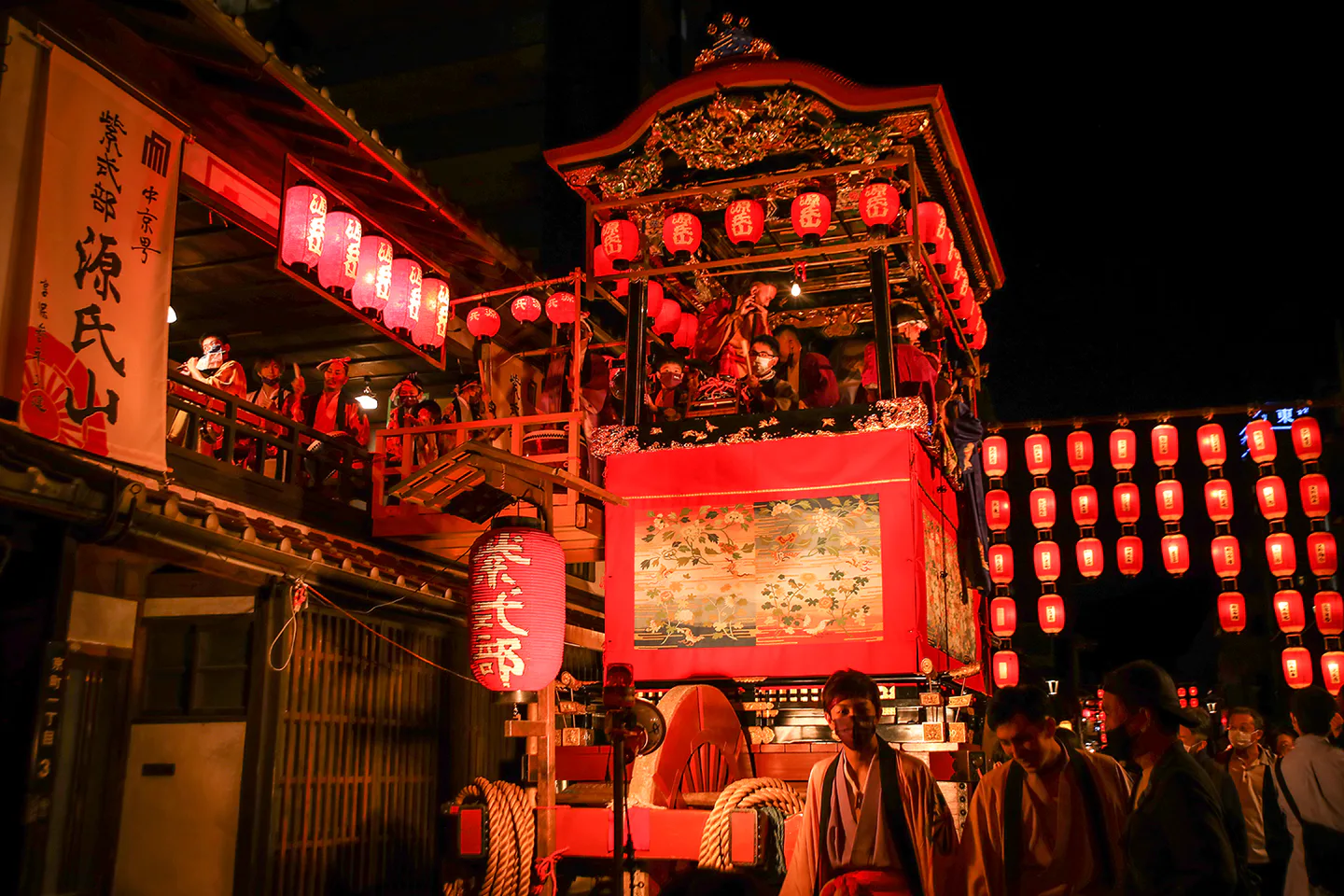
Otsu Matsuri's 2026 weekend has finished: Yoimiya was Saturday, October 10, and the main procession was Sunday, October 11. If you are comparing the two experiences for a future visit, the most useful distinction remains clear. Yoimiya is an evening among illuminated neighborhood floats; the main day puts all 13 hikiyama into the streets and adds karakuri puppet performances. A traveller with one unconstrained visit would get more of the festival's distinctive moving spectacle on the main day. A family needing a contained evening, or a photographer concentrating on lanterns and carved details, could reasonably prefer Yoimiya.
The dated record matters because old festival pages can be mistaken for a live schedule. The 2026 procession order, street and traffic maps and two-day dates were published before that October weekend. The festival calendar and organizer news carry the next updates. The old maps are useful evidence for how the event works; they are not a confirmed timetable for another year. Wait for the next event's own maps before fixing a precise viewing corner or hotel return route.
↔ Scroll table left or right
What you chiefly want to see | Stronger festival session | Cost of that choice |
Moving hikiyama and puppets performed in procession | Main festival day | More standing, crowd management and time outdoors |
Lanterns, textiles, carving and music at a deliberate pace | Yoimiya evening | No full daytime procession context |
A compact outing with young children or an older relative | Yoimiya, with an exit time agreed beforehand | Fewer moving-float and puppet scenes |
Both forms of the festival | Short Yoimiya plus selected main-day viewing | A second travel session or an extra night |
A Kansai trip also considering Kishiwada danjiri | Decide which festival style matters first | Crossing the region to sample both can consume the best viewing hours |
Why a moving float changes the whole visit
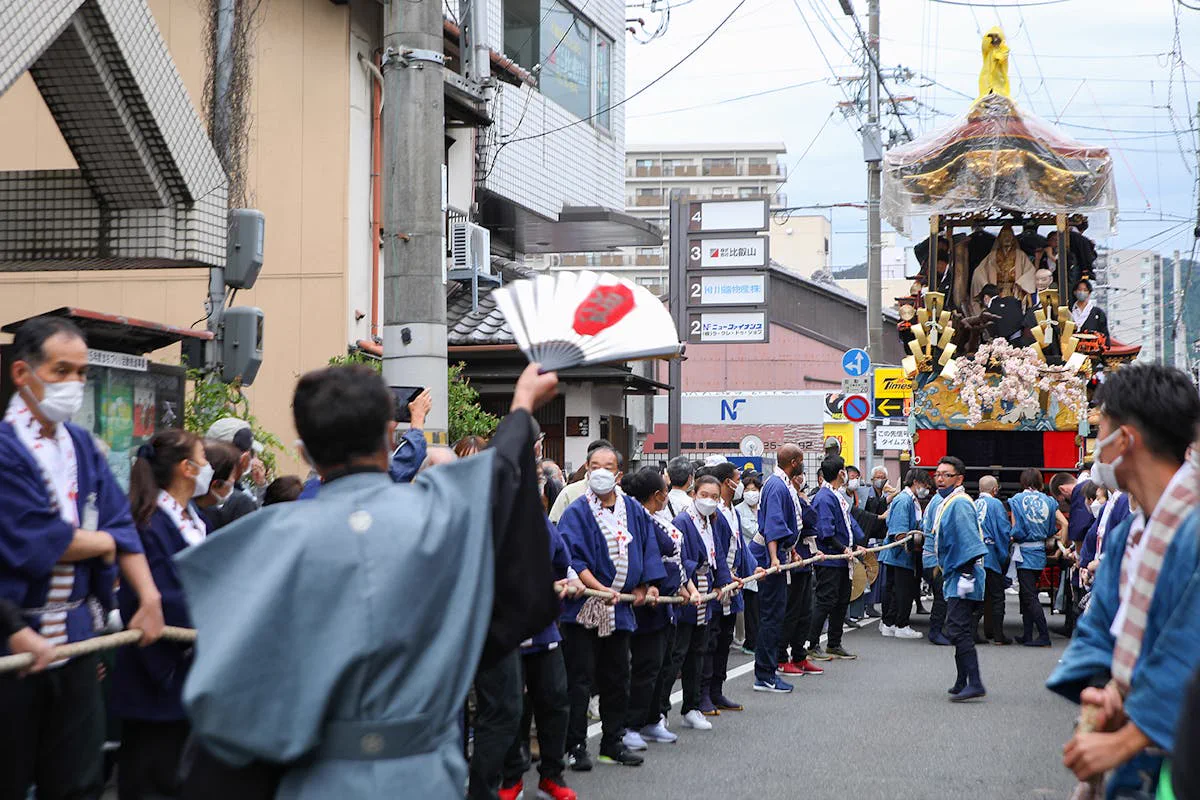
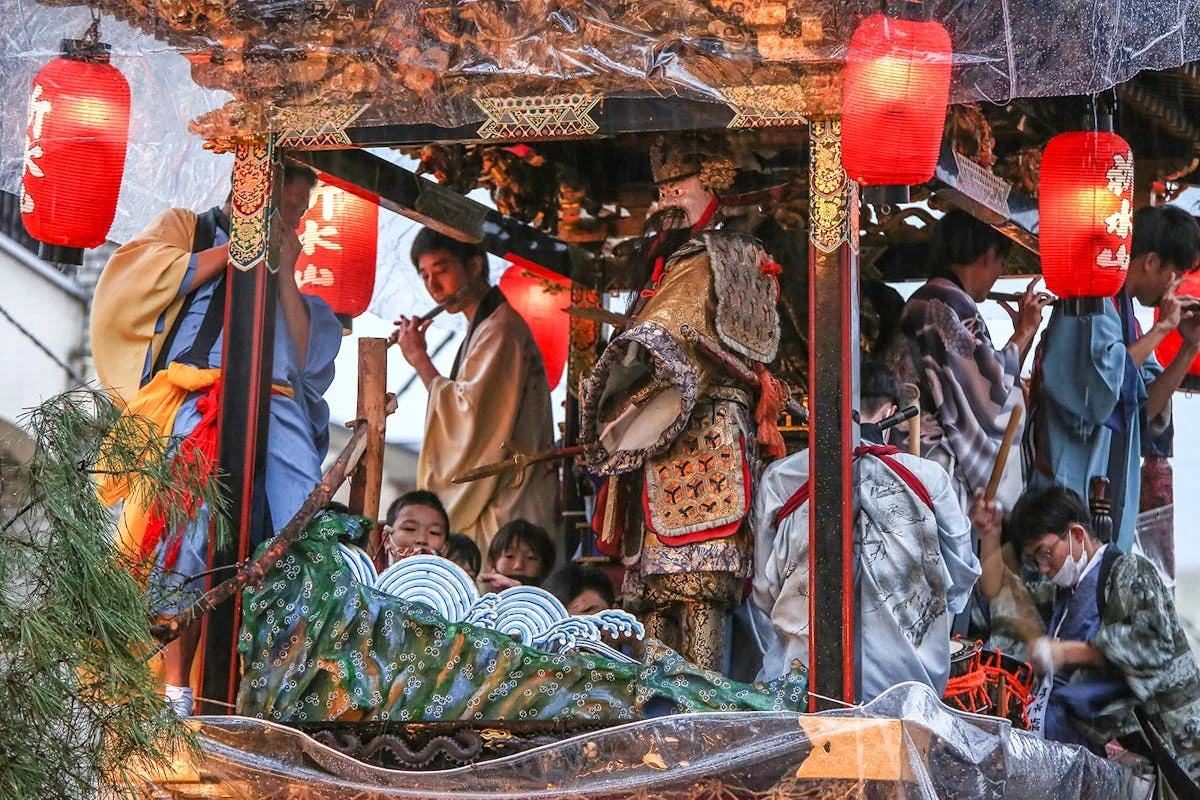
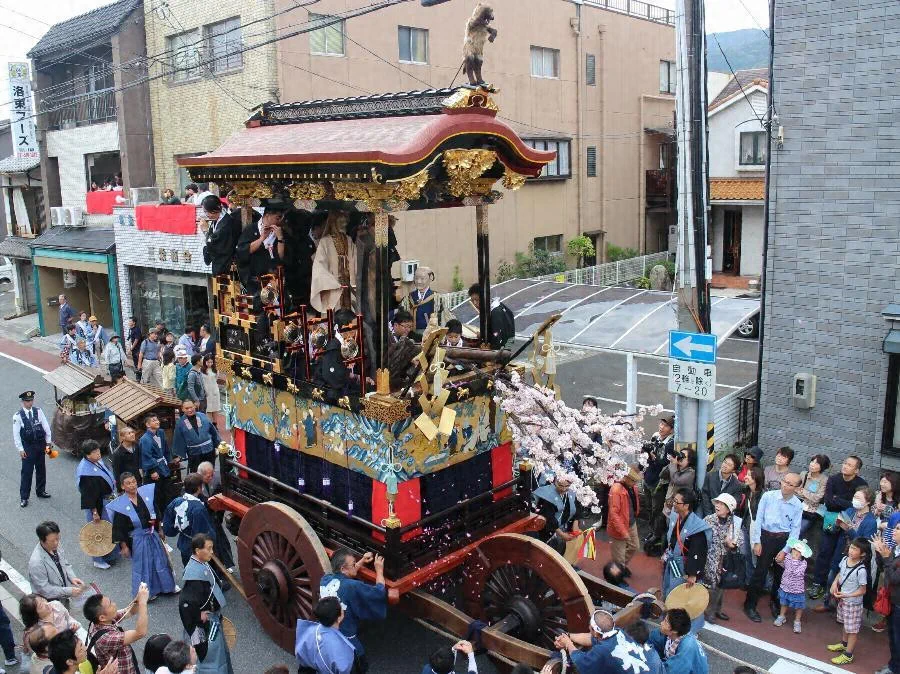
Thirteen hikiyama were in the 2026 main procession. The festival organization describes them as Edo-period floats carrying karakuri puppets; their route includes points where those figures perform. Seeing a float on the street is different from examining it at rest. Pullers, musicians and the crowd make its scale legible, and the puppet scene gains a clear beginning and end. If those mechanics are what brought you to Otsu, the main day is the choice that preserves them.
The floats are taken from storage and assembled before the festival. That preparation explains why the main event looks so different from a static display of craft. In 2026 the public calendar put yamadate, or float building, on October 4; Yoimiya followed on October 10 and the procession on October 11. An itinerary that only had a short evening could still appreciate the workmanship, but it could not reproduce the movement and puppet stops of Sunday.
One solid viewing area can be more rewarding than a frantic tally of float sightings. Choose a procession segment and a karakuri stop that make sense together, then allow enough time to watch rather than repeatedly crossing the stream of spectators. The published 2026 order placed Saigyo-zakura Tanuki-yama outside the draw, followed by the drawn sequence. That is historical detail for 2026, not a reason to assume the same order next time. Use the next year's route release to select a section. The Kyoto autumn illumination guide illustrates a similar choice between one well-timed scene and too many stops, though temple nights run very differently from a street parade.
What the lantern evening gives back
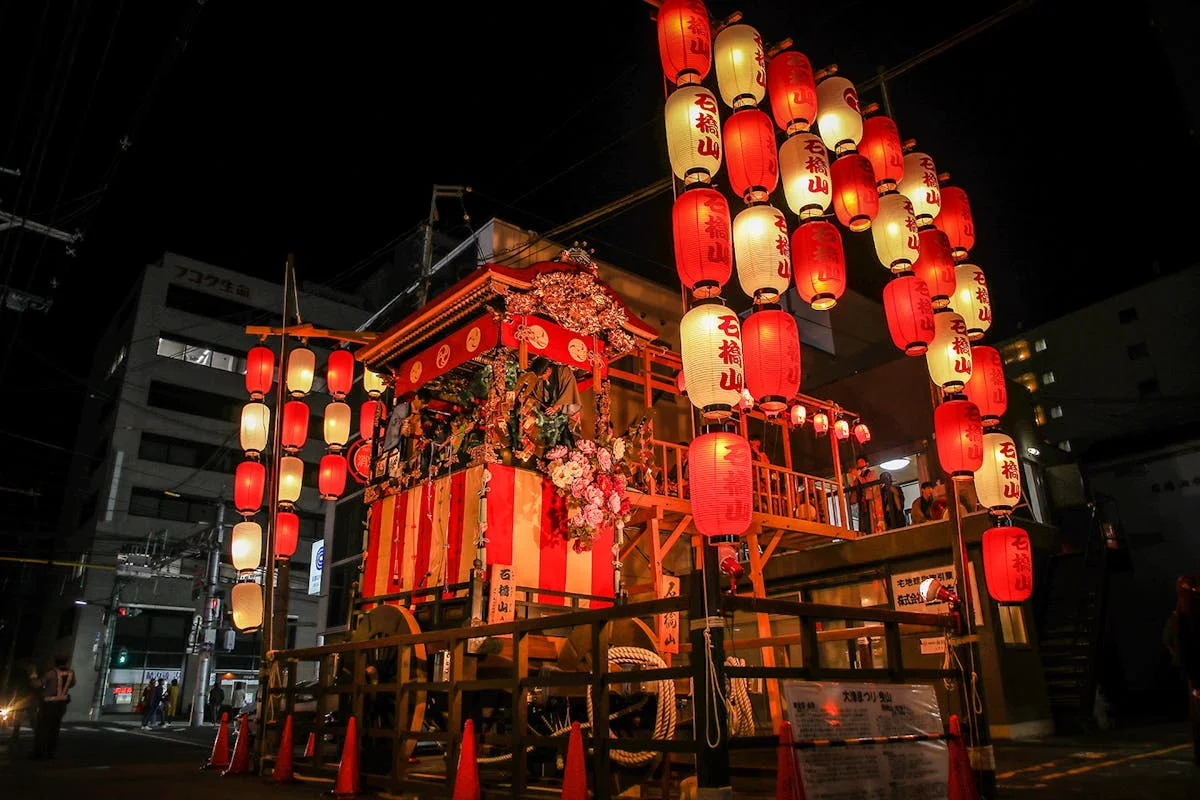
Yoimiya makes the floats easier to approach as objects. After the neighborhood activity earlier in the day, the evening puts lanterns, musicians, fabric and carved surfaces into a tighter, more atmospheric frame. In 2026 the organization described an evening running toward 21:00, with lantern preparation beginning in the late afternoon. Those hours describe the completed 2026 program; future opening and closure details still need a new calendar.
For a two-hour outing, choose a compact group of neighborhoods rather than attempting all 13 floats. Stay long enough for the lamps to matter, then leave before the walk becomes a collection exercise. This is particularly useful for a child or anyone who finds long periods of standing hard. A short visit can contain one complete visual idea: the float before dark, the change when lanterns glow and a little of the music. The main day asks for more patience and more tolerance of shifts in crowd flow.
Yoimiya also helps a Kyoto-based visitor who can reach Otsu only after another daytime commitment. You are still trading away the procession. Make that trade knowingly rather than assuming the lantern evening is a miniature of Sunday. The Kyoto two-base hotel comparison helps decide how much of a late return would remain after the train.
A short visit, a half day and an all-day visit need different targets
The time you can stand and move is a better guide than the number of floats. A roughly two-hour festival slot suits a defined Yoimiya neighborhood walk. Four hours can work on either day if you select a single objective. A substantial part of Sunday allows one or two procession sections plus a puppet performance. People attending both dates need not give them equal time: a short lantern session followed by a deeper main-day visit leaves energy for the irreplaceable moving scenes.
↔ Scroll table left or right
Time budget | Useful target | What to resist |
About two hours | A small Yoimiya cluster after lanterns are lit | Turning the visit into a 13-float checklist |
About four hours | One evening circuit, or one main-day procession section and puppet stop | Crossing the centre repeatedly to chase every float |
Most of the day | Selected sections of the main parade, with rest and an exit planned | Following one float indefinitely unless that is your actual interest |
Both sessions | Brief lantern viewing, then concentrated moving-float time | Making both days endurance tests |
For the main procession, measure the quality of a view by whether you can stay still long enough to see a float arrive, move past and complete the scene you came for. A count of nine fleeting floats may tell you less than three seen properly. Every repositioning consumes walking time and often loses a sightline. The route is also a working festival street, not a museum gallery; do not plan a rapid cross-town circuit as if paths will remain empty.
The 2026 maps eventually answered the exact street question that the original pre-release guide could not. They included related festival information and vehicle restrictions. For a future festival, make the day-choice first, then match a viewing section to the new procession and traffic maps once published. The Otsu Prince hotel review becomes relevant if the lakefront is also part of the trip, but that hotel's shuttle arrangement is a separate question from access to the central festival streets.
Children, older companions and the right place to leave
The best sightline is not always the best family position. A place near the front of a puppet stop may be difficult to exit when a child has reached their limit. Start with the route back to the station and the point at which the group will be finished. On Yoimiya, the stop condition could be three or four nearby floats and one period of fully lit lanterns. On Sunday, it could be one planned karakuri scene and a single procession section. Anything after those targets is optional.
This prevents the recurring “one more float” trap. A group can stay well beyond its comfortable time because the next hikiyama is nearly in view, only to leave with the densest crowd. A slightly less dramatic location can be better if the return to rail is straightforward. The trade-off is especially sharp for a stroller, a person who cannot stand for hours or a family managing dinner and bedtime. The Kyoto Station versus Shijo-Kawaramachi guide with older parents considers the same late-transfer burden from the accommodation side.
The 2026 street restrictions meant that a road route through the centre could not simply be treated as an ordinary car approach. The festival's rail access page places JR Otsu Station on the Kyoto side at about ten minutes by train from Kyoto Station and also describes the Keihan route via Biwako-Hamaotsu. It notes that parts of the Keihan Keishin Line can be suspended during the main procession. For future dates, check the rail operator's event notice and the new festival traffic map before deciding where to leave the crowd. The Kyoto versus Osaka base comparison helps if Otsu is only one of several day trips.
Does one Otsu evening justify changing hotels?
For a single session, a Kyoto room is often the lower-friction base. A hotel change takes check-out, luggage storage, a transfer with bags, check-in and a reshaped next morning. Those costs are real even when the railway ride looks short. A station-side Kyoto address can simplify the return after Yoimiya; a more atmospheric neighborhood may add another local transfer. The Kyoto autumn hotel-area comparison gives that choice more context.
An Otsu night becomes easier to justify when you plan to attend both festival sessions, have another Shiga stop the following morning, find Kyoto rooms unattractive on the same weekend or would otherwise face an awkward late connection. It can also let a low-stamina group return to the room between parts of the day. That is a location decision, not a claim that every festival visitor should sleep in Otsu. A lakeside room may still be far from the central procession; the Lake Biwa fireworks access guide is a reminder that “Otsu” can describe very different crowd and station patterns across events.
↔ Scroll table left or right
Hotel question | Stay in the existing Kyoto room when… | Consider an Otsu room when… |
Festival sessions | You will attend one evening or one part of Sunday | You will attend Yoimiya and the main day |
Next morning | Kyoto is the next useful rail base | Shiga or Lake Biwa is the next destination |
End of the night | One train returns you without a difficult extra transfer | The Kyoto return adds a tiring connection for your group |
Moving bags | Check-out and new check-in would consume valuable daytime hours | You already needed to change bases for the wider itinerary |
If comparing rooms for a future festival, use the Otsu accommodation map with the departure station and the next morning's route in mind. The Kyoto and Osaka four-day itinerary shows why moving hotels for one evening may be more costly on an already compressed trip. If the trip has room for Shiga beyond the festival, the Lake Biwa Otsu Prince stay offers a different lake-oriented reason to spend a night.
The 2026 Kishiwada conflict was a choice of festival, not a transfer puzzle
Otsu's completed 2026 dates overlapped the October Kishiwada danjiri weekend: eve events on October 10 and main events on October 11. The two festivals sell very different scenes. Otsu centres on Edo-period hikiyama, their ornamental detail, music and karakuri; Kishiwada is known for fast danjiri movement and forceful turns. A Kyoto or Shiga-oriented trip naturally favoured Otsu, while a southern Osaka itinerary could support Kishiwada more easily. The Kishiwada festival information and October festival guide supply the other half of the comparison.
Trying to take in both during the same weekend creates a long cross-Kansai movement at precisely the time when festival streets and crowds make arrivals least predictable. Choosing the style first gives you a coherent base and enough time to experience one event. The Takayama autumn festival night guide offers another lantern-float comparison, but it is a separate region and schedule, not an Otsu fallback. Nada's fighting-float festival gives a third, more forceful contrast in western Japan. For other forms of festival movement and light, compare Sendai Tanabata, Kyoto Gozan Okuribi and Dogo's dawn-centred festival on their own schedules.
Rain changes the scope of the outing
Bad weather can affect walking speed, float protection and how long a group is comfortable outdoors. Rather than assuming a dry-day circuit survives unchanged, reduce the goal. On a wet Yoimiya evening, select fewer neighborhoods and allow more time under shelter between them. On the main day, identify the one procession or puppet moment that matters most and be ready for altered operating conditions. The current festival notice, not the previous year's photographs, governs whether an event segment is changed.
The same caution applies when planning with historical maps. The 2026 procession order and road restrictions were eventually published, but they do not establish the next year's streets. A rain decision belongs close to the event; the accommodation and travel base can be chosen earlier. The free Kyoto autumn walks guide can help fill a separate daylight period, though it is not a replacement for a cancelled festival night.
Three plans show how the choice changes with the traveller. A couple based in Kyoto and attending once could give the main procession a half day, watch one karakuri stop and return before fatigue makes the train ride unpleasant. A family with a six-year-old and an older grandparent could make Yoimiya a short after-dinner lantern walk; if the puppets are essential, Sunday is possible with a more conservative viewing target. A festival-focused visitor with two nights could sample the lantern scene briefly, then reserve the larger time and standing budget for the main day. These are planning patterns, not claims that one date is universally better.
The five practical dimensions are distinct: the main day wins for moving-float context and irreplaceable puppet action; Yoimiya wins for lantern photography, short-visit efficiency and an easier family exit. Decide which scene you would regret missing, place the hotel around the exit and use the next festival's own route release for the street-level plan.
↔ Scroll table left or right
Comparison dimension | Yoimiya | Main procession |
Festival scene unavailable on the other day | Close lantern and decoration view | Floats moving through town with karakuri stops |
Night photography and fabric detail | Stronger after the lamps come on | Daylight reveals shape but not lantern atmosphere |
Family or low-standing flexibility | A short neighborhood loop can end early | A chosen viewing section and exit need more care |
Understanding float movement | Limited to neighborhood activity | Central feature of the day |
Short-visit efficiency | A focused two-hour visit can feel complete | A short stop risks missing a puppet performance |