
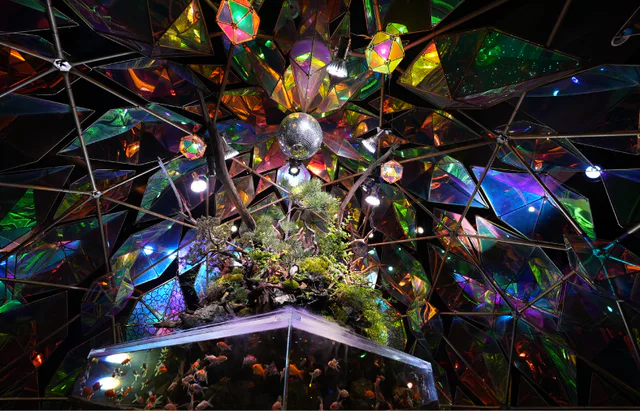
NARA KINGYO MUSEUM works best as an intentional second stop in Nara, after you have decided how much time the city’s eastern walking area deserves. Its entrance is on the fourth floor of Mi Nara, west of the familiar Nara Park circuit. The adult admission is ¥1,300, but a visitor arriving from the deer park pays in travel time as well: a bus or other transfer, a 60–120-minute indoor visit, and another journey back toward a station. With only half a day in Nara, the museum can quietly displace the temples and streets you came to see.
The calculation changes if you have a full day, dislike a long stretch outdoors, or came specifically for goldfish art. The museum is a sequence of designed scenes with live fish, reflective surfaces, umbrellas, projected colour and photo opportunities. It does not fill the role of a large natural-history aquarium. Decide whether that particular format is appealing before fitting Mi Nara into the route. The distinction is especially useful for someone comparing the NIFREL detour at Expo Park or a conventional large aquarium elsewhere in Kansai.
First solve the map, then the ticket
Mi Nara stands at 1-3-1 Nijo-oji Minami, with the museum on floor four. From Kintetsu Nara Station the published Nara Kotsu bus journey is about 15 minutes; from JR Nara it is about nine minutes to Miyaatoteien. Shin-Omiya offers a roughly 15-minute walk. These are transport legs, not door-to-door promises from Todai-ji or Kasuga Taisha. If you begin in Nara Park, allow time to reach a useful bus stop, wait, ride, find the fourth-floor entrance and later return toward your train.
That geography makes a four-hour first visit a poor fit. Nara Park, Todai-ji and the eastern temple area already occupy a coherent walking block. Breaking it to reach Mi Nara may leave two incomplete clusters. If Nara is a day trip, settle the departure-city choice with Nara from Kyoto or Osaka; a traveler with only a short window after a late arrival should protect the park circuit. A traveler staying overnight can place the museum on a different afternoon, as the Nara overnight decision explains.
| Time available after reaching Nara | Place for Mi Nara | What to protect |
|---|---|---|
| About four usable sightseeing hours | Skip unless the goldfish museum is the main goal | Nara Park and the eastern core without a mid-route transfer |
| Six to eight hours | Finish the park circuit first, then decide on a 60–90-minute museum block | A return trip with enough margin for the station |
| Nara overnight or a dedicated indoor day | Make Mi Nara a planned destination rather than an extra errand | Enough time inside to enjoy the visual rooms |
| Rain or strong heat | Replace an outdoor block with the museum if transport still works | The main Nara sight you care about most |
This table is a planning guide, not an admission condition. A photographer could spend two hours inside while a family might leave sooner. The point is to reserve time for both travel and viewing. The Nara autumn route comparison illustrates why moving between districts is a larger choice than adding one more stop along a walking path. A western Mi Nara visit should be a deliberate trade against another cluster, not an invisible line on the map.
What appears inside the ¥1,300 admission
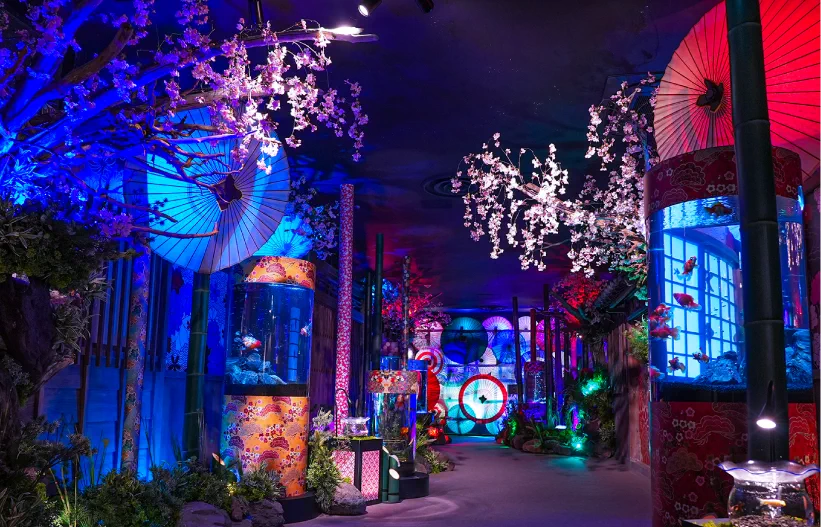
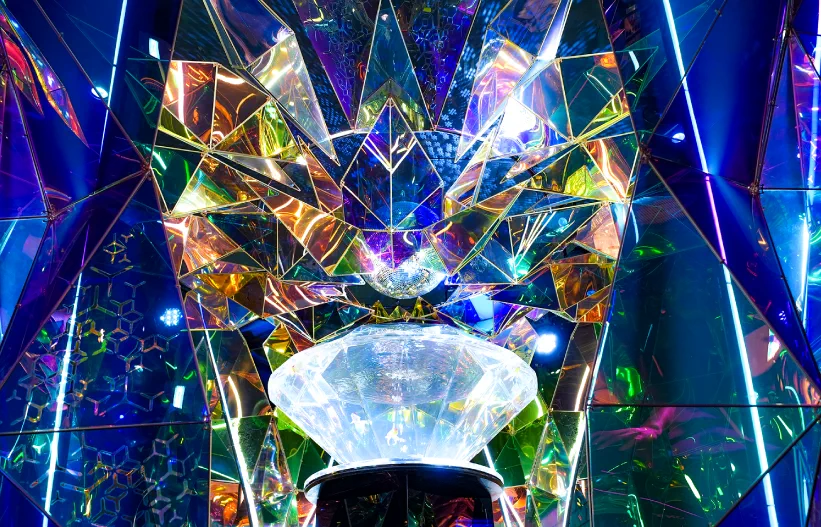
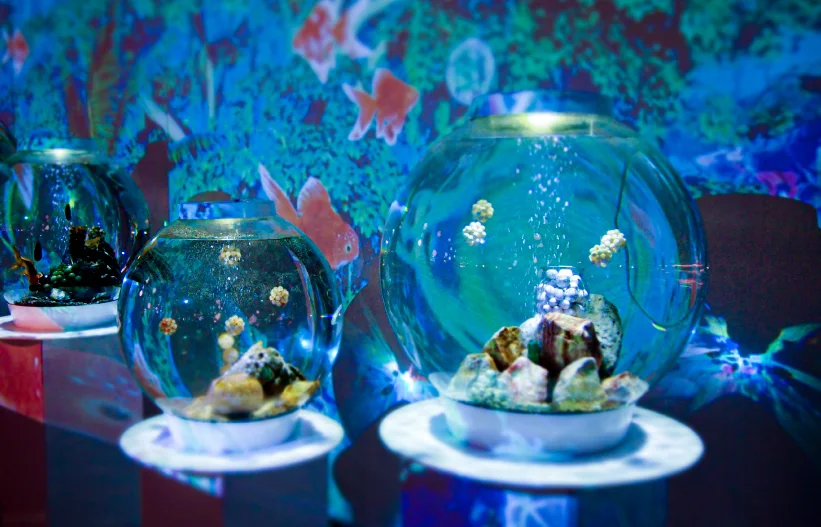
The collection is presented through artistic environments rather than a sequence of species-information panels. Fish tanks become part of an installation: changing light, mirrored geometry, umbrella displays and themed rooms shape how you look. The venue describes seven artistic spaces and approximately 3,000 goldfish. The quantity is less useful for planning than the exhibition style. If you enjoy photographing colour, waiting for a fish to cross a frame or simply looking at how the set changes around each tank, an hour can pass easily. If you wanted a marine-biology lesson, there are better uses of the same afternoon.
One image shows a corridor with lit tanks, branches and suspended umbrellas; another captures a mirrored, faceted structure around a central display. A third shows small globe tanks against a projected blue backdrop. They represent three different visual treatments, and explain why a visitor can get more from moving slowly than from counting tanks. The contrast with Kyoto International Manga Museum is instructive: there the visit expands when you read, while here it expands when you stop to examine and photograph a scene.
Plan 60–90 minutes for a straightforward circuit. Two hours is reasonable if the photographs are part of the purpose, you are travelling with children who want time at each display, or the rooms are busy enough that you wait for a clear view. The venue itself says average visits start at roughly one hour and some people stay beyond two. A strict train connection immediately after admission takes away much of this freedom. If your return train cannot move, put Mi Nara earlier in the day or keep it for another visit.
Single ticket or the two-museum combination?
Current single admission is ¥1,300 for a person of junior-high-school age through 64, ¥800 for elementary-school children and visitors aged 65 or above, and ¥300 for ages four through preschool. Most children three or younger enter free; school or organised-group exceptions appear in the ticket rules. The NARA KINGYO MUSEUM and NARA IKIMONO MUSEUM joint ticket costs ¥2,400 for an adult, ¥1,400 for an elementary-school child or senior, and ¥500 for ages four through preschool. The adult upgrade is therefore ¥1,100. The amount alone should not decide it.
Both museums occupy Mi Nara, so the combined ticket avoids a second cross-city transfer. It still adds a second indoor visit. Buy the joint ticket when the living-creatures museum is itself part of the day, especially for a family that has intentionally allocated a long indoor afternoon. If the goldfish displays are the only reason for coming west, the ¥1,100 upgrade merely purchases an attraction you had not wanted. A first-time Nara day can already be crowded with the park, Todai-ji and Naramachi; the bundle should earn its hours as well as its price.
The neighbouring NARA IKIMONO MUSEUM decision guide looks at that second admission as its own family stop. It is useful to read before buying a combination ticket, because two attractions in one shopping complex still require two separate spans of attention. Anyone hoping for a large aquarium should compare the purpose and travel time of Kyoto Aquarium instead of assuming that more minutes inside Mi Nara will turn goldfish art into the same experience.
| Ticket choice | Adult price | Best reason to buy | Likely mistake |
|---|---|---|---|
| Goldfish museum only | ¥1,300 | One focused visual-art stop after the Nara Park circuit | Assuming the admission also covers the neighbouring living-creatures museum |
| Both Mi Nara museums | ¥2,400 | You genuinely want two separate indoor attractions and have the afternoon free | Adding the second museum solely because the incremental ¥1,100 sounds small |
There are useful parallels elsewhere. The Otsuka Museum of Art demands a large time block for a very different collection; the Nezu Museum decision depends on whether its paid garden is part of your goal. Neither is a substitute for the goldfish displays. They make clear why a ticket should be judged with the experience and travel time, not the yen amount alone.
Hours, last admission and the summer-hours trap
The published normal hours are 10:00–18:00, with admission ending 30 minutes before closing. The summer extension that ran from 18 July to 24 August 2026 has finished, so a saved page showing a 19:00 closing time is unsuitable for an October itinerary. The venue describes year-round operation subject to changes for events or the Mi Nara complex. Recheck the current day’s hours when a late-afternoon visit matters, particularly around a holiday or a shopping-centre closure.
A departure from Nara Park at 17:00 is risky: you still need to reach a bus, travel west and find the fourth-floor entrance before 17:30. The practical last move is earlier than the printed last-entry time. Someone planning a late Kyoto return might get more from an attraction already near the eastern circuit. The Kyoto Station versus Gion base guide helps identify how much extra transport your evening hotel choice adds, while Kyoto versus Osaka lodging frames a full Kansai day-trip pattern.
Advance tickets can make payment simpler, but they do not reserve priority admission. Visitors are admitted in arrival order and the venue may control entry when the rooms are crowded. Weekends, long holidays and school breaks bring the greatest pressure; the stated busy periods commonly include late morning and much of the afternoon. A ticket bought online should not be treated as a queue pass. If a fixed train is waiting afterward, leave enough time for entry and the return bus rather than depending on a promised minute-by-minute visit.
Family logistics matter before you cross the entrance
The exhibition uses dark zones, bright lighting and sound. A companion sensitive to those conditions should assess the environment before buying. The venue says its routes can accommodate wheelchairs and strollers, although some passages are narrow. For young children, the more immediate constraint is the lack of a restroom inside. Food and drink are not allowed in the galleries. Use facilities in Mi Nara and finish snacks before admission, so a basic break does not interrupt the paid visit.
Re-entry is normally restricted; the venue allows a toilet exception when you tell reception first. Children of elementary-school age or younger cannot go in alone and need a guardian aged 16 or older, who also needs admission. That makes the museum a shared family block rather than a convenient place to leave children while adults split off. The entrance also has free lockers for small belongings. These details matter more for a family than shaving a few minutes from the published bus ride.
The museum accepts cash, cards, common electronic money and several mobile-payment methods for admission, although festival games and merchandise can require cash. For a group with older children, compare the combined ticket price for everyone rather than only the adult difference. A Nara day with multiple indoor stops can become expensive and exhausting even when individual child tickets look modest. The Nara Prison Museum transport and half-day plan is another example of an out-of-core attraction that needs its own route allocation.
Three routes that actually leave enough time
For a first Nara day from Kyoto, make the eastern walking area your morning. Decide after lunch whether you still have two uncommitted hours for Mi Nara, including the bus journey in both directions. If Todai-ji or the park has taken longer than expected, skip the westward move. Returning through Kintetsu Nara may suit a Kyoto itinerary differently from returning through JR Nara, so settle the rail station before boarding a local bus. A hotel directly tied to your rail departure can simplify that decision; use a Nara station-area lodging map only if an overnight stop is genuinely under consideration.
For a full day with rain or heat, shorten one outdoor segment and make the museum a planned afternoon refuge. This is more coherent than insisting on the entire park itinerary and then adding Mi Nara at closing time. The July weather comparison helps explain why a long Kansai walking day can feel harder than its map distance suggests. In late autumn, follow the late-November leaf timing before sacrificing a seasonal outdoor target for an indoor exhibition that is open all year.
For a Nara overnight, put Mi Nara on the arrival or departure side that leaves the park walk intact. Someone arriving from Osaka might use the western museum first and keep the next morning for the eastern sights; another traveler may reverse that order to fit the bus and rail connection. The Osaka day-trip comparison is useful if Nara must compete with other Kansai destinations. A seven-day Kansai route with one base, described in the one-hotel itinerary, leaves less room for adding distant attractions to every city day.
A photographer may deliberately reverse the standard recommendation and make the museum the central Nara destination. That is a reasonable choice when the illuminated rooms, fish and Japanese design are the attraction you care about. It is less compelling if the museum was selected only because a low admission number appeared beside a crowded park itinerary. In each version, a manageable return journey is part of the decision. Budget the transfer and the time you want inside before buying either ticket.
Make the detour conditional on the day you actually have
Choose NARA KINGYO MUSEUM if you have a full Nara day or a deliberate indoor/photo afternoon, and enough transport margin to let the scenes unfold at their own pace. Skip it on a short first visit when the park and Todai-ji are still unfinished. The single ¥1,300 ticket is sufficient for someone whose interest is the goldfish installation; use the ¥2,400 combination only when the second museum independently earns the time. The venue’s hours and access, current ticket prices and visitor rules are the three things to check for your travel date. The 2026 summer extension is now historical context, not the current closing hour.