
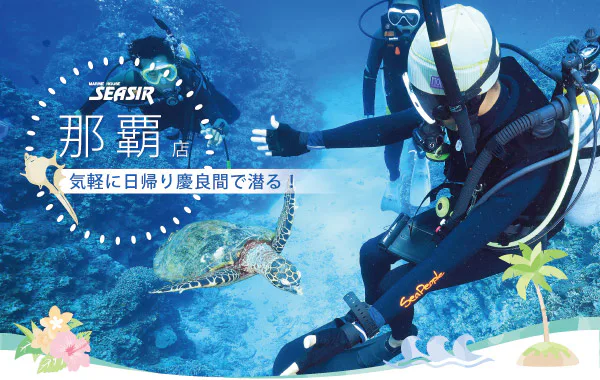
The decisive question for a Kerama discovery dive is whether you want to try breathing underwater. If the goal is simply to see blue water and fish, a snorkeling boat can give you the scenery without a scuba health screen, ear-pressure challenge or post-dive flying interval. A first dive makes sense when those new skills are part of the attraction and you can leave room in the itinerary for the boat, a possible change of site and a comfortable flight buffer.
Naha-based trips and stays on Aka Island solve different problems. Marine House SEASIR runs a Naha operation for day boats and an Aka operation for people already on the island. The boat departure, equipment, briefing, first descent and return can occupy a full day even if the time underwater is short. Before selecting a package, identify where it starts, how many dives it includes and the final possible surfacing time. Those three details matter more than a photograph of a turtle on the sales page.
↔ Scroll table left or right
If this describes your trip | Better starting choice | Check before paying |
You want to experience scuba itself and have a free day after it | Supervised introductory dive | Health eligibility, comfort in water and a flight interval based on the actual number of dives |
You chiefly want the reef and marine life | Snorkeling | Boat duration, water entry, flotation equipment and weather cancellation terms |
Your aircraft leaves the following morning | Earlier dive date, or snorkeling | Final surfacing time and the operator's no-fly instruction; an extra dive changes the calculation |
Boats often make you nauseous | A shorter local-water trip may fit better | A personal prevention plan and whether the medicine affects alertness |
The health questionnaire raises an issue | Resolve eligibility before booking | Any required clinician clearance and the operator's own conditions |
A first descent asks more of you than a swim over the reef
Discovery diving welcomes people without a scuba licence, but supervision does not remove your own tasks. You will listen to the instructor, practise breathing through the regulator, use simple underwater signals and clear your ears as pressure increases. The instructor controls the route and depth; you still need to say when something hurts or you cannot settle your breathing. An aborted descent may be the safest result of a well-run first attempt. A ticket cannot promise a particular depth, dive site, animal encounter or completed dive.
The question of swimming ability needs the operator's precise rule, rather than an internet slogan. Someone who does not swim strongly may still be comfortable in water with flotation and close supervision; someone who panics when their face is submerged may find the regulator the hardest part of the day. Ask what the program expects you to do unaided and whether the briefing includes a shallow practice period. If water comfort itself is uncertain, the Kerama activity comparison helps weigh scuba against snorkeling, SUP and a simple island visit.
It is sensible to treat the first descent as a learning session, not as a race to spend every minute underwater. A calm, short dive in a modest depth is a better introduction than struggling to meet a planned depth because you prepaid the boat. Check whether the package permits a snorkeling segment after the scuba portion; do not assume an unused second dive automatically converts to another activity or attracts a refund. Those are product terms, not universal Kerama rules.
Naha day boat or Aka stay changes the morning
The Naha model is convenient when your hotel is in the city and you do not plan an island overnight. It brings the shop or meeting point, boat, gear and return journey into one booking. Aka-based diving begins after you have already arranged the ferry and island accommodation. SEASIR's Naha and Aka operations illustrate both models, but a timetable or inclusion shown for one branch should not be carried over to the other. Confirm the exact product's meeting location, check-in deadline, hotel pickup if offered, equipment, number of water entries and return estimate.
For a Naha departure, the night before belongs near the meeting point. A resort in Onna or Motobu introduces a cross-island drive before a boat that cannot wait for traffic. The Naha versus Onna final-night guide explains the same geography from a hotel perspective; the Okinawa area guide helps if the diving day is one part of a longer trip. A no-car traveller can also use the two-day Naha route to keep the remaining city time compact.
Do not place a long northbound drive straight after the boat merely because you have collected the rental car. Motion, heat and unfamiliar equipment may leave you tired even when the dive went well. If the mainland itinerary also contains the Blue Cave, the boat-versus-shore entry comparison distinguishes a separate site and weather decision; it is not a substitute name for Kerama. The five-day Okinawa route shows how a Naha start can delay the car until it actually helps.
Calculate the flight interval from the last surfacing
Scuba creates a pressure exposure that snorkeling does not. The relevant clock begins when the final dive ends, not when the boat reaches Naha or when you leave the shop. The DAN flying-after-diving guidance sets a suggested minimum of 12 hours after one no-decompression dive and 18 hours after multiple dives in a day or diving on multiple days. A dive requiring mandatory decompression needs a substantially longer interval. Longer waits lower risk further; these minimums do not guarantee that decompression sickness cannot occur.
↔ Scroll table left or right
Dive history before the flight | DAN's suggested minimum surface interval | What it means for a Kerama booking |
One no-decompression dive | 12 hours or more | Count from the end of that dive; the operator may set a longer rule |
Two dives in the day | 18 hours or more | An optional second dive changes the category, even if it sounds like a small upgrade |
Diving across several days | 18 hours or more | The clock begins after the final dive, with any longer computer instruction taking priority |
Mandatory decompression stops | Substantially more than 18 hours | This is not a normal discovery-dive plan; follow specialist and operator instructions |
The DAN figures refer to divers without symptoms and commercial-flight cabin altitudes within the guidance's stated range. They are risk-reduction guidelines, not permission to fly when you feel unwell. A dive computer or operator may require a longer wait. PADI's general post-dive travel advice presents 24 hours as a deliberately conservative, easy-to-remember buffer. For a holidaymaker trying scuba for the first time, a full following day without flying is often easier to arrange than a tight next-morning calculation.
A second dive can have more itinerary cost than activity cost. Suppose the first water exit would give a generous interval, but the second exit moves later and the day's dive history now requires at least 18 hours. Do not decide from the upgrade price alone. Ask the crew when the last possible surfacing will be, what interval its own rules require and whether the departure flight still fits. The Miyakojima one-versus-two-dive guide explores the same scheduling mistake on a different island. Same-day flying after scuba has no sensible place in an ordinary Kerama holiday plan.
Ears can end a descent, and that is a sound decision
Ear equalisation is a physical condition of going down, not a measure of determination. Clear early and repeatedly. If pressure will not equalise, signal the instructor, move a little shallower and try again without forcing it. If pain remains, end the descent. The PADI diving safety rules specifically warn against continuing down through ear pain because injury can result. Tell the crew about a known ear problem before the departure, and seek appropriate medical advice rather than assuming a shallow advertised depth solves it.
This is why a first-dive purchase is an attempt at supervised scuba, rather than a contract for a certain number of metres. Keep the option of stopping clear in your mind before entering the water. If the first dive ends early, a later second dive is not automatically the remedy. Ear pressure, nausea or discomfort with the regulator may still be present. The instructor can explain the options on that day; a photograph of a tranquil reef cannot.
Boat sickness may decide the value before the dive begins
A Kerama day boat can be the wrong testing ground for someone with severe motion sickness. Nausea uses the same attention needed for breathing, listening, signals and ear clearing. A traveller who is already unwell at the first site may still meet the formal activity conditions but have a poor environment for learning scuba. Speak with a pharmacist or clinician in advance about a prevention approach suitable for your own health and medicines; some remedies can affect alertness. Tell the boat crew promptly when you feel unwell instead of waiting for the first water entry.
Do not use weather at the hotel as proof of sea conditions offshore. The operator can change sites or cancel when marine conditions require it, and the precise refund or reschedule rule belongs to the booked product. If a boat day is central to the trip, leave another usable day in Okinawa so a cancellation does not force a hurried substitution. The rain and typhoon planning guide covers the land-side backup; the Okinawa four-day route shows why stacking three long excursions leaves too little flexibility.
Strong motion sensitivity may point toward a shorter local-water product instead of a full Kerama day boat. That changes the seascape as well as the boat exposure, so decide which objective matters. Snorkeling on the same long boat does not remove the crossing. A shore-based activity can, but it will not deliver the same island itinerary. Keeping those trade-offs explicit prevents the word “easier” from concealing a completely different outing.
The medical questionnaire must be resolved before the dock
SEASIR asks underwater-activity guests for a truthful health declaration and applies participation conditions. Its health information describes circumstances that may rule out participation or require further steps. The operator's current form, and any medical clearance it requests, decide eligibility for the specific booking. Payment or arrival at the boat does not override those requirements. Complete the questionnaire before the cancellation deadline, especially if any answer could trigger a follow-up.
This article cannot judge an individual's fitness to dive. Respiratory, cardiovascular, ear and other conditions require the operator's screening process and, where needed, a clinician qualified to advise on diving. Be candid about relevant health history and medicines. The practical reason to settle it early is not only safety: a refusal at the dock can also consume the only marine day of a short trip. If snorkeling is the fallback, confirm separately that the same condition does not also affect that activity's eligibility.
A second dive is worthwhile only if the first creates a reason for it
The strongest case for a second introductory dive is that the first felt controlled, ear clearing was comfortable and you genuinely want more time practising underwater. The weak case is buying another descent merely because the afternoon is available or because a bundle discounts it. A first dive that already answered “Do I enjoy scuba?” may leave the rest of the day better spent snorkeling, resting or watching the water from the boat. Check what the package allows before you assume any switch is included.
Consider three distinct things at the surface: whether you were able to breathe calmly, whether your ears and stomach still feel good, and whether the later final surfacing preserves the preflight interval you chose. These are different constraints, and any one can settle the decision. You do not need to turn a successful first dive into a second one to validate the day. The Okinawa trip-cost breakdown is useful when deciding whether the extra spend belongs here or in a different activity.
Do not set a wildlife target for a beginner dive. Site selection, visibility and animals depend on conditions; a turtle or particular fish is never a reliable measure of value. A better outcome is being able to breathe, signal and equalise comfortably, then deciding honestly whether you want to learn more. If viewing the reef remains the whole objective, a snorkeling booking may offer a freer experience with fewer scheduling restrictions. The Okinawa activity overview helps keep Kerama separate from the aquarium, Onna shore activities and other marine products.
Fit the dive into the nights you actually have
The night before a Naha departure should make the meeting point easy to reach. A Naha final night can also simplify the flight day, provided the dive itself happened early enough. Asahibashi station lodging, Kokusai Street lodging and The Naha Terrace solve different city-evening needs; none changes a no-fly interval. The Tokyu Stay final-night review covers an early departure from another angle. Choose the address around the boat and airport movement, then leave enough time after the last dive.
If the tour is cancelled, keep the land day credible. The Naha without a car route can protect an urban base rather than turning the cancellation into an expensive northbound transfer. A resort stay may still be right later in the trip; the Okinawa self-drive hotel guide makes clear what that change asks of the daily route. The booking decision should therefore include a marine day, a weather alternative and a flight day, not only the underwater slot.
Compare Naha-area rooms for the boat morning on the Naha accommodation map. Once the nights are placed, choose scuba only if the learning experience is what you want, the health and ear questions are resolved, and the final dive leaves a comfortable interval before the aircraft.