
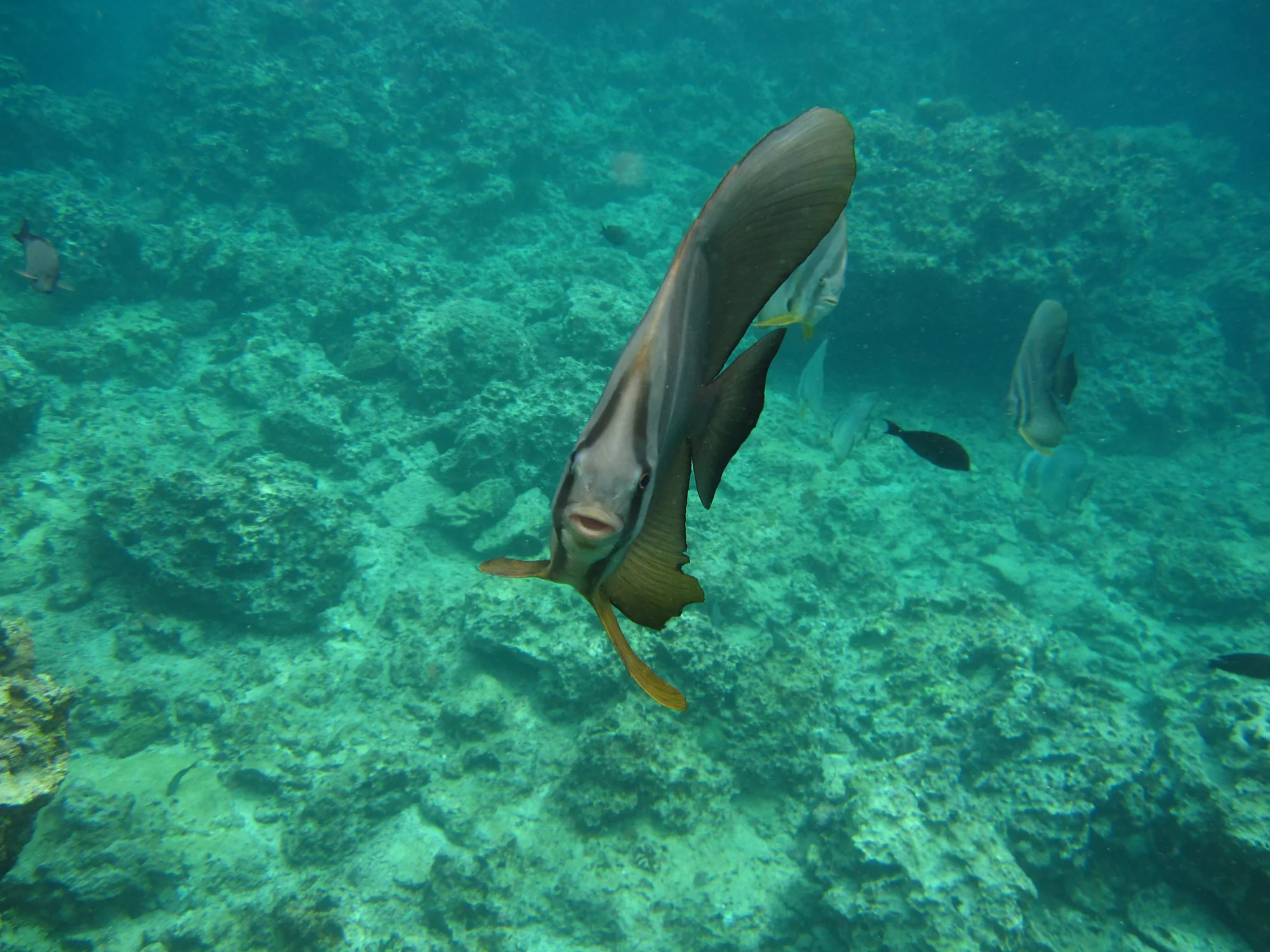
The Blue Cave is an easy name to book and a less easy morning to arrange. At Cape Maeda, the shore route begins with a public stairway into the water. A boat plan reaches the same coastal area from a harbour, usually sparing the group the steps and longer approach swim. Neither route gives you a guaranteed cave visit: the sea can make the entry, the crossing or the cave itself unsuitable. I would choose the operator whose failed-cave day I can live with, then compare the advertised photo package and price.
For a family with a four- or five-year-old, or a hesitant swimmer, the guided boat product is usually the simpler starting point because at least one current operator accepts those ages and keeps its group private. A confident group that gets seasick on small boats may prefer the shore, provided every person can manage the stairs and Cape Maeda has opened them. Your five-day Okinawa route also affects the decision: an Onna hotel can turn a two-hour water activity into a manageable half-day, while a Naha base adds a substantial return journey.
| If this is your constraint | Investigate first | The detail that can stop the booking |
|---|---|---|
| Child aged four or five | Boat tour with a published age range that includes the child | A shore operator with a six-year minimum cannot be made suitable by paying more. |
| Stairs, knees or an anxious first swim | Guided boat entry and a small or private group | Confirm how long the boat ride and in-water activity actually last. |
| Strong seasickness but comfortable shore entry | Shore tour at Cape Maeda | The site's closed-stairs flag removes this option for that period. |
| Medical condition, pregnancy or medication | Written eligibility terms before payment | Some operators require a medical discussion or exclude participation. |
| Blue Cave itself is essential | Cancellation or rescheduling terms | A substitute reef tour is not the same purchase if you would reject it. |
| No rental car | Meeting point and possible hotel pickup | A cheap tour can require an expensive taxi from your accommodation. |
The shore route depends on one public access point
Cape Maeda management posts a live status for the stairs used to enter the sea. When those stairs are closed for weather or sea conditions, swimming into the water from that entrance is not allowed. The site is a rocky headland, not a conventional guarded beach where the group can simply choose another patch of sand. Its rules require snorkelers to use a life vest or another float. Check the flag on the morning of the activity even when the sky looks clear; surface conditions at the headland matter more than sunshine over the hotel.
A shore tour has a useful virtue: there is no boat leg. It also asks more from a participant before the best part starts. You need to reach the base, change, carry or wear equipment, descend the steps and enter the sea without rushing anyone. The swim to the cave is part of the product, not a negligible walk. If a member of your party would be uncomfortable with that sequence, the shore tour is a poor way to save a small fare. Our Okinawa-with-parents hotel guide applies the same practical test to accommodation: reduce the last awkward transfer, rather than trusting a map distance.
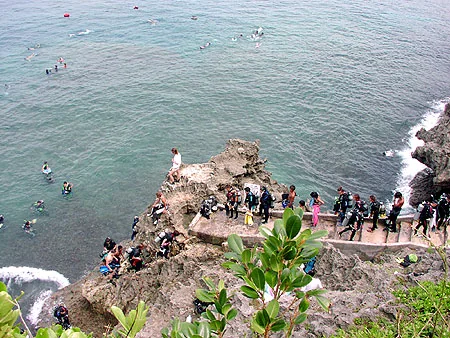
For a competent swimmer with comfortable knees, shore entry can still be the better experience. There is no small-boat motion to trigger nausea, and the group moves directly from the headland into the water. That advantage disappears when the stair status is closed. A tour seller cannot overrule the site's access restriction by describing its own plan as weather flexible. If you travel in a period when rain and typhoons may disrupt marine activities, put the cave on an earlier day and retain a rainy-day alternative that does not depend on someone entering rough water.
A boat removes the stairs; it does not remove the sea
Bokenjima's Blue Cave snorkel meets near Maeganeku in Onna and uses a boat from the nearby harbour. The operator describes a short crossing of about five minutes to the cave area. That changes the physical start of the tour considerably for a child, a tired traveller or somebody who dislikes scrambling down steps in gear. It does not mean that every closed-shore morning becomes a successful boat morning. The captain and guide still have to judge the boat passage and the in-water conditions safe.
The difference becomes clear in the booking terms. When conditions prevent the planned cave course, Bokenjima says a guest can move to another date if available, change to a safe alternative site, or cancel without a cancellation charge. Those choices are not interchangeable. If the cave is the reason you are coming to Onna, a substitute reef may be a disappointment even when it is an enjoyable snorkel. If the purpose is a supervised first swim among Okinawa fish, that alternative could be entirely satisfactory. Decide which case describes your party before a sea-condition message arrives.
This is why I would not reserve the Blue Cave for the last morning before a flight. If a Day 2 attempt cannot run, there may be room to move it. A final-day cancellation has no such recovery window, and a late return from Onna can interfere with the airport transfer. The Naha airport hotel decision is a separate one; the Blue Cave should not be forced into a tight checkout and departure sequence.
Two current tours show what the price difference actually buys
Published Blue Cave prices do not describe a uniform service. Bokenjima lists a private-group boat snorkel of roughly two and a half hours for ages four to 65. Its current graduated prices start at ¥3,480 per person for groups of six or more, rise to ¥3,980 for three or more, ¥4,500 for a pair, and ¥6,800 for a solo booking. The listed package includes the guide, boat, equipment, insurance, facility use and guide-shot photo and video data. The photo description mentions about 50 images. The exact price for your party size matters more than the headline “from” amount.
Marine Club NAGI's Cape Maeda-based snorkel is listed at ¥5,500 per person and about two hours, with a published snorkeling age range of six to 59. Its shop is close enough to the cave that the product can be undertaken from shore when access is permitted. NAGI presents small-group guiding and camera photography as part of its service, but I would check the deliverable on the actual reservation screen. “Photos included” does not tell you whether files, video, a fixed count or a download method are included on the same terms as a competing tour.
| Booking detail | Bokenjima boat snorkel | NAGI Cape Maeda snorkel |
|---|---|---|
| Water approach | Short boat ride from an Onna harbour | Cape Maeda-based shore access, subject to the stair flag |
| Published duration | About 2.5 hours | About 2 hours |
| Published ages | 4–65 | 6–59 |
| Adult price example | ¥4,500 each for two, ¥3,480 each for six or more | ¥5,500 each |
| Group format | Dedicated guide for the booked private group | Small-group tour |
| Media as currently described | Guide-shot photo and video data in the base plan | Camera photography advertised; verify the exact file package |
| Eligibility that needs special attention | Age and health declaration under the chosen plan | Age/medical rules and same-day blood-pressure screening for specified guests |
A pair would pay a published base total of ¥9,000 on Bokenjima's two-person rate or ¥11,000 on NAGI's ¥5,500 rate. That ¥2,000 difference is useful arithmetic, but it is not a quality ranking. One purchase includes a boat and private-group format, while the other may better suit a traveller avoiding boats. For a five-year-old, the NAGI product drops out at its published age rule; there is no meaningful fare contest. For six adults, Bokenjima's lower per-person rate changes the budget again. These are current published examples, not a promise of availability or a universal price for every date.
If you are comparing a third operator, make your own row for the water entry, the youngest and oldest accepted ages, group size, price at your exact party size, equipment and insurance, photos, and the procedure when the cave closes. This list is more useful than a broad “best snorkeling” label. It also helps separate the Blue Cave from a Kerama Islands boat day, where a longer crossing, multiple sites and a different time budget are the point.
Resolve the health rules before planning around the tour
NAGI introduced an additional screening rule on 20 June 2026. Guests aged 45 or over, or with a body-mass index of 30 or above, receive a blood-pressure check on the day. Its current policy says a systolic reading of 160 mmHg or more prevents participation, even when the guest has disclosed hypertension treatment or carries a doctor's certificate. NAGI also says that being unable to join under the same-day threshold can count as a same-day cancellation, for which a fee may apply. This rule is specific to the operator's tours; it should not be generalized to every Okinawa snorkel company.
The same operator excludes pregnant guests from all its tours and asks travellers with some medical histories or ongoing medicines to consult it in advance, sometimes with documentation. Its current eligibility answers explain the screening. Bokenjima also has health declaration requirements, though its rules and thresholds must be checked on the chosen plan. An online checkout that accepts a credit card is not proof that an individual can enter the water. If eligibility is uncertain, get the answer from the tour operator before making a non-flexible reservation or building the rest of the day around it.
A private guide can adjust instruction and group pace, which is particularly valuable when one person is comfortable in the water and another is apprehensive. It cannot remove a medical exclusion or make unsafe conditions safe. Likewise, a boat arrival does not eliminate the need to wear the required flotation device and follow the guide. Choose the plan around the least confident participant rather than assuming the strongest swimmer can carry the group through an unsuitable arrangement.
Seasickness and stair effort belong in separate columns
It is tempting to treat “easy access” as one feature. Here it has two opposite meanings. The boat makes the entry physically easier and usually avoids the stair descent and longer approach swim. The shore keeps a seasick traveller off a small vessel but adds the land-to-water effort. Even a published five-minute crossing can matter to someone who becomes nauseated immediately when a boat rocks at the harbour. Conversely, somebody with troublesome knees may find that short crossing much less difficult than the steps.
Ask each traveller which of those two discomforts is likely to end the trip early. A child worried about putting a face in the water may benefit from a private guide more than from a particular entry method. An older relative might be fine in the water yet dislike the steep approach. If neither method fits the party, choose another Okinawa marine day instead of forcing the cave. The Minna Island options illustrate how a beach day and an organized snorkel can be different purchases, while the Okinawa family hotel comparison helps decide whether a pool day may serve a young child better.
Photos can shift the total cost more than the first displayed fare
Bokenjima currently states that its guide-shot photo and video data are included with boat fare, equipment, insurance, guide and facility use. That makes it possible to compare a whole package. Another listing may advertise “free photos” while limiting the file count, offering only stills, or charging for a camera rental. NAGI promotes camera photography, but its published wording is not a basis to assume that its media package matches Bokenjima's approximate 50-image description. Check the exact booked plan rather than merging two companies' offers in your head.
The same care applies to price supplements. Confirm whether the amount includes wetsuit or buoyancy equipment, shower and locker access, boat fees and taxes. If your hotel is in Naha, add the journey to the meeting point before celebrating a ¥1,000 fare saving. The Okinawa car decision, rental-company comparison and car-free two-base plan show why an Onna activity should be placed alongside your accommodation choice.
The meeting point decides whether this is a half-day or a major transfer
Cape Maeda is on Okinawa's main island in Onna, well away from the Naha monorail corridor. Official access guidance places it around an hour by car from Naha Airport in ordinary conditions. That is a directional planning estimate, not a guaranteed taxi time. A tour's published two-hour duration begins at its own meeting and preparation process; it does not include travelling from the hotel, finding the shop, showering afterwards or driving onward.
Bokenjima currently meets guests at its Maeganeku shop. It says transfers are not normally part of the product, although an Onna-village hotel pickup may sometimes be arranged outside busy periods if requested before the booking. A possible exception is not a general shuttle from Naha. For a car-free traveller, check the shop address, the first practical bus or taxi, and the way back with wet gear before selecting a time slot. The five-day no-car itinerary keeps long bus journeys to a small number for exactly this reason.
If you stay in Onna, a morning tour can leave a genuine resort afternoon. You can return to the room, clean up and use the pool or beach without a long transfer. The Hiyori Ocean Resort decision, Hyatt Seragaki stay plan and Hotel Monterey time budget are more relevant to this day than a hotel chosen solely for being near Naha Airport.
Pair the tour with a nearby afternoon, not an overloaded drive north
On the map, Cape Maeda and Churaumi Aquarium both sit north of Naha. That does not make them neighbouring stops. A two- to two-and-a-half-hour published activity becomes a longer block once you add arrival, equipment, briefing, water time, changing and food. Pushing immediately to Motobu for a full aquarium visit can produce a long day, especially with children or after a rough-water change of plan. Our Churaumi timing and Motobu hotel guide deals with that journey as its own decision.
A more forgiving combination is an Onna lunch, Cape Manzamo, a Yomitan stop or time at the hotel. A self-drive group can still combine the cave and aquarium if it deliberately budgets for the drive and accepts a shorter visit. It should not be presented as the automatic route for a family's first Okinawa water activity. If the Blue Cave is cancelled, an aquarium or DMM Kariyushi visit near the airport may become an indoor alternative, but those are different geographic choices.
What I would reserve for each kind of group
I would start with a boat-entry private group for a family whose youngest child fits the published four-year minimum, or a group that wants the simplest physical water entry. I would read its backup-site policy closely, particularly if the child is excited by the cave rather than by fish and snorkeling in general. If the group dislikes the alternative reef, I would prefer a date change or refundable cancellation option. The four-day Okinawa route can help keep one additional free slot available.
For strong swimmers with no problem using the Cape Maeda steps, shore entry is a serious option when seasickness is the dominant issue. I would confirm the site flag and the operator's go/no-go communication before travelling to the meeting point. For a traveller subject to NAGI's blood-pressure policy, I would clarify the rule and cancellation consequence before paying. For a pregnant traveller, I would remove that operator's tours from the shortlist under its published exclusion. The details are individual; no broad Blue Cave recommendation should flatten them.
If the cave itself is a non-negotiable goal, the most honest booking is one that explicitly lets you decline a substitute site when conditions close the cave. If the goal is a first Okinawa marine experience, the group can be more flexible. Our Okinawa activity comparison places the cave beside the aquarium and Kerama day tours. The distinction also helps compare the Blue Cave with Ishigaki's Blue Cave and manta activities: similar tour names on different islands are not interchangeable, and a wildlife encounter can never be guaranteed.
Before booking, I would write down the exact meeting address, accepted ages, health declaration, entry route, inclusions, photo deliverable, cave-closure choices and final transport home. Then I would choose the slot that leaves another date free. For an Onna stay, the Onna hotel map can show accommodation around the activity area; check the location against the operator's actual meeting point before reserving. Sea status and tour terms can change, so recheck the live Cape Maeda flag and the chosen operator's booking page on the day you travel.