
Grand Hirafu works as a Niseko ski base because lessons, rentals, several hotel zones, restaurants and evening runs share one village. The mountain is larger than the first-day problem most visitors actually face. A beginner can lose a valuable morning moving between a hotel, equipment fitting and a lesson meeting point. An experienced skier can lose fresh snow to a distant rental pickup or a base lift queue. Decide where you will start each morning before choosing a pass that covers still more terrain.
The 2026–27 dates and prices are now published. Grand Hirafu is scheduled from 28 November 2026 to 5 May 2027; night skiing across Niseko United is scheduled from 12 December to 22 March. The Hirafu and HANAZONO local pass has its own 2026–27 tariff, so the old claim that it cannot yet be compared with All Mountain is out of date. In the 24 December–28 February peak band, an adult one-day online local ticket is ¥11,800 and an All Mountain ticket is ¥12,800. At the window they are ¥12,500 and ¥13,500. That ¥1,000 difference buys access to Annupuri and Niseko Village as well as the two local areas; it does not make either distant area practical if wind closes the upper connections.
↔ Scroll table left or right
| Peak adult ticket, 24 Dec–28 Feb | Hirafu + HANAZONO | All Mountain | Difference on like-for-like basis |
|---|---|---|---|
| One day online | ¥11,800 | ¥12,800 | ¥1,000 |
| One day at counter | ¥12,500 | ¥13,500 | ¥1,000 |
| Two days online | ¥23,200 | ¥25,100 | ¥1,900 |
| Three days online | ¥34,600 | ¥37,500 | ¥2,900 |
| Four days online | ¥46,000 | ¥49,800 | ¥3,800 |
Those are adult peak-season published prices, not a quotation for every traveller or date. Children, teenagers, seniors, regular season, early season and spring use different rows. The resort lists a four-hour afternoon local ticket and a separate evening local ticket; the exact category matters more than a generic “Niseko lift pass” label. Compare like with like on the 2026–27 local ticket table and Niseko United's All Mountain table before purchase. Online purchase buttons were still marked as being prepared on the resort page at this review date; a displayed online price is not proof the product can be bought immediately.
Buy wider mountain access only when the route will use it
The local Hirafu + HANAZONO ticket covers the two areas most convenient from a Hirafu stay. All Mountain adds Niseko Village and Annupuri, and a valid All Mountain day, hour or season product can use the Niseko United shuttle. Those are real benefits for a group deliberately changing sectors. They are less valuable if everyone will take lessons in Hirafu, eat in the village and return to the same lifts. The ¥1,000 one-day peak premium is small enough that a genuinely planned second sector can justify it; buying the wider pass solely because the map has four resort names does not create that plan.
Upper mountain lifts and the links between resorts can stop in wind. Snow that looks ideal from the hotel can coincide with a delayed ridge opening. Before choosing All Mountain, decide what you would do if the cross-mountain route never opens. The shuttle or a road transfer may preserve a second-area day, but that takes time, a timetable and an appropriate return. An exposed lift that stays closed all day can reduce the value of a pass bought for a summit crossing. The Niseko pass, rental and lesson comparison helps separate pass coverage from the lesson location.
Do not buy a multi-day product by counting hotel nights. A four-night stay usually supplies three complete mornings at the resort. If the first day is consumed by an airport transfer and the last by packing and equipment return, a four-day ticket can charge you for time you cannot use. Niseko United multi-day products run on consecutive days; the last day remains valid to the end of night operations when night skiing operates. Count actual ski days from the first day you will pass a gate, then consider whether an afternoon or evening ticket makes an arrival day worthwhile.
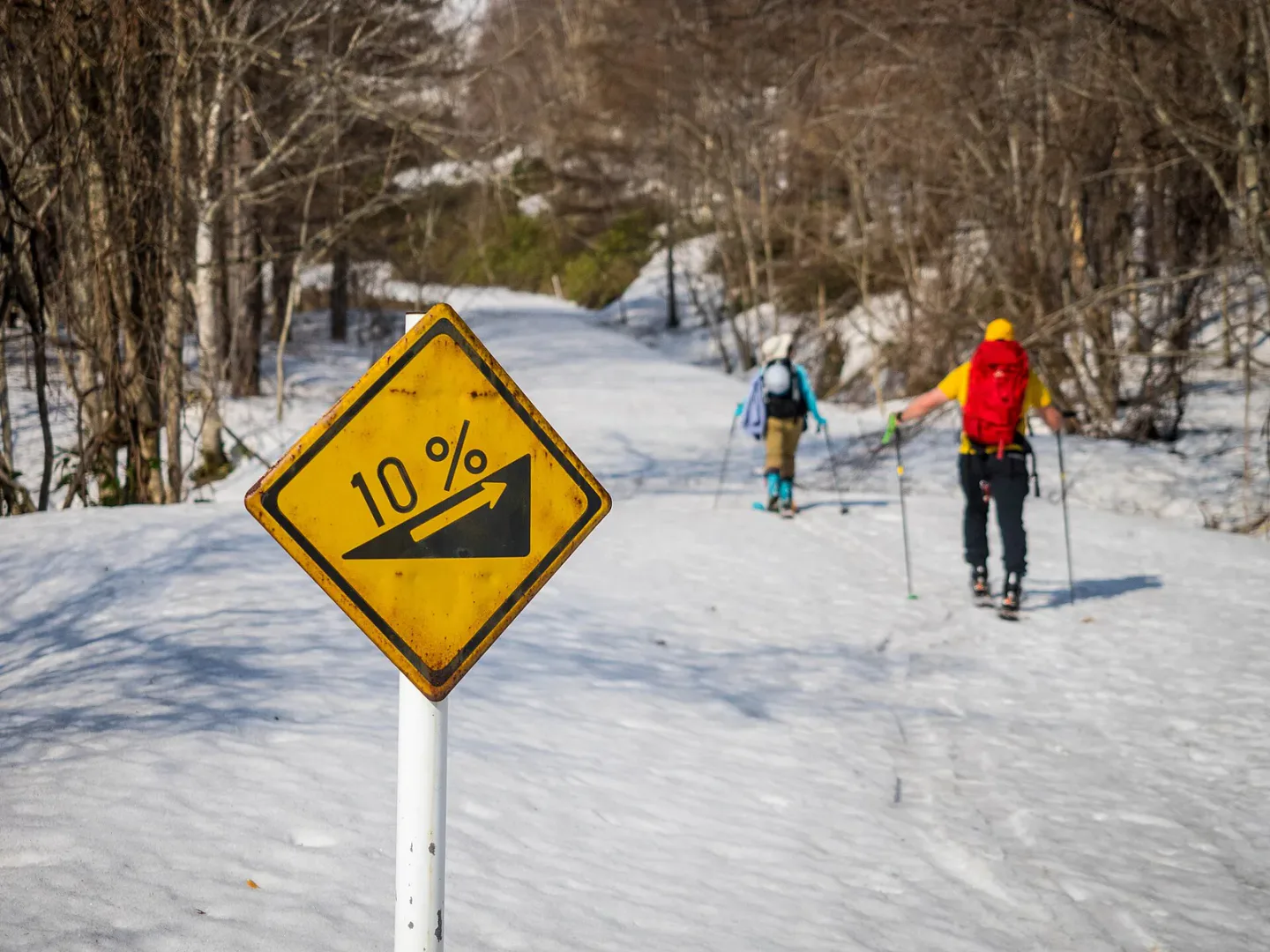
This retained photograph shows a ten-percent slope sign and two people walking with equipment. It illustrates the effort of an uphill approach with skis; it is not identified as a Hirafu trail or a measure of any particular hotel's walk. Ask about the actual winter route from your room to the rental shop and lesson entrance.
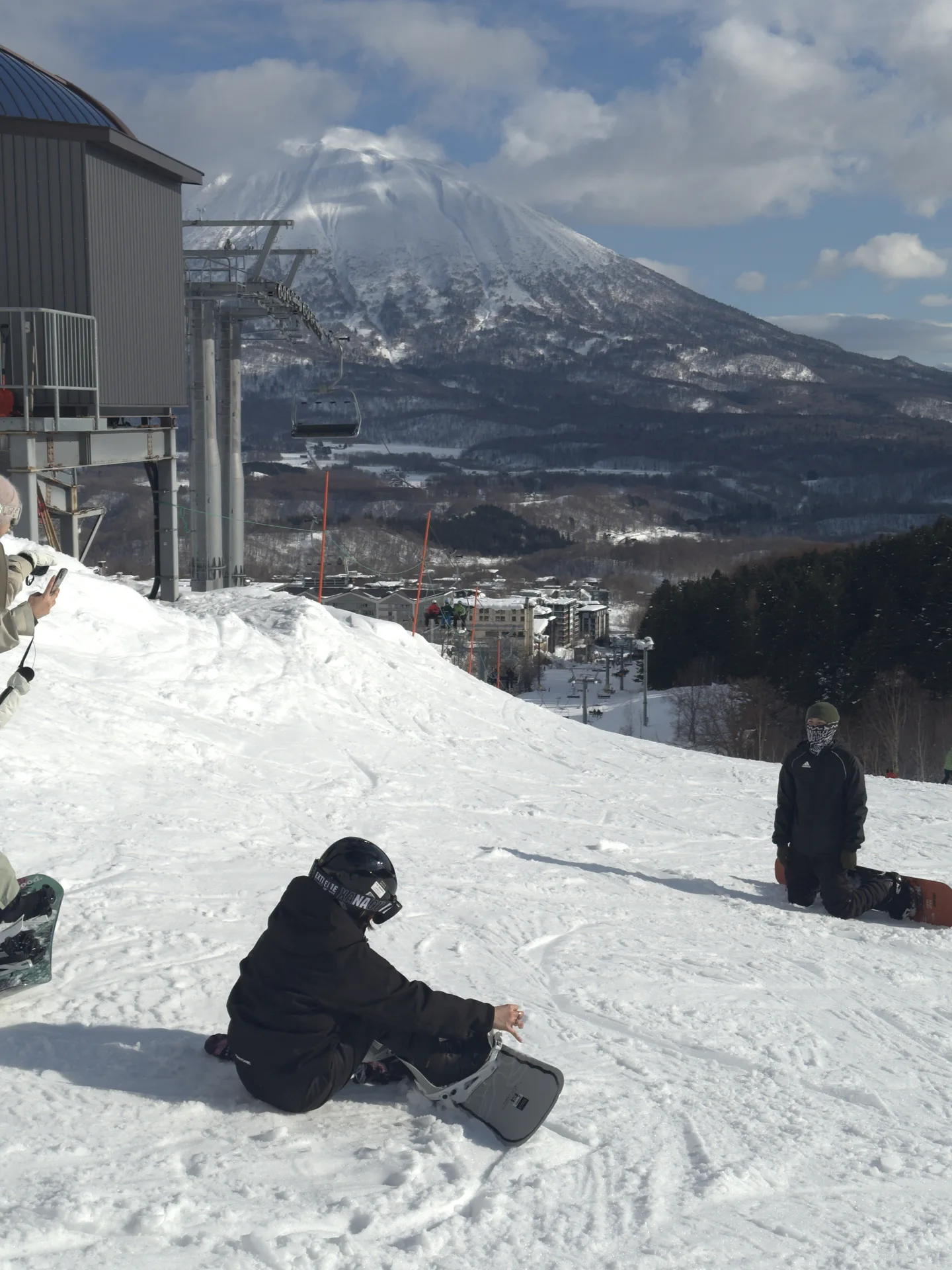
The photo shows a lift, a prepared snowy slope and Mount Yotei across the valley. It does not show that a ridge connection is open or that fresh powder is accessible. Use the live lift and weather reports on the morning of each ski day, particularly when a second sector or upper terrain is the reason you paid for All Mountain.
The first ninety minutes are a hotel and equipment problem
For a first-time skier, the route before the first run contains several separate hand-offs: breakfast, walking or shuttle, rental sizing, boots, any locker, school registration, the meeting point and then a suitable easy lift. A close hotel can still deliver a late start if the rental shop or lesson is across the village. Book the lesson and rental together where possible, then judge accommodation by the weakest skier's morning journey. The Niseko base comparison is more useful once you know which area the school actually uses.
Upper Hirafu may remove transfers for a guest whose hotel exit, ski storage and beginner route genuinely connect to the slope. That last word matters: a property can be called “ski-in/ski-out” while its return is awkward for a novice or only practical when a specific run is open. Compare the actual guest door and ski-back route before paying a large location premium. Central Hirafu can be easier for dining, equipment shops and mixed groups, even with a short transfer to the first lift. Lower Hirafu may give more room for the money, but its uphill walk or shuttle dependence recurs both before skiing and after tired legs return.
Advanced skiers face the same chain with a different cost. On a fresh-snow morning, rental fitting after lifts open, a missing glove or an uncollected pass can use the part of the day that cannot be recreated at 14:00. Set out the gear and identify the morning lift the night before. Check what actually opens rather than treating the deepest overnight snowfall as a promise that the highest chairs will run. A base queue may be long while other open terrain has capacity; a line at the first chair is information, not a command to stand there indefinitely.
For mixed abilities, the accommodation decision should be shared and the slope plan need not be. A beginner can take a lesson and repeat gentle terrain while a stronger skier seeks steeper runs. Agree on one lunch or after-ski meeting point, and make sure the weaker skier can return without following an unsuitable route. If one traveller does not ski, the village's cafés and restaurants make an independent day easier than a remote slope-only base, but a snowmobile outing is an active day rather than quiet waiting time.
Powder and crowds depend on what opens, not a fixed secret route
Grand Hirafu's appeal to confident skiers includes the possibility of fresh snow, but queues and closures determine how much of it a particular day yields. Keep the morning flexible around patrol and wind notices. A plan based entirely on one exposed lift can fail even when the snow underfoot looks excellent. Lower open terrain, an earlier lunch, an appropriate lesson or a later session can be better uses of time than waiting without a realistic reopening signal.
Fresh-snow demand also moves through the day. The first obvious base queue can be crowded precisely because it is convenient for everyone arriving at the same time. Once several lifts operate, moving toward suitable open terrain may be more productive than repeating that queue. This is not advice to enter closed terrain, ignore patrol boundaries or pursue untracked snow beyond your ability. The wider Niseko trip guide explains how the four sectors, transfer and budget choices fit together before a powder forecast narrows attention to one morning.
A restaurant plan can quietly work against a powder plan. Hirafu has a broader dining scene than many self-contained ski bases, and the places a group cares about may need reservations. A late sitting, winter walk back to the apartment and a short night's sleep are costs paid at first lift the next morning. Reserve the meals that genuinely matter and keep simple breakfast or groceries where you stay. Niseko food logistics become especially useful for families or a group whose members finish skiing at different times.
Night skiing should earn its place in the day
The advertised 2026–27 night-ski period is 12 December to 22 March, subject to conditions. The local ticket page lists an evening 16:00–19:00 product during the regular and peak tariff bands; at peak it shows ¥6,200 online or ¥6,900 at the window for an adult. A full-day ticket can run through night operations on its final day during the night season, but check the exact product conditions. Night skiing is especially useful after an arrival that leaves too little daylight to justify a whole-day pass.
It can also give a beginner a calm chance to repeat what was learned in a daytime lesson, provided the person still has energy and can see comfortably. A poor daytime session caused by wind may be partly recovered if conditions improve later. After a demanding full powder day, the calculation reverses. Extra laps can make the next, more valuable morning worse. The question is whether tonight creates a meaningful session or merely lengthens an already complete day.
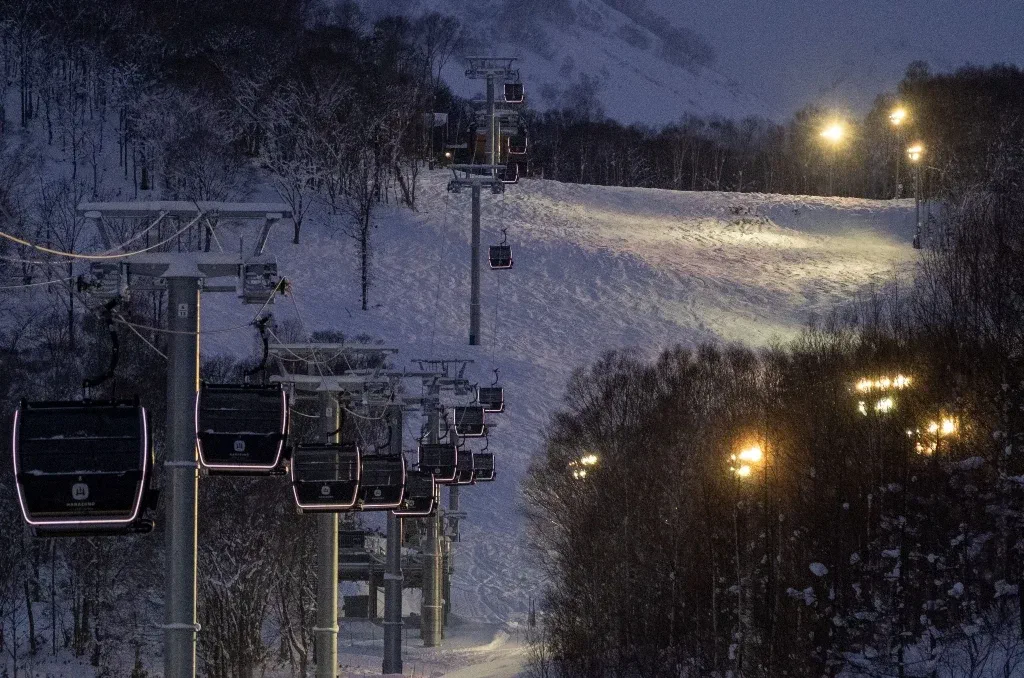
The evening photograph shows lamps along a snow-covered run and gondola cabins overhead. It gives a realistic sense of the lit terrain but cannot establish which lifts will operate on a future night. Do not reserve a late dinner that makes the transition from slopes to food a race, particularly if the group must return rental equipment or get children to bed.
A three-morning plan leaves room for weather and different ability levels
On the first complete local morning, make the geography familiar. Collect and fit equipment, meet any instructor, find the easiest suitable lifts and learn the routes back to the village before seeking a second sector. A group's first-day success is a shared set of workable return routes, not a maximum count of runs. If energy survives, the evening product can add a modest session; it need not be booked as an obligation.
Keep the second morning for the most important skiing. The night before, set out equipment and check the first lift you intend to use. At breakfast, change the route if wind, visibility or the lift board does not support yesterday's plan. A powder-focused skier may use this morning for the best available snow. A beginner may instead use it for a second lesson or steady practice. The same hotel can serve both when the meeting point is clear and each skier can get home safely.
Use the third morning to branch only if there is a reason. If Hirafu and HANAZONO still provide the terrain and lesson progression you want, a local ticket is coherent. If Annupuri or Niseko Village is an actual goal and connections or shuttle service make the transfer sensible, All Mountain provides the permission to go. For a group that already owns All Mountain, crossing simply to “use the ticket” can still waste the best conditions near its hotel.
↔ Scroll table left or right
| Trip pattern | Pass and route starting point | What could change it |
|---|---|---|
| Beginner, first morning in Hirafu | Local access aligned with lesson and rental | School meets in another sector or the group needs shuttle access |
| Two or three complete mornings on the Hirafu side | Price the local multi-day ticket against the same dates online or at the window | A planned Annupuri or Village day becomes practical |
| Confident skiers using several sectors | All Mountain if the transfer plan survives a closed ridge | Wind removes the connection and shuttle travel exceeds the terrain benefit |
| Partial arrival afternoon | Consider an afternoon or evening local product | Transport delay, fatigue or rental closing removes useful ski time |
| Rest after a hard powder day | Skip an automatic night session | The next morning is deliberately slow and conditions are good after dark |
Airport and road travel belong in this plan. A New Chitose arrival can consume a substantial portion of a winter day before check-in and rental. Compare the airport-to-Niseko transfer against your actual flight and ski bag, then decide whether the first evening is usable. The same caution applies to departure: a final run has less value if it threatens equipment return and an onward journey.
What to pay for before snow, and what to leave flexible
Accommodation, a sought-after lesson and equipment in the right location may justify early commitment because availability constrains the first day. Lift passes require a different assessment. Niseko United's online terms describe non-refundable purchases for ordinary illness, injury, transport disruption, buying mistakes and most weather-related changes, and a separate non-refundable ¥500 keycard purchase. An online discount does not make a ticket flexible. A family with fixed hotel, lessons and airport transfer may accept that risk; a traveller still choosing between skiing and a rest day may prefer to decide later.
The current local site advertises roughly five percent off online versus ticket-window prices, but its purchase links were marked as preparation at the time of this review. Read the live purchase screen and cancellation terms before assuming a tariff shown on a website can be secured today. The resort does not sell local four- to seven-day products at Grand Hirafu ticket windows. A party expecting to purchase five local days at the first morning counter could be forced into a different product. The .Base, Mountain Center and Ace Family ticket locations have different seasonal dates; the Welcome Center is for collecting an already bought online ticket, not ordinary counter sale.
The conclusion is a route decision before a pass decision. Hirafu's village helps when mornings, meals and different skier abilities are planned from the actual hotel. Use the published 2026–27 local and All Mountain figures to price that route, then allow for wind and the season's operating days. For lodging, compare stays in Hirafu after identifying the lesson and first-lift side you need.
Other related guides and resort information: Niseko ski-in/ski-out hotel comparison · Grand Hirafu — 2026–27 operations and local-ticket publication notice · USJ Horror Night Last Train 2026: Umeda, Namba and Backups · Avoid Kyoto Autumn Crowds in 2026: Rail Corridors, Early Starts and Hotel Bases · September Grand Sumo Tokyo 2026 Is Sold Out: Resale and No Walk-Ups · Niseko Private Ski Lessons 2026–27: 3 Hours vs 6 Hours, and Who Should Share? · USJ Halloween Horror Nights All Night 2026: Tickets and Plan · Best Dates for USJ Halloween 2026: Crowds, Prices and Hotels · Port of Nagoya Public Aquarium 2026: How Long to Spend and When Night Entry Is Worth It · Miraikan Grand Antarctica Exhibition 2026: Tickets, Highlights and Odaiba Plan · Free Autumn Leaves in Kyoto 2026: Parks, Paths, Ginkgo and Routes · Hiroshima Night Food Tour 2026: Worth US$100 If the Menu Is Not Guaranteed? · Nada no Kenka Matsuri 2026: If You Only Go One Day, Choose Oct 15 · Gujo Odori 2026: What Dates Are Left After the All-Night Dance? · Yamaga Lantern Festival 2026 Seats: Refund Deadline, Ticket Types and What You Get Back · Osaka Night Views: When Free Beats the Observation Deck — and When HARUKAS 300 Is Worth Paying For