
The Osaka Amazing Pass does not make every Osaka hotel equally convenient. Cross Hotel Osaka places you by Dotonbori, where a Tombori River Cruise ticket must be exchanged for a timed sailing and evening seats can sell out. Hotel Granvia Osaka sits directly at JR Osaka Station in Umeda, closer to an early northern start but farther from a late Dotonbori return. A pass day that begins at Umeda Sky Building and ends on the canal pulls in both directions. Choose the hotel by the first timed attraction, the last return and the room you will actually sleep in. The pass itself covers selected transport and participating attractions; it does not make a premium hotel room or every museum exhibit part of the ticket.
JapanLayer hotel assessment by dimension
↔ Scroll table left or right
| Hotel | Access | Space | Comfort | Cleanliness | Neighbourhood | Service | Value |
|---|---|---|---|---|---|---|---|
| Cross Hotel Osaka | 7.0/10 | 8.0/10 | 8.0/10 | 8.0/10 | 10.0/10 | 7.0/10 | Insufficient evidence |
| Hotel Granvia Osaka | 9.4/10 | Insufficient evidence | Insufficient evidence | 8.8/10 | Insufficient evidence | 9.1/10 | Insufficient evidence |
Where the pass-day minutes go
↔ Scroll table left or right
| Decision detail | Cross Hotel Osaka | Hotel Granvia Osaka |
|---|---|---|
| Strongest pass-day edge | Short return after a Dotonbori cruise | Start near Umeda attractions before 15:00 cutoff |
| Station approach | About three minutes from Metro Namba Exit 14 | Directly linked to JR Osaka Station |
| Two-bed category risk | Confirm named twin and view | Casual Twin 17 m², atrium window; Standard Twin is another category |
| Timed attraction friction | Cruise slot still requires same-day exchange | Sky Building pass admission has a 15:00 limit |
| Next-day fit | Namba food and city evenings | JR arrival or onward rail |
| Transport check | Nankai and Metro approaches differ | Pass coverage does not make all JR rides free |
Swipe to compare the hotels
The pass day has two clocks
The first clock is attraction admission. Umeda Sky Building's Kuchu Teien Observatory currently accepts the Amazing Pass for admission only until 3 p.m.; after that the pass gives a discount rather than free entry. The Tombori River Cruise needs a same-day exchange for a specific departure, and popular evening departures can fill. Osaka Castle Museum has its own closing and last-entry times. A trip that casually schedules all three after lunch can lose much of the pass value. The Amazing Pass itinerary should be arranged in time order before hotel cost enters the calculation.
The second clock is the hotel return. Cross is about three minutes on foot from Osaka Metro Namba Exit 14 and one minute from the Dotonbori area. If the cruise finishes after dinner, a family or couple can walk back without another station transfer. Granvia is directly connected to JR Osaka Station; the traveller must still get back from Namba by metro or another suitable line, then navigate the Osaka/Umeda station complex. That journey may be easy for a couple carrying no bags, but it is not equivalent to a one-minute Dotonbori walk. The Cross Hotel's Dotonbori-location analysis isolates what that premium actually buys.
An early Umeda start reverses the argument. Granvia lets a guest begin beside Osaka Station and walk or take a short onward journey towards Umeda attractions. Cross guests first leave Namba. The pass covers specified train and bus services, but the minutes spent descending to a platform, riding and exiting do not disappear because fare is included. If you prefer a morning observatory visit before the 3 p.m. pass cutoff, Granvia can make the start more forgiving. The Osaka observatories comparison helps decide whether Umeda Sky Building should be included at all.
Decide whether your route begins in Minami or Kita
For a Minami-led day, book a Tombori River Cruise sailing during the daytime, then use the afternoon for an attraction that fits the remaining pass hours. Cross makes the ticket-exchange errand easy to combine with breakfast, since you can approach Dotonbori early and return to the hotel area later. The cruise desk starts distributing timed tickets before the first sailing; a traveller who waits until dinner to request an evening sailing may find it full. A Cross stay does not reserve a seat for you. It simply reduces the cost of reaching the exchange point and returning after the ride. The Osaka Namba shopping and hotel guide is useful if the evening also includes stores and food.
For a Kita-led day, start near Granvia, visit the Umeda attraction while pass admission applies, then travel south for the castle or canal. That route can avoid one return to the north before noon. It works especially well when your next day is a JR departure from Osaka Station. Granvia's front desk is on the nineteenth floor, so allow lift and station-navigation time even though the building is station-connected. Its access directions distinguish the Central, Sakurabashi, Bridge and West exits for different arrivals and accessible routes. A station-linked hotel is not a guarantee that every platform is beside reception. The Granvia Osaka station access guide explains that final indoor route.
The Amazing Pass is a poor reason to select either hotel if your actual day is centred on Universal Studios Japan or a Kyoto day trip. The pass has defined transport coverage and participating attractions; it is not a universal regional rail ticket. A USJ-focused itinerary needs a different hotel and ticket calculation, while a Kyoto day requires a separate rail plan. The Osaka pass comparison and Osaka hotels for Kyoto and Kobe day trips keep those expenses separate. Pay for a pass only on the day its covered attractions justify it.
Room category can outweigh the location gain
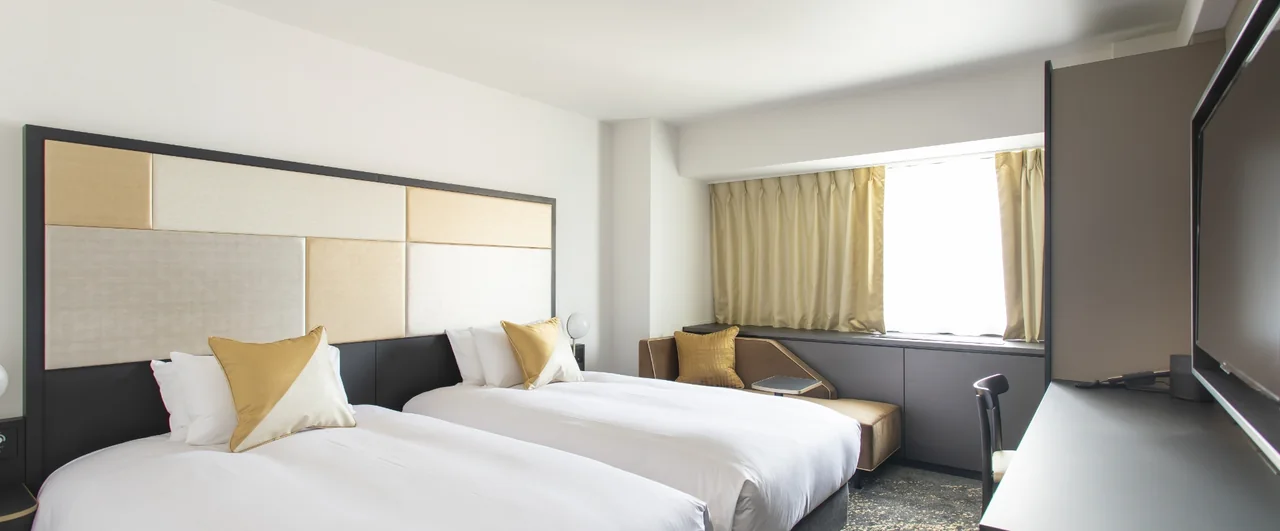
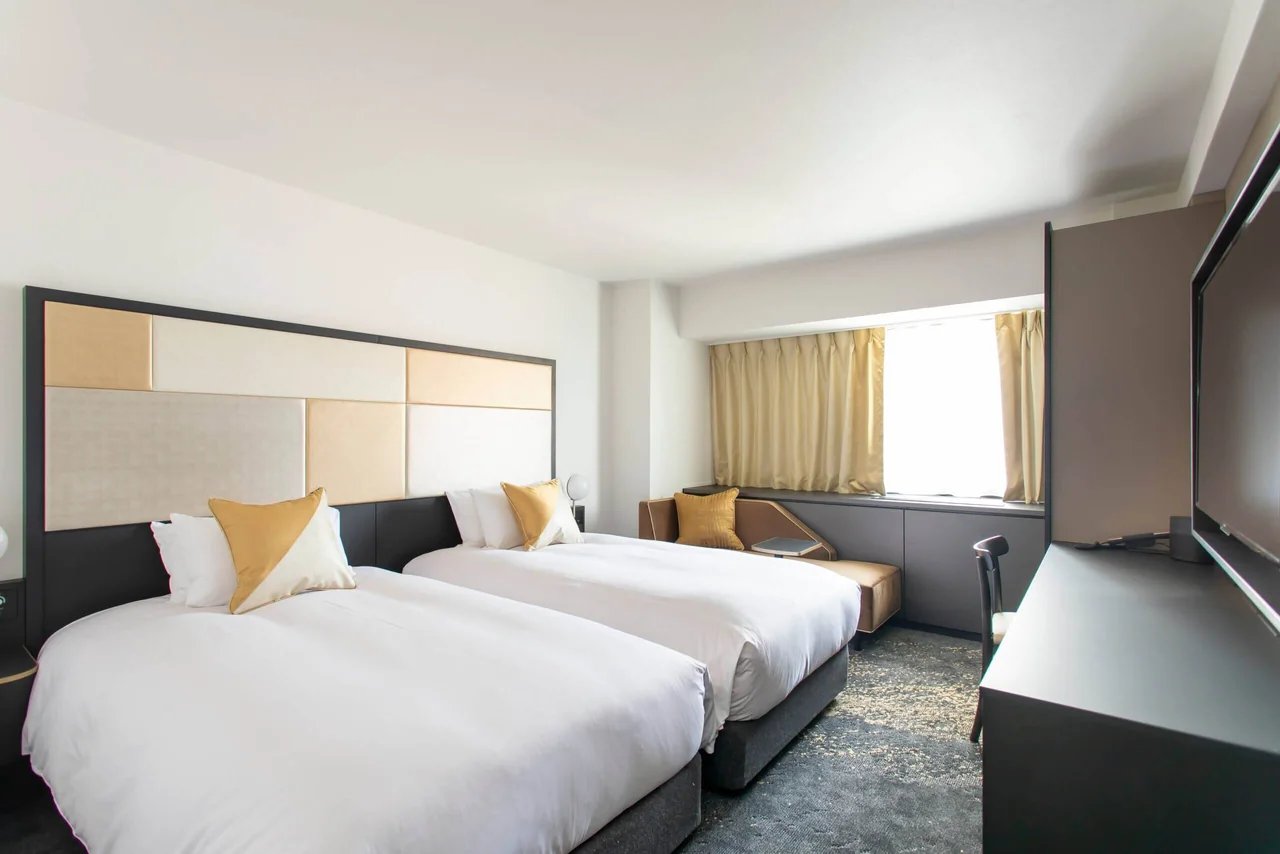
Cross Hotel Osaka offers a room experience suited to a short city stay: its rooms are described with separate bath and toilet arrangements, and several categories look toward the Dotonbori side. But a “Cross Twin” and a lower-category twin are not automatically identical in size, view, lounge access or price. A couple seeking separate beds should inspect the named twin, bed widths and cancellation cutoff. The Dotonbori-facing premium may be wasted if the group will arrive after dark and leave at dawn, or if the room window does not show the scene imagined from a listing's exterior photograph.
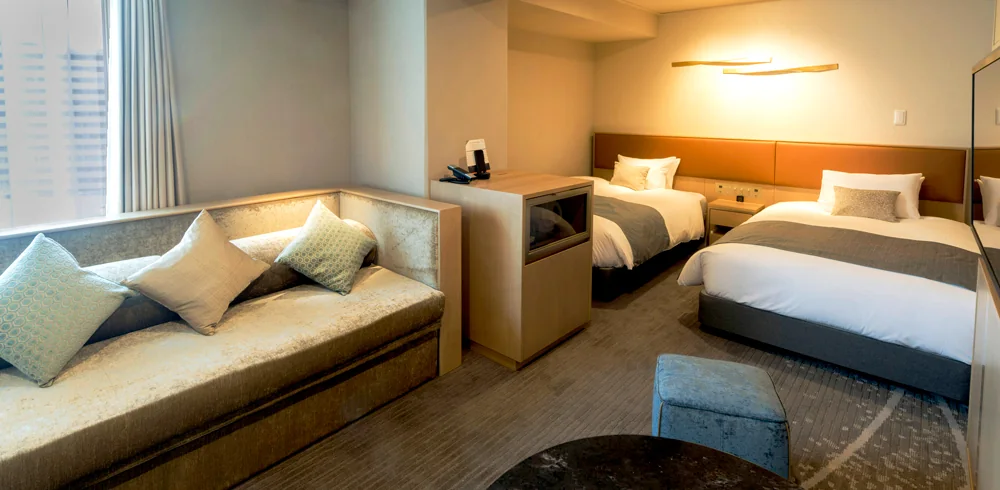
Granvia's twin range is especially broad. Its Casual Twin is 17 square metres with two 97-centimetre beds, a window facing an internal atrium and no outward city view. The Studio Twin is 20 square metres, with one regular bed and one additional bed arrangement. The standard twin and larger grades move beyond those entry categories. A search result that displays the cheapest “twin” can therefore make Granvia appear better priced while delivering less room and no city view. Compare the exact category against Cross's exact twin rather than accepting a generic hotel-level rate. The Osaka Station hotel comparison gives nearby alternatives if the relevant Granvia category is unavailable.
For a solo traveller, a smaller Granvia room may be a sensible use of money when the pass day is spent almost entirely outdoors. For two adults with large cases, the same room could be cramped after a day crossing the city. Cross's separate bathroom layout may be more valuable if both travellers want to bathe before dinner. The useful comparison is the room's function during the hours you will be inside it: sleeping, unpacking, dressing and perhaps waiting for a rainy afternoon to pass. The Namba versus Umeda stay guide covers district choice beyond this single pass day.
A family should not infer four-person capacity from two large beds or the word “twin.” Granvia lists named family and connecting categories, including a Family 4 around 43 square metres; Cross may require a suitable triple or a second room depending on ages and occupancy. Enter every child and compare actual named rooms before treating one property's cheaper double as a family solution. If the hotel part of your stay lasts several nights, a kitchen or laundry elsewhere in Namba may be more valuable than a central pass-day location. The Osaka hotels for groups and Osaka long-stay hotels widen that room comparison.
The pass has exclusions that change your day's value
The current Amazing Pass attraction list treats each participating facility as a once-per-validity-period admission, not an unlimited re-entry card. Some places have narrower windows, reservation steps or a discount rather than free entry at certain times. Umeda Sky Building's 3 p.m. cutoff is one concrete example. The Tombori River Cruise's time-slot exchange is another. The Osaka Museum of Housing and Living is listed for a temporary closure from September 2026 into early January 2027; building a 2026 autumn pass plan around that stop would be a mistake. Check the date-specific list before buying the pass, then price the hotels around the attractions that remain usable. The Amazing Pass overview is a quick starting point, but the day-specific route matters more.
The pass also cannot solve opening-hour conflicts. Osaka Castle Museum can close well before an evening cruise, while shops and Dotonbori food continue later. If the plan is Castle in the morning, Umeda in the early afternoon and Minami at night, Granvia supports the first departure; Cross supports the late return. If Umeda is skipped and the day is mostly Castle plus Dotonbori, Cross's return advantage grows. If the group is doing a mainly northern museum day, the pass may be valuable even when Cross is not the best bed. The Osaka attractions map helps test whether the proposed sequence crosses the city unnecessarily.
The date matters for transport as well. The 2026–27 Amazing Pass has different one-day, two-day and 28-hour products. Transport coverage varies by product; the one- and two-day details name Osaka Metro and specified private railway segments mainly within Osaka, with exclusions. JR travel and trips beyond the covered zones should be priced separately. Staying at a JR-linked hotel does not mean every rail journey from its doorstep is covered. A guest at Granvia may need to walk to a covered metro entrance for a particular pass journey, while a Cross guest may be beside a suitable Namba metro entrance. The Osaka seven-day budget itinerary is a useful check on when a pass day belongs within a longer stay.
Arrival and departure can reverse the pass-day answer
A Kansai airport arrival on a Nankai train naturally reaches Namba. Cross is roughly ten minutes from Nankai Namba by its own route description, despite the shorter three-minute claim from the Metro's Exit 14. Granvia requires an onward move to Osaka/Umeda unless the airport rail route has already been chosen for Osaka Station. Conversely, an arrival on a JR airport service or an onward JR journey can favour Granvia. The Kansai airport to Osaka route guide should be settled before using a hotel's nearest-station headline to choose the room.
An early Shinkansen from Shin-Osaka introduces another transfer. Granvia's Osaka Station location can make the JR leg feel straightforward, but it is still a separate ride and station change. Cross needs a journey from Namba, potentially by the Midosuji Line. If missing the train has a high cost, allow a morning buffer and compare a Shin-Osaka hotel as well. The Shin-Osaka early-train hotel guide addresses that specific final night. A pass-day hotel should not be chosen solely for attractions if the following departure is time-critical.
For a couple staying two nights, consider which day is the pass day. A Cross room can be a natural base for a Dotonbori evening on both nights, even if the pass itself is used only once. Granvia can be better when one day is the pass route and the other is a JR-led Kyoto, Nara or Kobe outing. The Osaka day trips guide helps count those repeat journeys. The pass is a one-day or defined-period product; the hotel affects every day of the booking.
Open the right quotation first
If the trip's strongest event is a night cruise and dinner in Dotonbori, start with Cross Hotel Osaka. Price a named twin or other suitable room, verify whether the room or rate includes any lounge or meal feature you expect, and remember that hotel proximity does not reserve the cruise. If the strongest event is an early Umeda attraction followed by a JR departure, start with Hotel Granvia Osaka. Avoid judging its value from the 17-square-metre atrium-facing Casual Twin unless that is genuinely the room you want.
Then put both totals beside the same pass-day timeline: the first attraction's entry deadline, any same-day ticket exchange, transport segments outside the pass, dinner, last return and the next morning's train or flight. A hotel that saves fifteen minutes once may not justify a large room premium across three nights. A hotel that makes the same late return easy every evening can. The decision becomes clearer when the room category and the actual pass attractions are fixed together, instead of comparing the pass and the hotel as separate shopping tasks.
Updated 4 October 2026. Check the pass's participating-venue and transport list for the exact use date.