
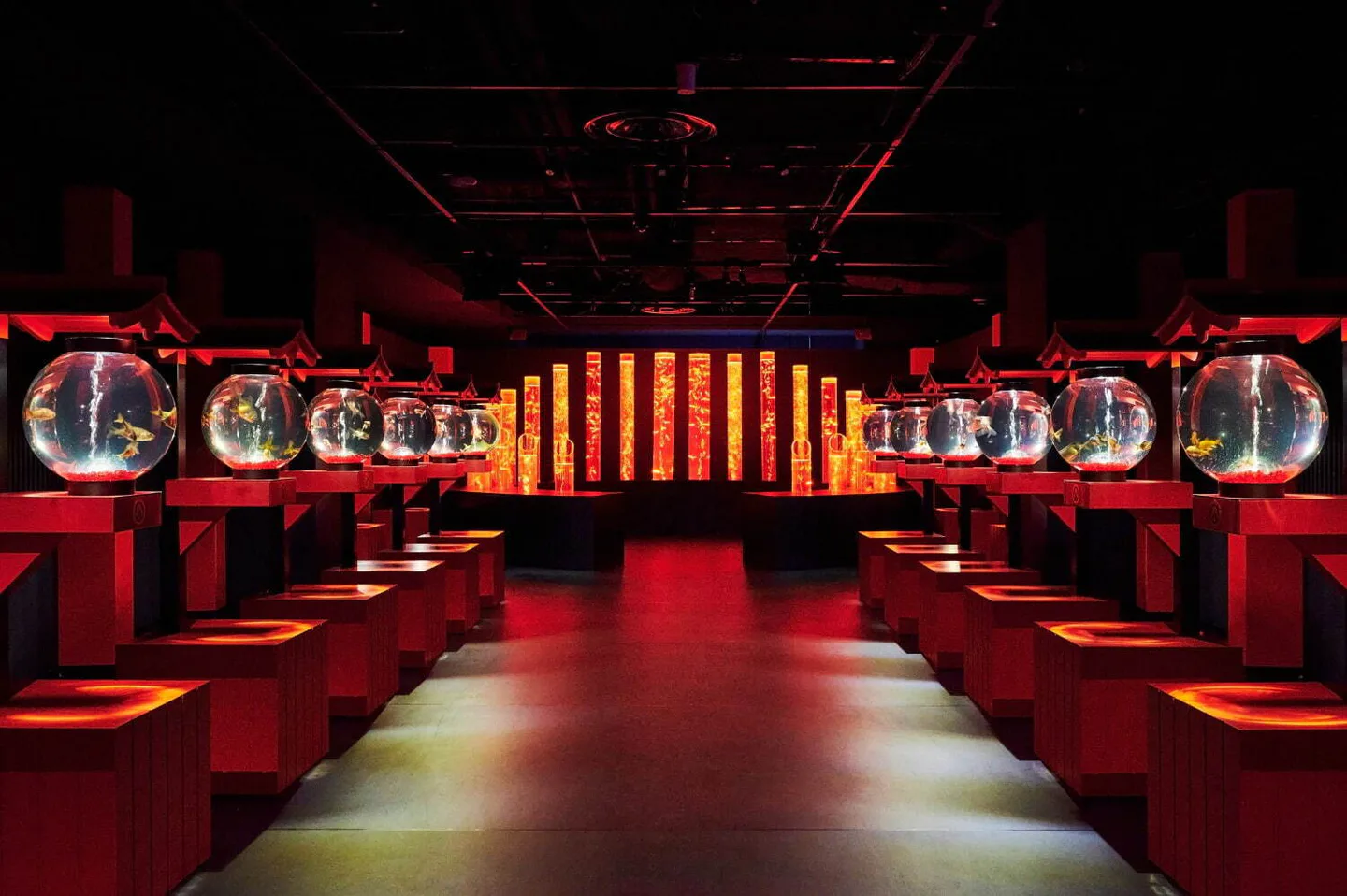
Art Aquarium Museum GINZA is a short visit built around live goldfish, shaped tanks, lighting and sound. The general web ticket is ¥2,500; a same-day ticket from the Ginza Mitsukoshi machine is ¥2,700. The price makes most sense when you are already in Ginza or nearby Yurakucho and want roughly 60–90 minutes of visual art. Crossing Tokyo solely to see it adds a larger time cost than the ticket difference suggests.
There is a date limit now. The museum has announced that its Ginza Mitsukoshi exhibition will end on 6 January 2027, after its final seasonal programme, Ginza no Kingyo Hyakka-ten, which began on 2 October 2026. The Summer Art Aquarium 2026 display ended on 30 September; its special yokai-themed evening programme ended earlier, on 12 August. Neither summer format is the admission product being sold for an October visit. If the closing season interests you, read the date in the live ticket flow before building an itinerary around it.
The museum's fish are living animals used in the installation. That is a personal decision before the ticket maths. If ornamental goldfish displayed in sculptural tanks are the subject you want to see, Ginza can be an efficient place for it. If using animals as visual media is unacceptable to you, choose a collection-led art museum or another indoor activity. The operator's description of the exhibition does not settle a visitor's welfare concerns.
What kind of visit is this?
↔ Scroll table left or right
Your deciding question | Fit | Reason |
Already in Ginza and want a compact visual stop | Strong | The museum sits inside Ginza Mitsukoshi and can join the same district day. |
Expect species variety, large habitats and aquarium education | Poor | Goldfish and designed visual environments are the point here. |
Uncomfortable with live fish displayed as art | Skip | Geographic or ticket value cannot remove that concern. |
Only one major immersive-art slot in Tokyo | Compare first | teamLab can anchor a day; this museum's advantage is its smaller time footprint. |
Visiting with young children | Conditional value | One paid general or student admission covers up to two children of elementary age or younger, but strollers cannot enter. |
Arriving with a suitcase or dependent on a stroller | Solve storage first | Both are excluded inside and the museum has no luggage lockers. |
Expecting the summer evening overlay | Wrong season | The after-16:00 yokai-themed programme ended on 12 August 2026. |
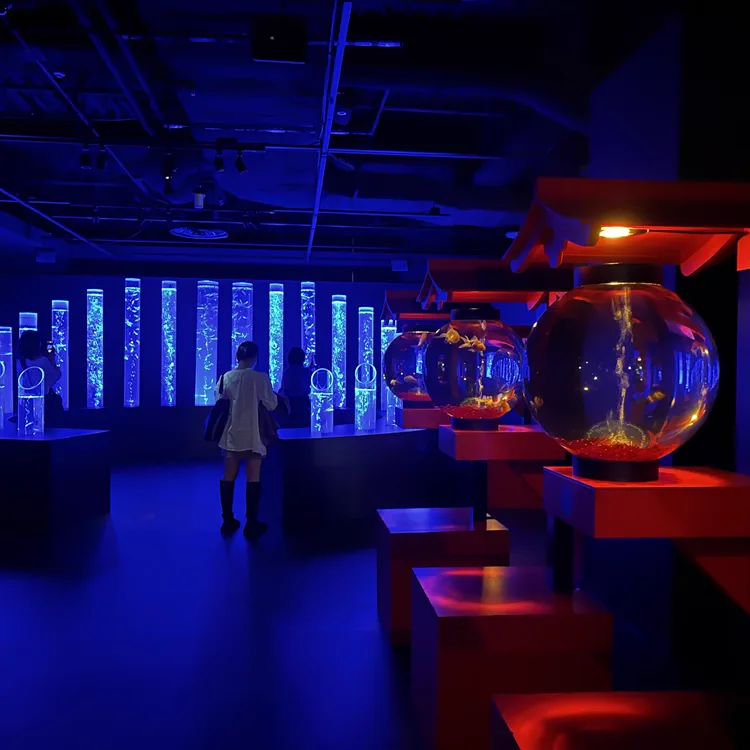
In the exhibition, tanks and fish work with colour, fragrance and Japanese-inspired design. A conventional aquarium asks for different criteria: breadth of species, interpretation of habitats and often much more space. The word “aquarium” should not make you expect that kind of institution here. A visitor who mainly wants fish education could be disappointed even if the installation looks impressive in photographs.
The live-animal question cannot be resolved by a route score. Some visitors regard ornamental goldfish displays as part of a long visual tradition and are comfortable buying a ticket. Others would rather not fund an exhibition where the animals are central to the design. The museum explains what it presents, but a venue's own exhibition description is not an independent assessment of husbandry. If that missing kind of evidence is a condition for you, make the choice before selecting an admission time rather than expecting the word “art” to settle it.
Likewise, a small museum visit and a trip-defining immersive show serve different parts of a Tokyo plan. For non-animal collection art, consider Artizon Museum. If immersive work is the sole major art attraction on your itinerary, compare the available teamLab Borderless and teamLab Planets formats before assigning that slot to a shorter Ginza stop. The decision depends on the kind of experience, not a generic museum ranking.
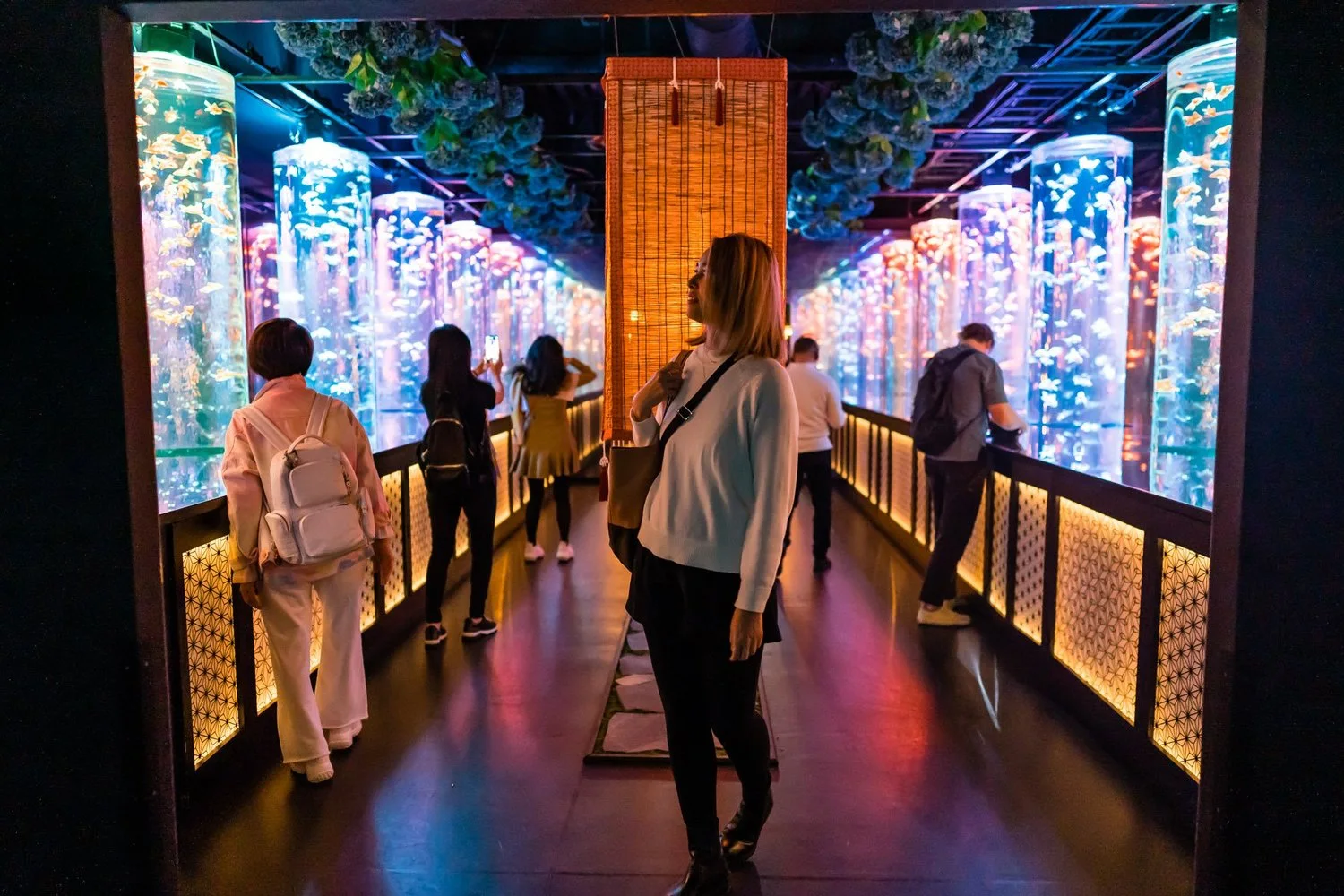
The route costs more than the ¥200 ticket difference
Hours are normally 10:00–19:00 with the last admission at 18:00, subject to Ginza Mitsukoshi closures and maintenance. A web ticket costs ¥2,500 and the machine ticket ¥2,700. The practical budget is the museum visit plus the trip to Ginza, your entry time and any baggage handling. An hour to an hour and a half is a planning allowance for the exhibition, not a limit on how long you may look at the fish or take photographs.
If you are already shopping in Ginza, eating in the area or moving between Yurakucho and Tokyo Station, the museum is a contained indoor block. If your day begins in Shinjuku or Asakusa and returns there immediately afterward, the same ticket can consume a much larger share of the day. That route difference is why a strong recommendation for one person is not transferable to every Tokyo itinerary.
Think through a hotel-transfer day separately. A suitcase that cannot enter means finding storage before your booked admission time, then retrieving it before the next train. The museum can be physically central and still be awkward at the point when you have bags. A normal Ginza afternoon without luggage can deliver the same display with far less coordination.
One workable central-day sequence is lunch around Yurakucho, a timed museum admission, then a Ginza walk or an onward train from Tokyo Station. The attraction stays within a compact geographic corridor, so its indoor hour does not trigger a second cross-city journey. Reverse the example for a Shinjuku-based day: if you travel to Ginza only for the exhibition and then return west for an evening booking, the museum's short indoor duration disguises a much larger block on the calendar. The rail fare may be modest, but the duplicated journey is the real trade-off.
Numbers for two different routes
↔ Scroll table left or right
Decision dimension | Already in Ginza | Dedicated trip across Tokyo | What changes |
Route fit | 9.5/10 | 4.8/10 | Building-level addition versus a new transport assignment |
Time efficiency | 9.1/10 | 6.3/10 | 60–90 minutes stays compact only if approach and exit do |
Weather resilience | 9.4/10 | 9.4/10 | The exhibition is indoors in either route |
Booking flexibility | 7.2/10 | 7.2/10 | Timed web entry and possible capacity waits |
Luggage and stroller resilience | 3.8/10 | 3.8/10 | No entry for either item and no in-museum lockers |
Family price efficiency | 8.8/10 | 8.8/10 | Up to two young children can enter with one paying visitor |
Experience distinctiveness | 8.0/10 | 8.0/10 | Living goldfish, sculptural vessels and staged light |
These are conditional planning scores, not a single quality grade for the art or the fish. The route changes two columns sharply while the exhibition itself stays the same. A live-animal objection or an unsolved suitcase problem is a stop condition rather than a low number to be averaged against good weather resilience. For that reason, one overall score would conceal the decision a visitor actually faces.
The time commitment can be written plainly: time inside the museum plus the district detour, any wait near the booked entry time, and the work of storing a stroller or bag. If the last three terms are small, the compact exhibition may fit easily. If they are not, a ¥2,500 ticket is only a small part of the purchase.
The scores for weather, booking and family pricing remain the same in both route scenarios because the venue's rules do not change with your hotel address. Route fit and time efficiency do change. That distinction prevents a misleading verdict such as “good value for everyone”: a rainy day may favour an indoor museum, but rain does not remove a suitcase, make a stroller admissible or turn a timed ticket into an open-ended reservation. Use the dimensions that actually differ in your itinerary instead of averaging every row into one number.
The final Ginza season has replaced the summer display
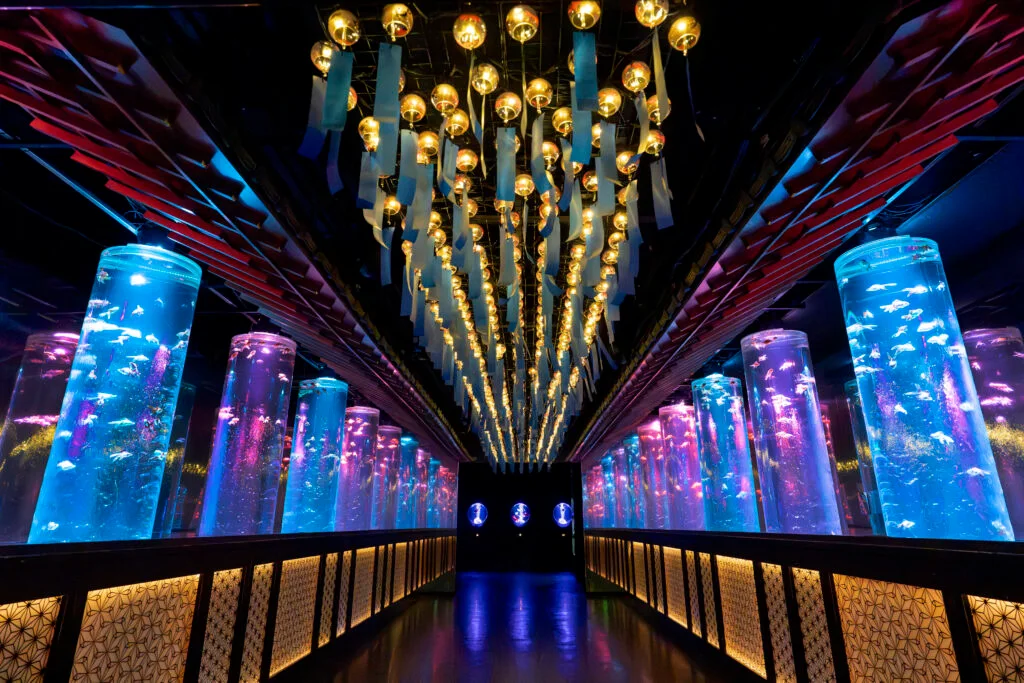
Summer Art Aquarium 2026 ran from 26 June through 30 September and included spaces promoted as the Goldfish Folding Screen Room, Super Oiran – Yui and Edo Kiriko-related displays. Those details describe the past summer programme. A second, shorter “Mystical Goldfish Museum” presentation ran from 21 July through 12 August with a special after-16:00 sound-and-light treatment. Old photographs and listings for those installations can still circulate, but they should not be read as an October ticket promise.
The current final-season exhibition opened on 2 October 2026 and is scheduled through the announced Ginza Mitsukoshi closing date of 6 January 2027. It uses autumn motifs including ginkgo and spider lilies in the operator's description. This is a particular reason to check the booked date: the seasonal visual setting may differ from both the summer imagery and the permanent-looking photographs you see online. The museum has said it plans another phase around its twentieth anniversary in 2027, but it has not supplied an alternative Ginza address in the closing notice.
There is no reason to delay merely to catch a summer event that has finished. Choose the final-season programme on its own terms. Visitors planning a Tokyo trip after 6 January 2027 should not put this Ginza Mitsukoshi venue into a fixed itinerary unless a later venue has been announced and is actually selling tickets.
The change matters especially for anyone arriving with a saved summer guide or a social photo of a particular room. A ticket for the final Ginza season is admission to the exhibition on that date, not a reservation for every installation shown during 2026. The Goldfish Folding Screen Room or Super Oiran – Yui may appear in archived summer coverage; the later autumn display has its own design. Use the current programme to decide whether the visual style appeals to you, and treat the July–August evening overlay as a past event.
Family admission and stroller handling pull in opposite directions
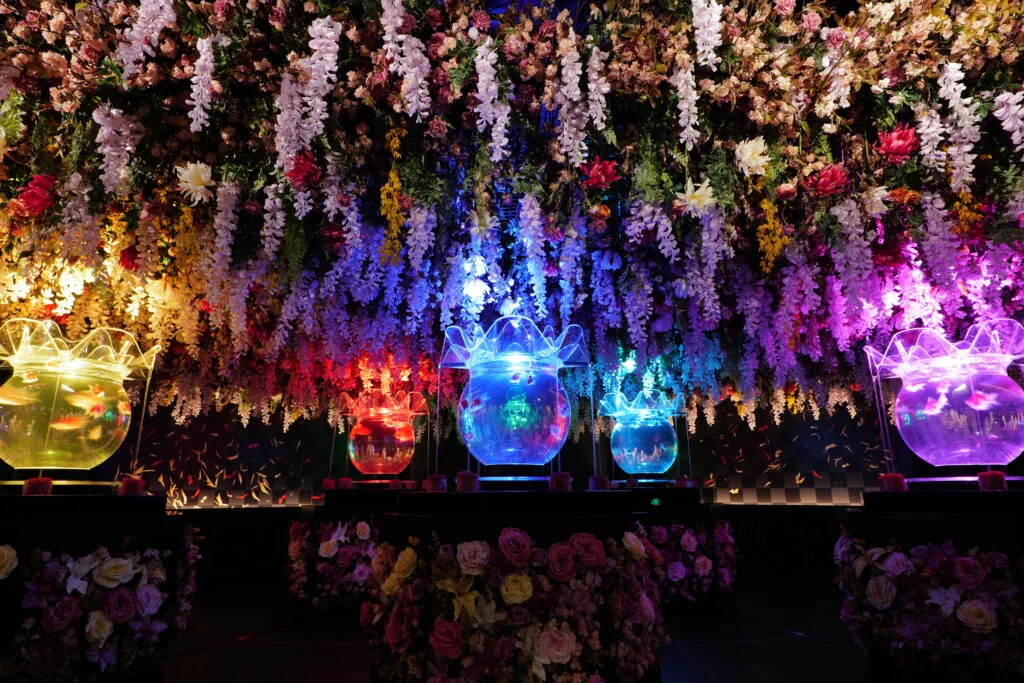
One general or student ticket holder may bring as many as two children of elementary-school age or younger without paying their admission. That can make the total price for a parent and young children attractive. It does not tell you whether those children want to spend an hour watching fish in dark, designed rooms. A child who likes colour and close-up tanks may enjoy it; a child who expects large animals or hands-on play is looking for another kind of outing.
Strollers cannot go into the exhibition. The museum directs visitors to leave them in a designated area on Mitsukoshi's ninth floor. Suitcases are also barred, and there are no luggage lockers inside the museum. A child who needs the stroller throughout a shopping day may need to walk or be carried during the visit. On a transfer day, store suitcases elsewhere before going up; do not assume the low child ticket cost makes that logistics problem disappear.
For a family with one paying adult and two free children, the arithmetic is favourable only if the adults can manage those practical conditions. If a second adult is coming chiefly to help, their own paid ticket belongs in the total. The museum's family policy is a useful price fact, but the visit is still a visual exhibition with timed entry and a no-stroller interior.
There is a difference between “children are free” and “this is a children's attraction.” A child may enjoy following individual goldfish through illuminated tanks; another may become restless in rooms where they are expected to look without touching. The displayed fish themselves must not be touched. If the family needs a long block of interactive play, spend the low-cost museum opportunity elsewhere rather than stretching this visit to fill a morning. If an adult is particularly interested, the free-child policy makes a short shared look easier to justify without promising that every child will want the full 90 minutes.
Photographs are allowed; a perfect frame is not promised
Personal stills and video are permitted. Flash, external lights, tripods and monopods are not. That suits a phone or handheld camera but makes the result dependent on reflections, moving fish and other visitors. If photographs are the main reason to go, allow more than the usual 60–90 minutes; do not plan around an empty gallery or equipment the rules exclude.
The visual effect relies on dark rooms, bright tanks and movement. You may find an image you like quickly, or wait for fish and visitors to move. It helps to decide whether seeing the display itself would satisfy you even if the exact photograph you imagined does not happen. Paying for an attraction solely to reproduce an online frame makes the visit fragile, especially at a timed-entry venue you cannot re-enter later.
On a camera-led visit, the restrictions shape the equipment choice. A compact handheld setup is compatible with the rules; a plan that depends on flash or a fixed tripod is not. The fish and glass are reflective, and other guests are sharing the narrow visual corridors. Photography can lengthen the visit beyond a quick walkthrough, so protect a little space before the next booking instead of assuming that the suggested 60–90 minutes is a guaranteed exit time.
Put the timed ticket inside a workable Ginza day
Web admission is tied to a selected date and time. Capacity restrictions can still mean a wait, and leaving the exhibition ends that visit; re-entry is not part of the ticket. Deal with a meal, toilet stop and all bag or stroller storage before presenting the QR ticket. Then see the rooms in one continuous block and continue the Ginza day afterward.
↔ Scroll table left or right
Shape of the day | Likely fit | Why | Constraint to solve |
Ginza shopping or meal day | Strong | The exhibition fills one contained indoor window | Time the meal and shops around admission |
Wet central-Tokyo afternoon | Strong | Rain does not remove the indoor display | Entry and stroller rules still apply |
Tokyo Station or Yurakucho day with stored bags | Conditional | Ginza is already in the same central corridor | Confirm bag retrieval time |
Hotel transfer with a suitcase or stroller dependence | Weak | Storage and carrying can overtake the museum time | Move it to a normal sightseeing day if possible |
Only one major immersive-art slot | Compare teamLab | A short Ginza installation and a day anchor serve different purposes | Choose the specific experience you want |
Seeking a conventional aquarium | Poor | Species breadth and habitat education are not the main product | Choose an aquarium instead |
The museum is a good rainy-day substitution when you are already central; it is less spontaneous than an ordinary shop or café because the online entry time fixes the sequence. If the route requires a long trip from another district and a trip back, compare that travel with the art or aquarium choice you would give up. Ginza works best here as the existing setting of the day, not as a label that automatically makes the attraction worth a cross-city detour.
For an October 2026 to early January 2027 visit, the clearest positive case is simple: you will be in Ginza, you are comfortable with live goldfish as part of visual art, and an hour or so inside fits between your other plans. The clearest reasons to pass are an animal-medium objection, a wish for a conventional aquarium, a single immersive-art slot better spent elsewhere, or unsolved luggage and stroller logistics. The summer shows belong in the museum's history; buy only for the final-season display offered on your date.
If the museum is part of several central-Tokyo evenings, compare Ginza-area rooms for your dates rather than moving hotels for one short timed visit.
Museum and ticket details
Museum pages: Art Aquarium Museum GINZA — site · Summer Art Aquarium 2026 announcement · ticket store · 2026 limited evening-programme ticket page · visitor rules and opening hours
Related guides: Kanmon Strait Museum: When the ¥500 Ticket Is Worth It—and When the Free Areas Are Enough · Southwest Grand Hotel Okinawa Review: Is a 45 m² Room and Pool Worth the Urban-Resort Premium? · Kyushu National Museum Tickets: When ¥700 Is Enough — and When the Special Exhibition Is Worth It · JR Kyushu Hotel Blossom Naha Review: Is Kokusai-dori Access Worth Giving Up a Station-Front Stay? · JR Kyushu Hotel Blossom Shinjuku Review: Is the 25m² Superior Twin Worth It? · Sakura Castle: The Stamp Is Open 24/7 — The Castle Is in the Moats, Not a Keep · Mitsui Garden Hotel Osaka Premier Review: Is Nakanoshima Worth the Trade-off? · teamLab Borderless Tokyo Review: Is It Worth 2–3 Hours of Your Tokyo Trip? · lyf Tenjin Fukuoka Review: Is a 12m² Room Worth the Shared Kitchen and 24-Hour Lounge? · Kyoto International Manga Museum 2026: The ¥1,200 Ticket Is Cheap — Is It Worth 2–4 Hours?