
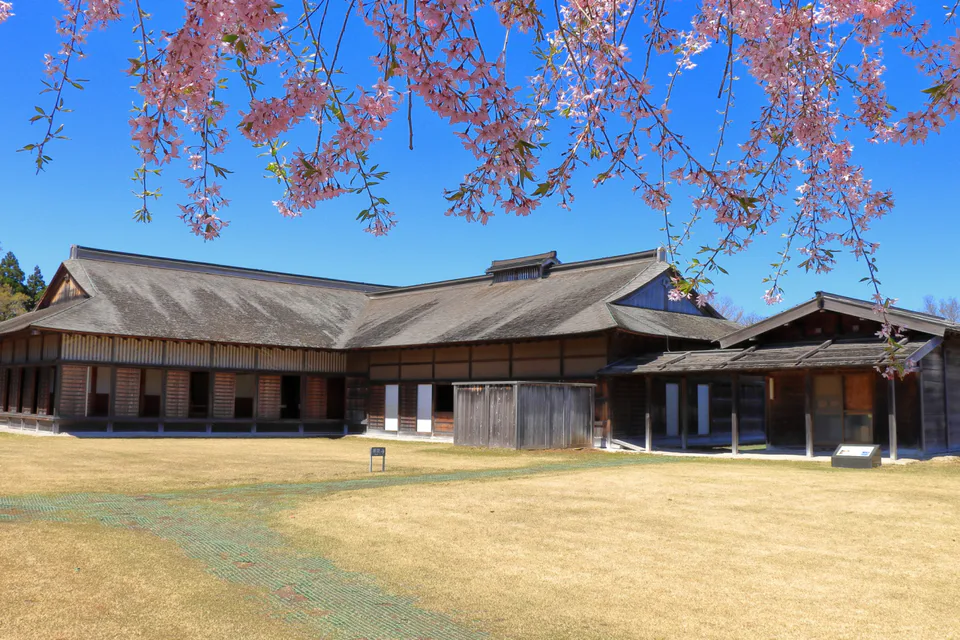
Nejo Castle in Hachinohe is most rewarding when you come to see how a medieval Nanbu stronghold worked, rather than to look for a stone keep. Earthworks and the outer site can be walked without paying, while the reconstructed main bailey costs ¥250 for an adult on an ordinary day. The buildings there turn a largely open landscape into a readable working compound: halls, storage and production spaces make the former castle's daily use easier to imagine. Japan 100 Famous Castles No.5 collectors have a separate, simpler task. The stamp sits outdoors beside the Hachinohe City Museum entrance and is currently available at any hour.
Those three experiences run on different clocks. The adjacent city museum remains closed for a long renovation, but Nejo's outdoor area and paid bailey are operating. An after-hours stamp cannot substitute for entering the reconstructed buildings. Conversely, someone who wants the main bailey should not cross Hachinohe only after its 16:30 last admission. Decide which version of Nejo you are making before choosing a train, a bus or an Akita-to-Aomori transfer.
Three Nejo visits with different payoffs
| Time and purpose | What to do | What you will miss |
|---|---|---|
| Late arrival or a collector's short detour | Use the outdoor No.5 stamp by the museum entrance. | The reconstructed bailey; the stamp is only proof of a stop. |
| About 30–45 minutes in daylight | Walk the free outer grounds and look across the earthworks. | The interior arrangement that explains the medieval site. |
| About 90 minutes or more | Enter the ¥250 main bailey and follow halls, work areas and defenses. | The closed city museum's broader Hachinohe collection. |
The best first visit is usually the third. At ¥250, the payment is small, but the time inside the reconstruction is the real addition. If Hachinohe is already a base for a wider Tohoku trip, a morning at Nejo can be a good use of the city's daylight. If you would need a large diversion from your actual route, the small ticket price does not make the trip efficient. Compare the overnight and transfer logic in the Tohoku base guide before treating Nejo as an isolated bargain.
The main bailey is the reason to buy admission
Nejo's appeal is architectural explanation rather than grandeur. The main bailey is reconstructed from archaeological work to show the composition of a medieval compound. A broad hall represents formal and administrative space; smaller buildings suggest storage, workshops and practical work. Walking between them is more instructive than trying to find the one photogenic tower that never existed here. The site's value grows as you compare the buildings' roles with the earthwork and the open ground around them.
The castle is associated with Nanbu Moroyuki, who is said to have established it in 1334 as a northern base in a divided medieval Japan. The Nanbu family remained connected with Nejo for nearly three centuries; the 1627 transfer to Tono in present-day Iwate ended its role as their residence. The restored main-bailey arrangement represents a later phase rather than claiming to show the exact first buildings of 1334. Look for the reconstructed main hall, workshop, board-built storehouse, shed and stable. Those choices make a small community's work visible, which is why the paid section matters more than an empty-site photograph. The Hachinohe castle history explains the long Nanbu sequence.
That is a different question from whether a reconstruction is original. The restored structures are interpretation, but they explain what a purely empty field would leave abstract. Pay the ¥250 if you want to use that interpretation for at least an hour. Stay outside if your interest is limited to the overall outline or a quick stamp. At Morioka Castle, stonework and elevation carry more of the story; at Kubota Castle, a free park and a very cheap turret create another split. Nejo's ¥250 buys a stronger sense of a functioning medieval household.
Nejo is one of the Japan 100 Famous Castles, but the series contains very different sites. The Nemuro peninsula fortified sites ask you to read a landscape with little building fabric; Goryokaku makes its star plan easiest to grasp from an added viewpoint. Matsumae Castle creates yet another kind of Hokkaido stop. At Nejo, the reconstructed working spaces do the interpretive job. If the group expects a towering castle silhouette, explain that before allocating a long bus detour.
Current admission, hours and free days
The park opens 9:00–17:00 and closes entry to the paid area at 16:30. The main bailey is ¥250 for an adult, ¥150 for a university or high-school student and free for children through middle school. The rest of the grounds are free. Regular closed days are Mondays except the first Monday and public holidays, plus the day after a holiday and 27 December through 4 January. A public holiday can shift the apparent weekday pattern, so check the calendar for your actual date rather than relying on “closed every Monday.”
Hachinohe City has published free main-bailey admission for Culture Day on 3 November 2026 and for Ginkgo Week from 6 through 15 November, with 9 November still a closed day. The Nejo Castle Festival's free opening on 3 October has already passed. The November dates can improve the value of a trip you already wanted, but they do not make the neighbouring museum reopen. The city also lists armour and kosode clothing photo activities on 7–8 November with advance booking; check availability separately if that is the reason for travelling. The Nejo site calendar carries the current dates and prices.
| What is open | Normal rule | November 2026 exception |
|---|---|---|
| Free outer grounds | Walk without a main-bailey ticket during site hours | Seasonal colour changes the visit, not the outer admission |
| Reconstructed main bailey | Adult ¥250; last entry 16:30 | Free 3 November and 6–15 November, except closed 9 November |
| Hachinohe City Museum galleries | Closed for renovation | Ginkgo Week does not reopen the museum |
| No.5 stamp by museum entrance | Outdoor 24-hour access | Stamp access does not grant entry to the bailey |
Seasonal events can alter the feel of Nejo without altering its core reason to visit. Ginkgo foliage lends colour to the reconstructed setting. A workshop or festival day can add performances and people but reduce the quiet time needed to study the buildings. If your larger Tohoku route is centred on foliage, use the regional colour timing guide instead of assuming one November week peaks across Aomori, Akita and Iwate together.
The city museum closure does not close the castle
The Hachinohe City Museum began its long closure in October 2025 for building and exhibition renovation, with reopening planned after the works rather than during this autumn season. The Nejo outdoor site is a separate operation. You can still enter the paid reconstructed bailey on an open day and use the exterior stamp. Old combined museum-and-castle ticket descriptions are therefore a poor purchase guide until the museum actually resumes visitors. Do not delete the castle from an itinerary merely because a search result says the museum is shut.
The reverse caution also matters. A 24-hour stamp does not mean the reconstruction is open at midnight, nor does it create access to the museum's closed galleries. An evening collector can complete No.5 while accepting that the architectural visit must wait. The site's stamp placement and access details identify the outdoor spot beside the museum entrance. A much older closure notice can conflict with that later arrangement; use the current placement rather than relying on a pre-renovation anecdote.
This split makes Nejo more flexible than some other castles but does not make every route sensible. At Sendai Castle, an open outdoor site can still leave a collector without a stamp after the desk shuts. Nihonmatsu Castle asks another order-of-operations question. Nejo's exterior stamp is useful insurance when a late Hachinohe arrival is unavoidable, but the castle should be judged on the paid bailey if you are making a dedicated daytime journey.
Getting there from Hachinohe Station
Nejo is away from the Shinkansen platforms and from the centre's densest hotel area. The shared bus corridor between Hachinohe Station and the city centre includes Nejo (Museum-mae). The published adult fare from Hachinohe Station to that stop is ¥250. That fare is one leg of the calculation; the return departure is just as important. Before entering the paid area, confirm when a usable bus goes back to the station or onward to your hotel, especially on weekends or when a Shinkansen connection is fixed.
Do not use “museum” in the stop name as evidence that the building has reopened. It is a location name and remains useful for reaching Nejo Castle. A day built around the reconstructed bailey needs a bus arrival before the 16:30 last admission, plus enough time to see the working spaces. A bus that leaves you only 20 minutes before the gate closes may still let you stamp No.5, but it is not a good paid visit. Check the station-to-Nejo fare corridor and your travel-date timetable together.
| Travel pattern | Practical Nejo plan | Main risk |
|---|---|---|
| Hachinohe Station rail transfer | Only enter the bailey with about 90 minutes available on site plus bus margins | A ¥250 bus fare each way and waits can consume a short connection |
| Hachinohe overnight | Make Nejo a daylight half-day and return to the city without a train deadline | Do not assume the closed museum fills the rest of the morning |
| Late collector arrival | Use the 24-hour outside stamp, then decide if the next morning warrants a return | Stamp does not deliver the reconstructed-site experience |
For an autumn circuit, the Tohoku rail itinerary helps decide whether Hachinohe is a base or a pass-through. If you are comparing castle stops rather than foliage, Taga Castle is another example where a new building and an old stamp instruction can point in different directions. The meaningful comparison is the whole transport day, not the ¥250 admission alone.
A Hachinohe overnight can also support a different day entirely. Compare Hachinohe with Aomori and Hirosaki hotel bases before committing to the city. If the real purpose is autumn colour, Hakkoda's ropeway and weather choices or the Lake Towada–Oirase route can absorb most of a separate day. Nejo fits as a deliberate castle morning, not a replacement for those longer mountain and lake trips.
Among nearby numbered castles, Hirosaki Castle has a very different park and keep question. Farther south, Kawagoe Castle offers a surviving palace section instead of Nejo's reconstructed domestic layout. These are comparisons of what you can actually see, not a ranking based on entry fees.
Who gains the most from the reconstruction?
Families with school-age children often find a reconstructed compound more legible than a field of earthworks, provided the group has at least an hour to explore. Visitors interested in medieval household organisation and Nanbu history also have a clear reason to pay. A collector completing No.5 can use the outdoor stamp at almost any hour, but should consider whether a dedicated Hachinohe detour is worth it without the bailey. Someone seeking a surviving stone keep is unlikely to find Nejo a satisfying substitute for that specific interest.
There is no numerical “castle quality” score that resolves those differences. Nejo is informative when its buildings answer the question you brought; it is low-value when it is reduced to a distant stamp run with two buses and no time inside. If Hachinohe is a good hotel base for your wider trip, compare properties near the rail station and bus route using the Hachinohe castle-area accommodation map. A station-area room suits early Shinkansen departure; a central city room may work better for restaurants and a separate morning at Nejo.
Budget 90 minutes or more if the reconstructed bailey is the purpose of your visit. Use the free grounds for a shorter daylight stop, and treat the 24-hour stamp as a convenience when the train arrives late. The museum renovation changes what else you can see, but it has not erased the castle. Nejo's best argument remains the same: ¥250 buys enough reconstructed space to understand a medieval working site that would otherwise be easy to underestimate.