
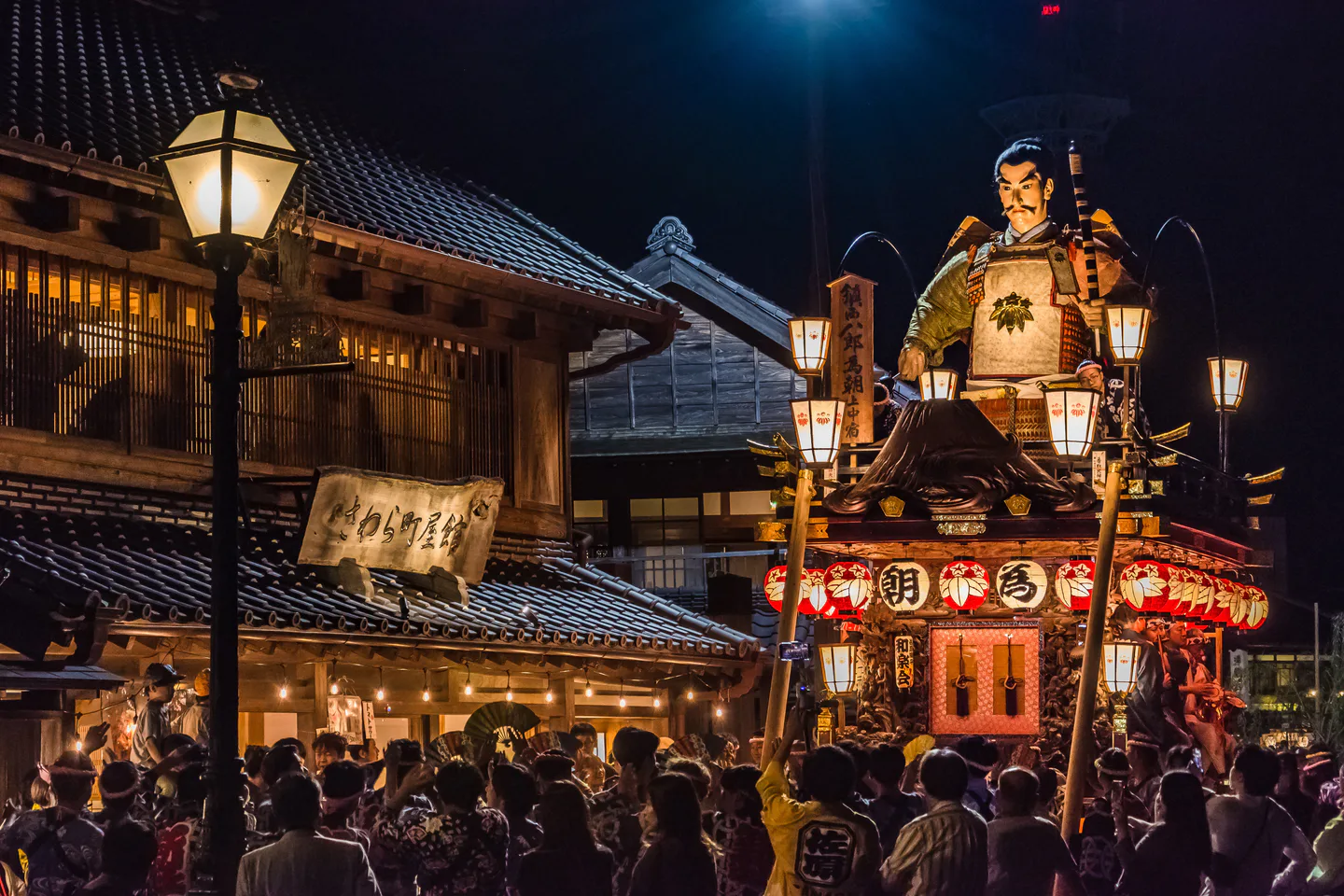
Sawara’s autumn festival ran from Friday 9 to Sunday 11 October 2026. The question for a Tokyo visitor was how much of the evening to keep: the carved floats and towering figures were easiest to read in daylight, while their lanterns and Sawara-bayashi music changed the streets after dark. A long day trip covered both for many travellers. A Sawara or Narita hotel earned its cost when it solved the late return, an early flight or a desire to see a second festival morning. The 2026 programme is now a record of how that choice worked, not a timetable to assume for another year.
The most distinct day was Saturday. Katori City scheduled all 14 autumn floats to line up by noon, a joint procession from about 13:30 and a dispersal around 16:30. Friday and Sunday allowed more wandering between floats on their individual routes, with shrine processions at different times. Across all three days the advertised festival hours were 10:00–22:00, so a visitor leaving in mid-afternoon missed the lit evening atmosphere even if they had already seen the main daytime display. The right departure time depended on how much that second view mattered.
↔ Scroll table left or right
Visitor plan | What it solved in 2026 | Main constraint |
Tokyo day trip | Daylight floats followed by part of the lantern-lit evening | About 110 minutes each way by rail from Tokyo Station; protect the late return. |
Sawara overnight | Late float viewing and a second morning in the town | A separate hotel and luggage move must add real value. |
Narita overnight | Festival evening plus positioning for a Narita flight | Check the onward train and airport hotel shuttle timing. |
Daylight-only visit | Float carving, large figures and Saturday lineup | Misses the changed lantern-and-music atmosphere after dusk. |
Drive from Tokyo | Useful only when the broader route needs a car | Riverbank parking and a shuttle still separate car from floats. |
What happened on each of the three days
The autumn Suwa Shrine event traditionally takes the Friday, Saturday and Sunday around October’s second Saturday. In 2026 those dates were 9–11 October, and Katori City later published a day-specific programme. That resolved the old planning uncertainty: the weekend was not merely a calendar inference, and Saturday was not just a guess at the best lineup day.
On Friday the mikoshi procession began from Suwa Shrine at 15:00 toward its temporary resting place. Sawara-bayashi performances, hand dances and nonoji-mawashi float turns appeared at various points rather than at a single guaranteed camera position. Sunday’s mikoshi returned from the resting place to the shrine from 09:00; music, dance and float turns again occurred around the district. A visitor arriving late on Friday or leaving early on Sunday could still see floats, but the shrine movement belonged to a particular part of the day.
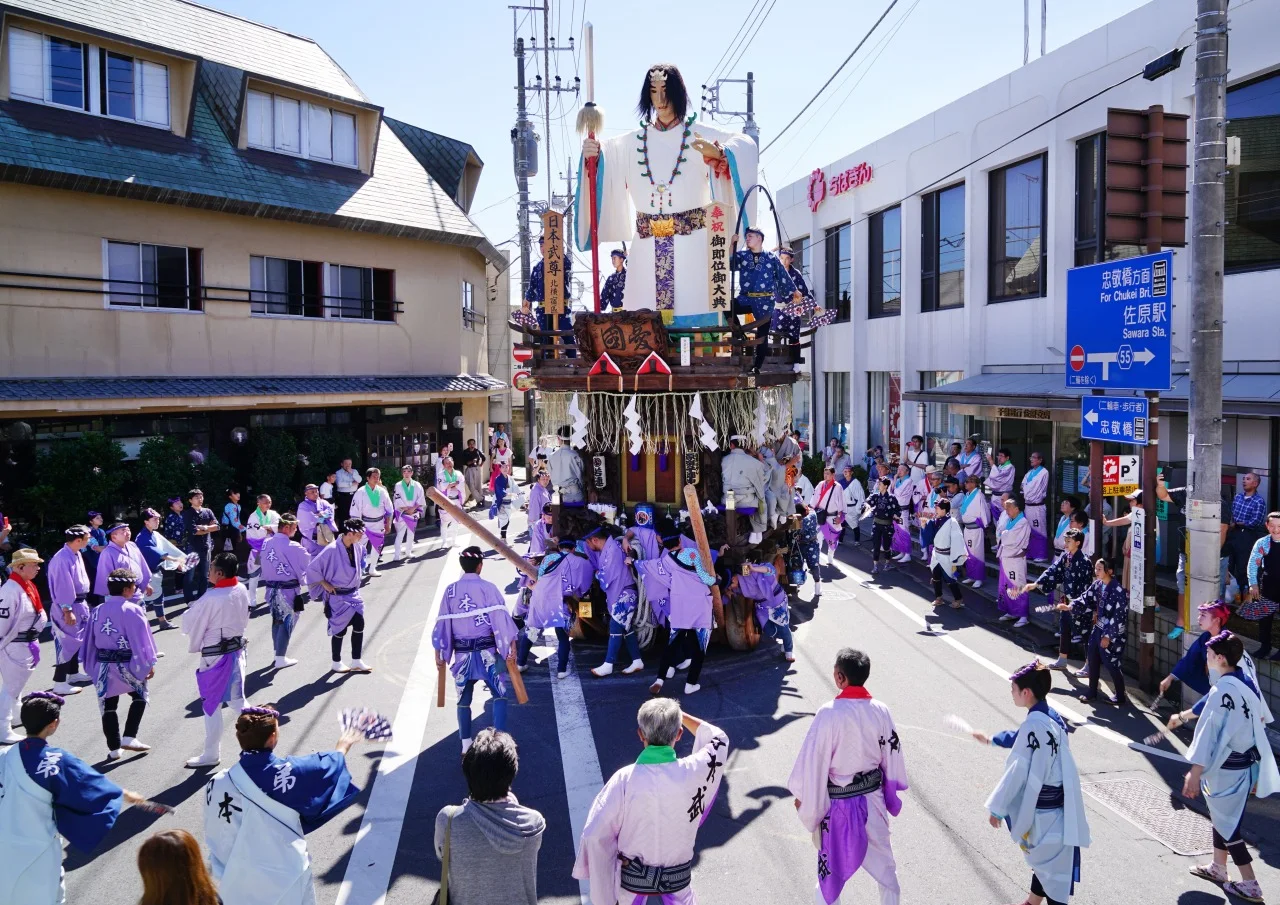
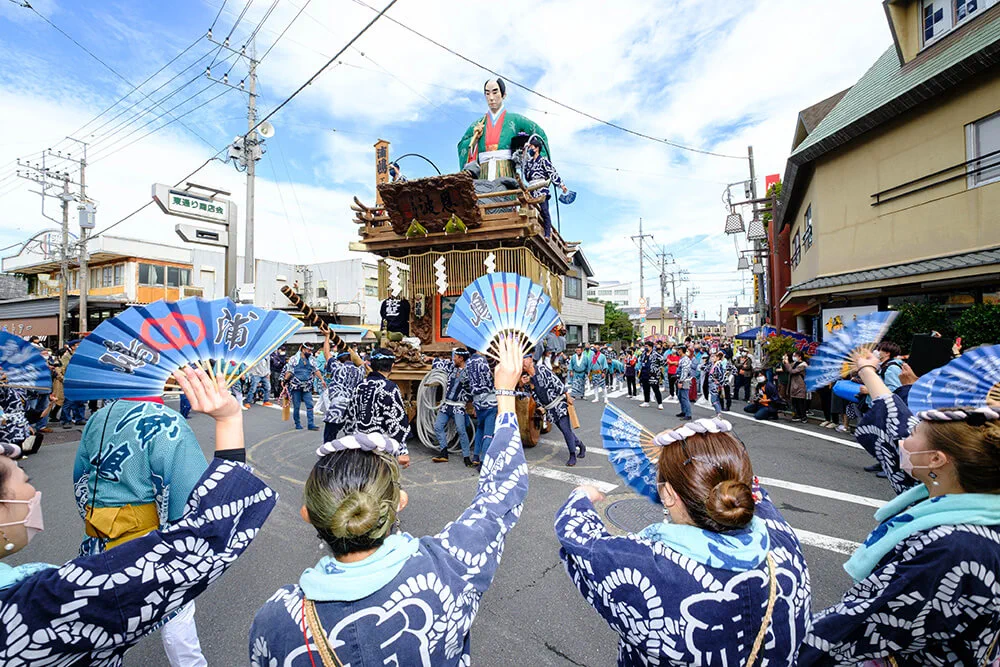
Saturday gave the strongest fixed block for someone who wanted the whole fleet together. The 14 floats were to finish lining up by noon near the former Fugetsudo to Takeda Barber area. Music and hand dance followed around 13:00, a joint procession began around 13:30, and the separation finished near Chukeibashi Bridge about 16:30. The floats also moved on local routes outside that shared sequence. The printed programme helped choose a day; the digital map helped locate movement once the festival was under way.
Friday 9 October: Suwa Shrine mikoshi from 15:00; local float movement and performances continued into the evening.
Saturday 10 October: all 14 floats lined up by noon and moved together from about 13:30; Sunday 11 October brought the mikoshi return from 09:00.
These clock times explain why “arrive whenever and look for a parade” was a weak plan. A Saturday guest arriving after lunch could miss the lineup even while still finding the floats later. A Friday visitor who wanted the mikoshi should leave Tokyo with enough margin for the 15:00 start. Dates and programmes vary by year; this 2026 order is useful as a model of the decisions, not an advance promise for the next edition.
The autumn floats belonged to a different part of Sawara
Sawara no Taisai is a name for two shrine festivals. The July Yasaka Shrine celebration brings ten floats through Honjuku; October’s Suwa Shrine event uses 14 in Shinjuku. The craft and Sawara-bayashi music connect them, but a summer video or map can point to the wrong district for an autumn visit. Katori City describes 24 floats across both festivals, split ten and fourteen.
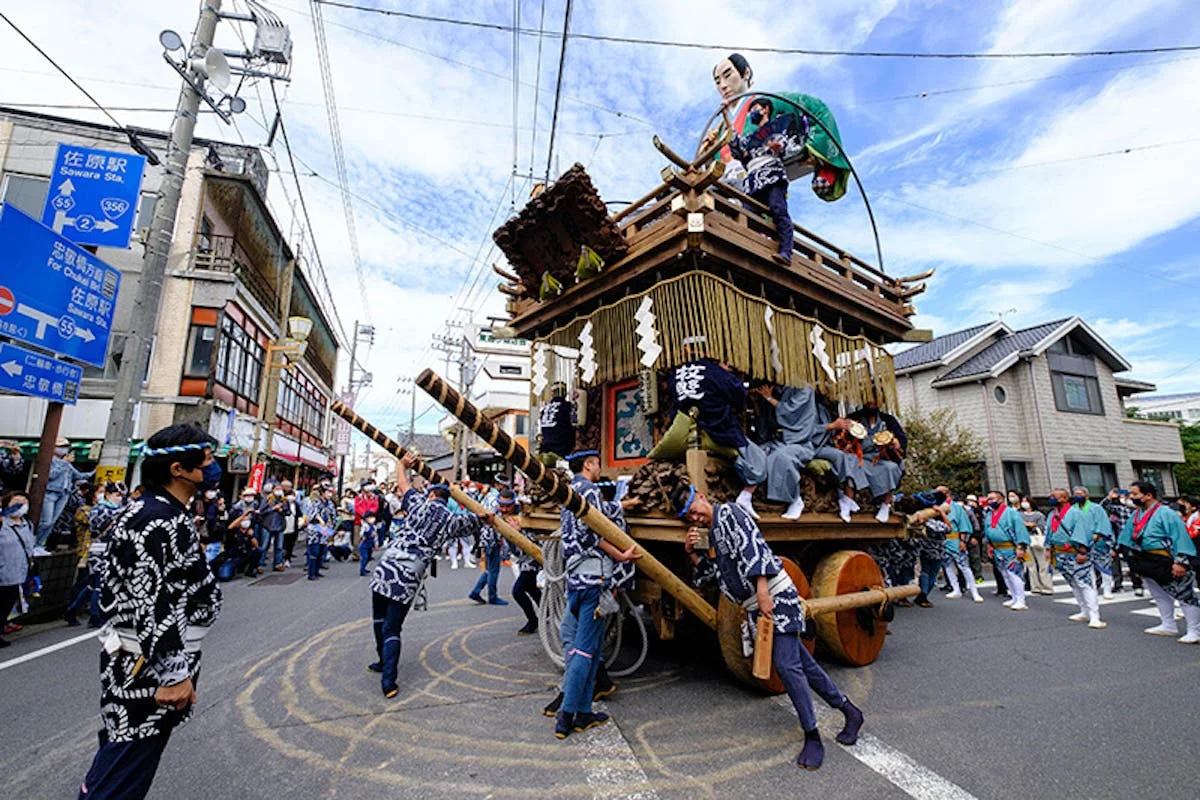
The autumn floats have substantial wooden bodies, Kanto-style carving and figures high above the roof; the city says some figures reach about four metres. Their scale matters most when a float turns close to old merchant buildings. The digital festival map was more useful than a saved intersection from another year because it showed moving floats and the mikoshi, as well as toilets and rest areas. It did not turn every performance into a fixed show at a fixed time.
Why daylight and darkness were both worth part of the visit
During the day, the woodwork, doll costumes, ropes and the crews’ handling of the heavy floats were visible without relying on street lighting. The historic merchant façades gave a clear backdrop, and it was easier to understand how closely a float could pass an ordinary street corner. Someone interested chiefly in construction could enjoy a shorter daytime visit, especially on Saturday when the lineup made comparison between floats possible.
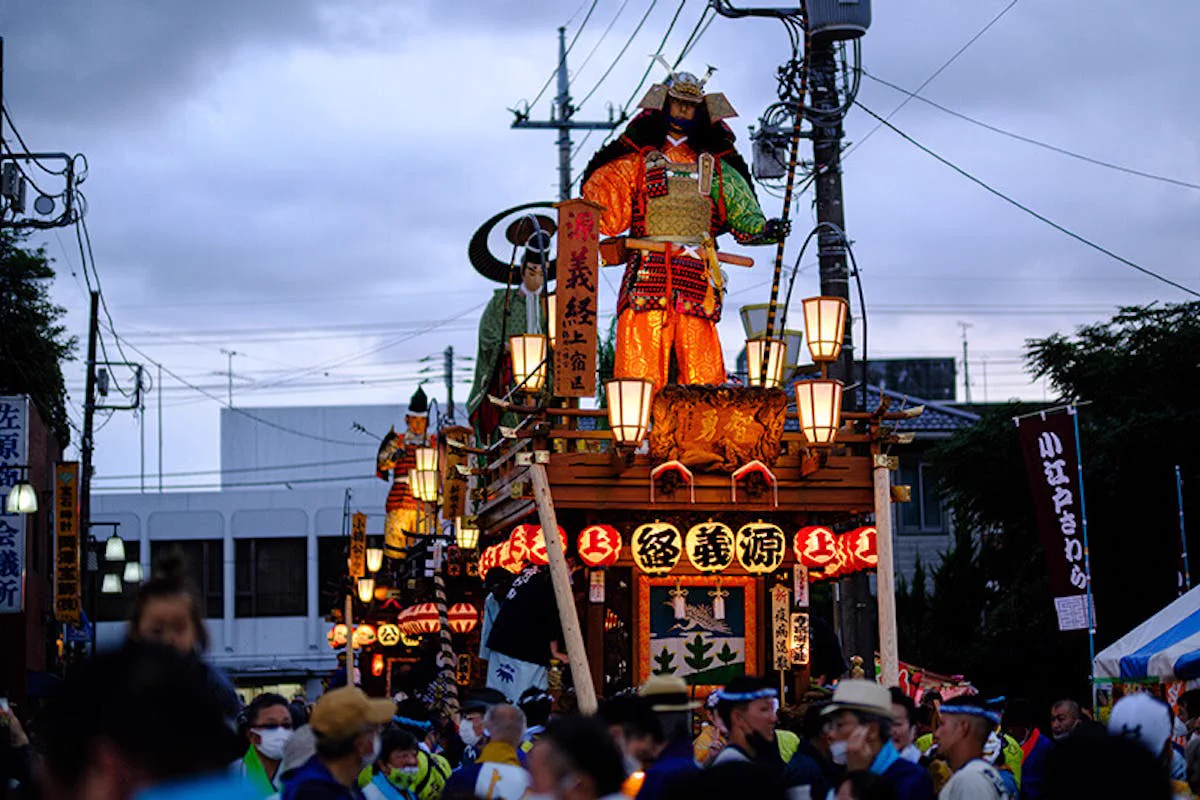
After dusk, lanterns picked out the floats against dark timber and the Sawara-bayashi music became easier to follow along a street. The city programme continued until 22:00, though no visitor needed to remain for every final movement to gain that contrast. Leaving at 16:00 changed the nature of the trip: it removed the illuminated view rather than merely saving an hour of waiting.
The useful compromise for a Tokyo day visitor was to stay through a meaningful stretch of night movement, then return without a hard appointment in the city. A night photographer might reasonably stay longer and book nearby accommodation. Someone travelling with children or an early next-day departure could leave earlier after seeing lanterns come on. The extra hour should serve a particular reason, since the return journey was substantial.
Nonoji-mawashi was a moving target
Nonoji-mawashi is the controlled turning manoeuvre associated with Sawara’s floats. A team rotates a tall wooden structure through a tight arc, tracing a shape likened to the Japanese character の. It is a test of coordinated handling and presentation, not a race. Watching one turn gives a better sense of the float’s weight and the crew’s role than a photograph of a stationary lineup.
Katori City listed turns at various locations during the three festival days, so the city’s moving-float map mattered more than an old social-media geotag. A person who stayed in one spot waiting for a 2025 clip to recur could miss a better turn nearby. The sensible viewing method was to find the current cluster of floats, keep enough walking time between streets, and accept that each team’s path could change the next moment.
Bus detours changed the local arrival, not JR service
The 2026 road restrictions diverted several local buses. Some stops called Sawara Station and nearby central stops were suspended on affected routes, while temporary stops such as Sawara Station North Exit were used. That notice concerned buses and street access. JR Sawara Station remained the rail arrival point, with the festival district immediately outside; the phrase “station stop suspended” did not mean trains stopped calling.
For a Tokyo visitor arriving by rail, the practical question was how to reach the correct festival streets on foot and where to return after dark. A traveller relying on a city bus for a short local hop needed the detour map and temporary-stop names. Ordinary-day journey-planner screenshots were a poor guide inside a restricted district, especially when crowds and moving floats could slow the shortest route.
The city listed Tokyo Station to Sawara at about 110 minutes by rapid train and Chiba Station at roughly 70 minutes via Sobu and Narita lines. Those are substantial travel legs to place either side of the festival. A long day trip remained feasible, but it was not a nearby Tokyo neighbourhood outing. Anyone booking a same-night dinner or show back in Tokyo would have to cut the festival short to protect that commitment.
Which bed made the return easier?
Three lodging patterns solved different problems. Tokyo kept the existing base and avoided a hotel move. Narita worked when a flight or airport-area morning already belonged next on the route. Sawara bought time after the lanterns and, if desired, another morning in the historic town. The test was what the extra room night allowed the following day, not whether the festival alone could fill a hotel stay.
A late train or a second check-in was not automatically the harder choice. A Tokyo resident or visitor already settled for several nights might prefer the long return over packing again. Someone flying from Narita early could find that a move toward the airport removed stress from the next morning. A person making photographs after 21:00 might prefer Sawara itself. These are different uses of a night, even when all three travellers watched the same floats.
Tokyo for a single long festival day
Stay in Tokyo when the room remains useful before and after Sawara. Leave enough time for the intercity trip, arrive while float details are visible, eat before the most crowded evening period and keep the return free of hard reservations. The daylight-to-night transition then justifies the long day without a hotel move. This is the most straightforward first visit if there is no airport constraint or special night-photography project.
Narita when the next morning already points east
Narita is a route choice rather than a substitute festival venue. If a Narita flight follows, moving to an airport-area hotel after Sawara can place luggage, shuttle and check-in closer to the next morning’s job. It still creates an evening transfer, so compare the actual last train or hotel shuttle window before deciding. A room near the airport makes less sense when the next two days of sightseeing are in Tokyo.
Sawara for a slower second look
A Sawara room is most defensible when the lantern scene, late float movement or another morning around the merchant streets is the point of the journey. It removes pressure to leave at a particular moment and allows the festival night to end on foot. It is a larger commitment than a day trip: accommodation supply is more limited than in Tokyo, and moving luggage needs to fit the wider itinerary. One short glimpse of lit floats alone may not justify that change.
For the flight-day decision, the Narita late-arrival and airport-base guide examines when a Tokyo transfer is worth it. The capsule versus shuttle-hotel comparison covers two ways to simplify a night near the terminals. Those airport details should determine a Narita stay, not an assumption that it is automatically closer to every useful Sawara train.
Saturday had a real programme advantage in 2026
There was no need to infer that the middle day would be best from earlier editions. The published 2026 schedule specifically placed the 14-float lineup and joint procession on Saturday 10 October. A visitor whose aim was to compare the full set or see them move together had a concrete reason to choose Saturday. Friday and Sunday offered the mikoshi at different times, roaming floats, music and nonoji-mawashi, with a less concentrated viewing pattern.
The choice still depended on the kind of movement wanted. Saturday’s lineup helped a first-time visitor understand the fleet at once; a wandering visit on another day could be rewarding for someone willing to follow floats through the old streets. The city’s programme listed the shared Saturday sequence, while the digital map tracked current locations. Neither tool removed the need to walk and allow for crowds.
All 14 floats together in Saturday’s noon lineup.
The mikoshi leaving or returning to Suwa Shrine on Friday or Sunday.
A nonoji-mawashi turn located through the current festival map.
Lantern-lit float movement with Sawara-bayashi after dusk.
If a future autumn visit has only one possible date, preserve the daylight and evening blocks rather than assuming that the middle Saturday will repeat every 2026 detail. Check that year’s city calendar and map for the programme that matters to you. The recurring autumn festival structure is stable; the exact choreography is annual.
Driving added a shuttle and a final exit
Katori City provided a free 1,000-space temporary parking area on the Tone River riverbank for 2026. A shuttle ran between that lot and the festival area daily from 09:30 to 21:00, with a 500-yen cooperation contribution for each passenger of elementary-school age or older. The usual shuttle boat did not run. Road restrictions and bus detours still mattered, and the car remained outside the historic viewing streets.
For a visitor coming solely from Tokyo, rail avoided finding the riverbank lot, waiting for the shuttle and returning to the car after an evening among crowds. Parking capacity alone did not guarantee a fast drive home, especially when the shuttle finished before the festival’s advertised 22:00 close. The train deposited passengers at Sawara Station beside the festival area. A car could make sense for a wider Chiba route, but it created several extra decisions for a simple out-and-back festival visit.
The return route deserved checking before the first float. A driver needed the position of the lot and the last shuttle; a rail visitor needed a realistic walk to Sawara Station and the onward train plan. The festival’s moving street routes could change the easiest path across town. Neither mode was helped by choosing a viewing spot solely because it looked close on an ordinary street map.
Rain changed the visible detail
Katori City described the 2026 festival as proceeding in rain while protective sheets could cover the large float figures. That kept the event distinct from an automatic cancellation, but it altered what a visitor could see. Carving, costume and giant dolls were central attractions in daylight; a cover could obscure some of them. Wet streets also changed walking and photography, particularly for anyone waiting for night lighting.
A traveller drawn mainly by music, float movement and the old-town setting might still find a rainy day worthwhile. A photographer seeking uncovered doll detail could value the clearer day much more. The sensible distinction was between the festival operating and the specific view a visitor wanted. Severe weather could also bring further changes, so the day’s city notice still mattered.
On a wet festival morning, Katori City’s day-of-event notice was the place to look for any change to routes or activities. The standing rain policy did not answer whether a particular turn or procession would run exactly as printed.
A workable first visit from Tokyo
Leave enough time for the roughly 110-minute Tokyo Station rail journey and arrive by early afternoon. Eat before the evening crowd builds, then use the first daylight hours for carving, figures and a slow walk through the merchant district. Saturday visitors who wanted the full lineup needed to be there by noon rather than treating early afternoon as the first arrival target.
Find the floats on the current digital map, which also marks the mikoshi, rest areas and toilets. For Friday, the 15:00 shrine movement was a useful fixed point; for Saturday, the 13:30 joint procession gave the afternoon its shape. Leave open time around those anchors because float movement and crowd routes do not work like timed museum entries.
As daylight faded, choose a street where a moving float could be seen with its lanterns lit. Avoid crossing town repeatedly in pursuit of one photographed intersection. A short period of night movement with Sawara-bayashi may be enough for a first visit; a longer watch is a deliberate choice for someone who values the changing scene.
Return by rail to Tokyo if that is still the trip base. Move toward Narita only if it improves the next flight day, or stay in Sawara if late viewing and a slower morning justify a room. Before committing to a final float position, know how to reach the station or lodging from there through the restricted streets.
The wider route can change the recommendation. A Japan autumn itinerary that already includes Chiba or an airport transfer gives Sawara a different place than a Tokyo round trip. If the following morning is a standard Tokyo sightseeing day, the existing Tokyo room may remain the better base despite the late return.
What the 2026 schedule teaches
The 9–11 October 2026 festival offered two ways to read Sawara: a concentrated Saturday look at all 14 floats and a slower street visit on Friday or Sunday, each with an illuminated evening. Most Tokyo-based first-time visitors could cover their preferred day as a long trip, arriving while the craftsmanship was visible and staying until after dark. A hotel near Sawara or Narita needed a second purpose, such as night photography, another festival morning or an airport departure.
The published programme resolved the uncertainty that existed earlier in 2026: Saturday’s lineup, the two mikoshi movements and the parking shuttle were specified. Future editions should be planned from their own city calendar. The durable lesson is to choose the day by the movement you want, then leave enough return margin for a festival that can keep the streets active until late evening.